
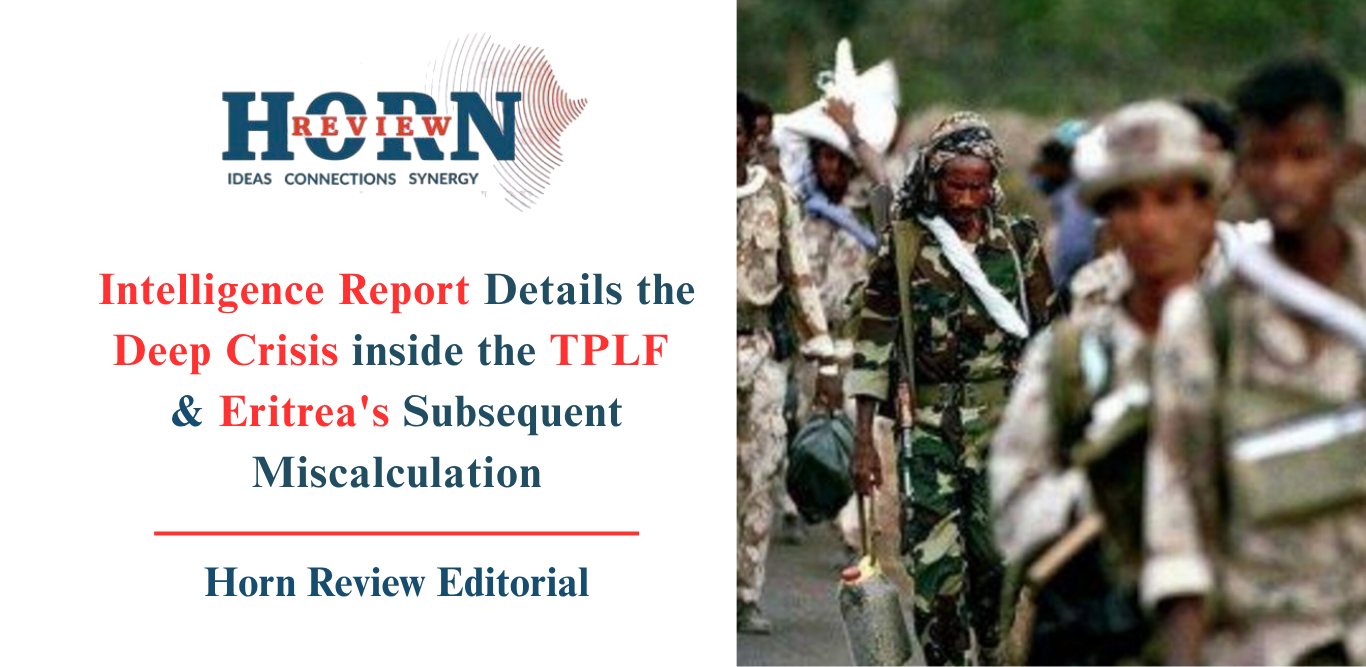
Intelligence Report Details the Deep Crisis inside the TPLF & Eritrea’s Subsequent Miscalculation
The central mystery of the present Tigray crisis is not simply why the TPLF is preparing for another confrontation with the Ethiopian federal government. The deeper question is why a political organization that once exercised power at the center of Ethiopia is now attempting to reconstruct itself as an autonomous political-military authority within a federal order in which its regional status is constitutionally subordinate to the federal state. The federal government is not an external enemy in the conventional sense; it is the sovereign national authority within which Tigray exists as a regional constituent unit. The more fundamental problem, therefore, is the TPLF’s continuing attempt to convert regional political control into autonomous strategic power capable of challenging the authority of the federal state.
Yet even that formulation does not fully explain what is now taking place. The most consequential struggle may not be between the TPLF and the federal government at all. It may be occurring inside Tigray itself, where the political, military and intelligence architecture created during the previous war appears to be undergoing a profound reconfiguration. The people now being pushed aside, detained, surrounded, or driven into opposition are not incidental figures who happened to fall on the wrong side of an ordinary intra-party dispute. They include people who commanded the TPLF war effort, administered Tigray region after Pretoria, ran military intelligence, and built the security apparatus upon which the TPLF’s survival depended. The progression from Getachew Reda to General Tadesse Worede, Colonel Tewolde Embeb and other figures of the wartime establishment therefore raises a question more consequential than who currently controls the TPLF: what kind of Tigray is the emerging leadership attempting to construct, and which Tigrayan political-military tradition must disappear for that construction to succeed? The available evidence increasingly suggests that the answer cannot be found solely inside Tigray. It has to be examined against the strategic transformation occurring across the Eritrean border.
For decades, the central contradiction in Tigrayan strategic thinking was that the political movement that had acquired extraordinary influence within Ethiopia was simultaneously locked into an existential confrontation with the Eritrean state. The 1998–2000 war hardened that antagonism; the 2020–22 war gave it an even more intimate and traumatic form. Eritrean forces entered Tigray alongside Ethiopian federal forces, and the survival of the Tigrayan political order became inseparable from resistance to an Eritrean state that much of the TPLF’s political and military establishment regarded as permanently hostile. The resulting institutional memory was not superficial. Entire generations of commanders, intelligence officers and political leaders formed their strategic identities through opposition to Eritrea. That history created a constituency for whom accommodation with Asmara was not simply another foreign-policy option. It represented a revision of the strategic premises upon which their careers, institutions and wartime legitimacy had been constructed. This is why the internal purge matters.
If the present TPLF leadership were merely eliminating political rivals, the sequence could be explained as an ordinary struggle for organizational control. But if the individuals being removed are disproportionately those who reject renewed militarization, resist an Eritrean alignment, defend the Pretoria political framework, or retain enough independent military authority to obstruct the emerging strategy, then the process assumes a much deeper character. It becomes an attempt to change not simply who governs Tigray, but which strategic doctrine governs Tigray. And at this point, it’s safe to say its no longer TPLF’s. Rather Isaias Afeworki’s.
The first visible manifestation of this transformation was Getachew Reda, an ardent opponent of any alliance with the Eritrean regime. His removal can be interpreted as a dispute over Pretoria, a struggle between personalities, or a contest between moderates and hardliners. Each interpretation captures part of the story. But the more consequential interpretation is that Getachew represented a political direction in which Tigray’s post-war survival depended upon operating within the political space created by the Pretoria Agreement and upon managing the relationship with the Ethiopian federal government rather than attempting to reconstruct an autonomous military-political order capable of confronting it. His displacement therefore represented more than a change of leadership. It opened the way for the restoration of the hardliner TPLF’s pre-war institutional primacy and for the reconstruction of a political strategy increasingly organized around military leverage and Eritrean anchorship.
The subsequent sequence gives that episode greater significance. Debretsion Gebremichael returned to the presidency; the pre-war regional political structure was restored; the interim political arrangement established after Pretoria was progressively dismantled; military mobilization intensified; and, before the September 2026 declaration by seven armed groups, the TPLF had already developed a strategic alliance with Eritrea and opened the northern front of Ethiopia’s border without federal authorization. This was not merely another episode of regional political maneuvering. It represented a fundamental departure from the post-Pretoria framework: a regional political organization was developing an external military relationship and acting across the northern frontier without the authorization of the federal state to which the regional government is constitutionally subordinate. The subsequent September alliance therefore did not create the TPLF’s external alignment from nothing; it formalized and expanded a strategic direction that had already been developing through the TPLF’s rapprochement and alliance with Eritrea. The September alliance consequently needs to be understood as the second stage of a broader realignment rather than as its beginning. The TPLF moved first toward an Eritrean strategic relationship and toward reopening the northern security front; it then joined Fano, the Oromo Liberation Army and other armed organizations in a broader Ethiopian coalition.
The reversal is strategically extraordinary. The TPLF spent decades constructing Eritrea as an adversarial pole of its worldview, fought Eritrea directly during the 2020–22 war, and then moved toward a political environment in which cooperation with actors associated with Eritrea became conceivable. This establishes something more important than TPLF being an Eritrean proxy: the strategic architecture that governed northern Ethiopian politics during the previous war has been radically rearranged.
This makes the Eritrean dimension impossible to treat as a peripheral issue. An intelligence report from 25 September 2026 adds another layer. The reporting states that Eritrea is effectively behaving as though it has become emboldened and is now asking to be confronted, an expression intended to capture a perception of deliberate provocation and military readiness. The same intelligence reports an intention to move brigades composed of units from different Eritrean divisions away from the Assab–Bure front toward the Northern Red Sea Zone, specifically the districts of Ethiopia’s Afar region, Berahle and Dalul. The formations reportedly include elements of the 44th Division, 67th Division and 38th Division. The reporting further identifies Colonel Teshome, described as commander of the militia units of the 44th Division; Colonel Osman Sabe, identified as intelligence chief of the 67th Division; and Yasin Hussein, described as a Defense Intelligence battalion officer, as occupying coordinating leadership roles in the movement.
The geography is particularly important. A movement from the Assab–Bure axis toward Berahle and Dalul is not automatically synonymous with an Eritrean assault on Tigray. Those areas belong to the wider Red Sea–Afar strategic system, linking Eritrea’s southeastern military frontier with the approaches toward Afar and northern Ethiopia. Open reporting in September has independently described fighting and military activity around Berahle, Abala, Erebti, Dalul and other areas of Afar, although specific claims about control of individual locations remain contested or unverified. The significance of the intelligence therefore may lie in the possibility of a broader repositioning of Eritrean military capacity around the strategic arc connecting the Red Sea, Afar and Tigray.
Such an assembly of brigades indicates a mobile reserve, a specific operational requirement, and an attempt to create greater flexibility across several axes. The involvement of military-intelligence personnel suggests that the movement is not merely a routine logistical rotation. Any intelligence analysis should correlate this with developments inside Tigray.
The key question is therefore not whether the internal TPLF transformation and the reported Eritrean repositioning are components of a larger strategic sequence. They clearly are. The TPLF political leadership is simultaneously removing commanders who oppose renewed militarization or an Eritrean accommodation while Eritrea is repositioning multi-divisional formations and intelligence-linked personnel around the Northern Red Sea and Ethiopia’s Afar approaches, the possibility of strategic coordination is out of the question.
The individuals now being targeted are not simply political personalities. What is happening inside TPLF is qualitatively different from removing an ordinary political competitor. It is plausible to suggest the targeting of the old military leadership can be interpreted as pre-war internal securitization. Before an organization enters a major confrontation, it must determine who controls its weapons, who commands its formations, who controls intelligence, who defines the enemy, and who has the authority to question the strategic direction of the leadership. The elimination or neutralization of commanders who possess independent authority can therefore be understood as preparation for external conflict even when the immediate violence is directed inward. Nevertheless, this development points to a security establishment that may not be uniformly aligned behind the new strategic direction. The political language surrounding these developments is equally revealing. Once Now that the TPLF begins to be divided into categories such as “patriots” and “traitors,” the struggle ceases to be only a dispute over policy and becomes a struggle over political identity.
This is where the reports surrounding TPLF hardliners of Eritrean lineage also require careful treatment. The assessment that some current TPLF hardliners have Eritrean lineages is part of the bigger picture. TPLF hardliners with Eritrean lineage have been operationally meaningful for not just their identity, but also their intersection with demonstrable networks: military relationships, intelligence contacts, financial channels, communications, political intermediaries, cross-border movement, historical organizational ties, and other forms of sustained connectivity with Eritrean institutions.
Another more strategically coherent Eritrean objective here is to weaken the institutional networks that could once again generate an autonomous Tigrayan military threat; eliminate or marginalize the political-military actors most resistant to accommodation with Eritrea; prevent the re-emergence of a unified anti-Eritrean Tigrayan command structure; and cultivate a Tigrayan political configuration whose interests are more compatible with Eritrean security requirements. Eritrea would not necessarily need to destroy Tigray. It could seek to reshape the political composition of Tigray so that the region ceases to be organized around the strategic assumptions that produced prolonged confrontation with Asmara. A fragmented Tigray dominated by a faction willing to cooperate with Eritrea could, from an Eritrean strategic perspective, be less threatening than a politically unified Tigray led by commanders whose institutional identities were forged through opposition to Eritrea. That possibility also explains why the old TDF establishment matters so much. The previous Tigrayan military leadership was not merely a collection of officers. It embodied a strategic tradition. Many of its senior figures had fought Eritrea, built intelligence systems around monitoring Eritrean activity, and understood Tigrayan security through the prism of Eritrean hostility. Removing such figures could therefore have consequences extending far beyond personnel politics. It could remove the institutional memory required to resist any future strategic realignment. This would make the present internal struggle a contest over strategic conception itself.
The question, now therefore, is whether or not Ethiopia’s Tigray remains politically organized around an autonomous military nationalism capable of resisting both external intervention and federal political authority, or whether TPLF seeks to subordinate itself within Ethiopia’s federal order while building a different set of external relationships, or whether it seeks to use Tigray as the military and political spearhead of a broader restructuring of the Ethiopian state.
Under this interpretation, the conflict is not simply another chapter in the Ethiopia–Tigray confrontation. It is a struggle over succession within the Tigrayan strategic order where a generation of anti-Eritrean establishment within the TPLF is systematically displaced, and the transformation is larger than a change of personnel – rather a change in strategic memory. And that is why the targeting of the old military and intelligence establishment within the TPLF may ultimately prove more important than any single battlefield movement. The war may be approaching from outside. But the decisive transformation is taking place inside.

RELATED
Posts
25
Sep
The United States’ Shifting Sudan Strategy and the Limits of Coercive Leverage
Washington's approach to Sudan's civil war has shifted in character...
25
Sep
Ethiopia’s Tigray Crisis in Context
Washington's approach to Sudan's civil war has shifted in character...
25
Sep
The Case against Armed Coalitions and Libya’s Pattern
Washington's approach to Sudan's civil war has shifted in character...
25
Sep
Pakistan’s Growing Footprint in the Horn of Africa
Washington's approach to Sudan's civil war has shifted in character...
25
Sep
Grand Fulla and the End of Egypt’s Nile Veto
Washington's approach to Sudan's civil war has shifted in character...
25
Sep
Egypt’s Scarcity Narrative and the Reality of Nile Water Use
Washington's approach to Sudan's civil war has shifted in character...
25
Sep
RSADO Raises Alarm as US Lets Eritrea Sanctions Expire
Washington's approach to Sudan's civil war has shifted in character...
25
Sep
The Alliance for “Survival” as Eritrea’s Proxy Coalition
Washington's approach to Sudan's civil war has shifted in character...
25
Sep
How Cairo’s Institutions Read Ethiopia
Washington's approach to Sudan's civil war has shifted in character...
25
Sep
Sudan’s Rejection of War with Ethiopia Despite Hardline Voices in Khartoum
Washington's approach to Sudan's civil war has shifted in character...