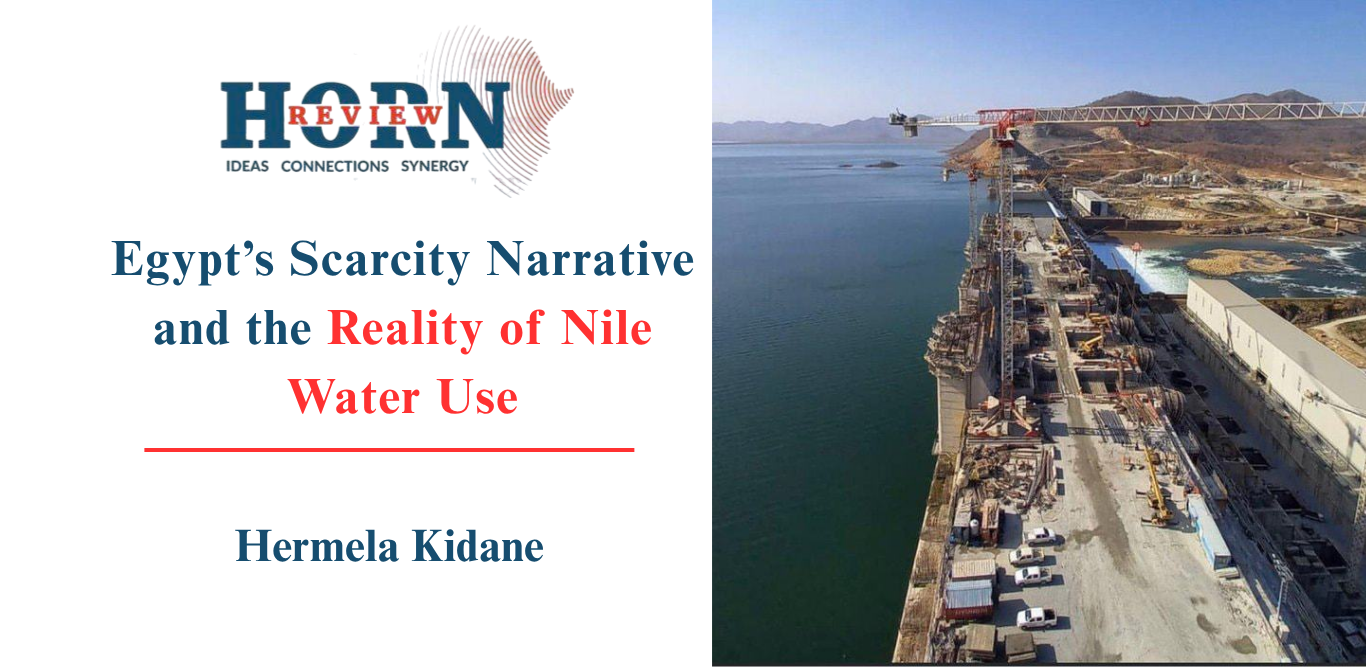
Egypt has portrayed the Grand Ethiopian Renaissance Dam as an existential peril to its water security grounding this claim in near total dependence on Nile flows. Analytical scrutiny of Egypt’s resource base, consumption patterns and regional behavior shows a structural inconsistency. The rhetoric of scarcity coexists with substantial non renewable groundwater reserves, persistently inefficient agricultural practices, and a pattern of regional intervention that prioritizes the preservation of historical privilege over cooperative basin management. Ethiopia’s pursuit of hydropower development by contrast rests on the principle of equitable utilization of resources originating within its territory and is consistent with both developmental necessity and international water law norms.
The Nubian Sandstone Aquifer System constitutes the world’s largest known fossil groundwater reservoir spanning more than two million square kilometers across Egypt, Libya, Sudan and Chad. Estimates place total storage in the order of 150,000 cubic kilometers of which a substantial portion lies beneath Egyptian territory. This volume is equivalent to several centuries of average Nile discharge. Although the resource is non renewable and extraction must be managed to avoid irreversible drawdown even conservative utilization scenarios indicate that the aquifer could buffer Egyptian demand for many decades and in some modelled sub basins for centuries under controlled rates. Geological surveys and experimental wells have confirmed additional access potential beyond the traditional Western Desert oases. The existence of this strategic reserve fundamentally qualifies claims of absolute hydrological vulnerability. A state possessing century scale groundwater depth possesses negotiating flexibility that the absolutist existential threat framing systematically understates.
If scarcity were the operative constraint corresponding discipline in domestic water use would be expected. Empirical evidence points in the opposite direction. Agriculture accounts for approximately 76 to 80 percent of Egypt’s water budget. Flood and furrow irrigation remain dominant across the majority of cultivated land, generating high conveyance and application losses. Rice and sugarcane among the most water intensive crops continue to occupy areas despite repeated technical warnings. Egyptian sugarcane under traditional methods exhibits a blue water burden roughly double that of sugar beet alternatives while rice cultivation has historically exceeded hydrological sustainability thresholds prompting later restrictions to limited governorates.
The absence of volumetric pricing abstraction fees or formal permits in the Old Lands combined with input subsidies further weakens incentives for efficiency. Harold Edwin Hurst’s decades of Nile research for the Egyptian authorities established the statistical foundations for long term storage planning including the concept of century storage. Those insights have not been matched by commensurate demand side reforms. Population growth and economic expansion generate legitimate pressures however these are endogenous challenges whose resolution cannot be externalized onto upstream states exercising their own development rights.
Egypt simultaneously advances large scale desert reclamation and urban expansion projects that draw upon both Nile transfers and aquifer resources. Initiatives such as the Toshka and New Valley scheme and the New Administrative Capital involve the conveyance of water into arid zones to support irrigated agriculture and sprawling urban landscapes including extensive landscaped features. These investments demonstrate a capacity and willingness to redirect scarce surface and groundwater resources toward transformative national projects. Parallel to this Ethiopia’s Green Legacy Initiative has mobilized the planting of more than fifty billion seedlings since 2019 enhancing watershed resilience, reducing sediment loads and contributing to regional environmental stability. Rather than acknowledging such upstream stewardship Egyptian policy has emphasized containment and political pressure. This asymmetry expanding water intensive development in desert environments while resisting Ethiopia’s non consumptive hydropower generation scores a preference for maintaining downstream control rather than optimizing basin wide efficiency.
The legal and political planning of Egyptian claims reinforces this pattern. The 1929 and 1959 agreements allocated Nile waters exclusively between Egypt and Sudan excluding upstream contributors that supply the majority of Blue Nile flow. Egypt has consistently rejected the Cooperative Framework Agreement’s principle of equitable utilization. Its engagement with Sudan further illustrates the prioritization of influence military and political support for the Sudanese Armed Forces including reported deployment of advanced drones near the shared border reflects an interest in ensuring a pliable downstream partner. Sudan is treated less as an independent riparian than as an extension of Egyptian security calculations. Broader regional posture suggests resistance to the independent economic and infrastructural advancement of states on both sides of the Red Sea consistent with a strategy of preserving hierarchical advantage.
Ethiopia’s position is grounded in material and legal realities. The GERD was financed through domestic resources commercial bank lending, public bonds and citizen contributions thereby avoiding external conditionality. Its primary purpose is electricity generation. Hydropower is non consumptive water passes through turbines and continues downstream. With a substantial share of Ethiopia’s population still lacking reliable access to electricity the project addresses a fundamental development deficit.
Ethiopia has repeatedly indicated readiness for operational coordination and data exchange. The persistent obstacle has been Egyptian insistence on preconditions that would effectively freeze upstream utilization in perpetuity. Population dynamics and economic aspirations in Egypt are internal governance matters they do not nullify the sovereign right of an upstream state to develop its resources provided harm is avoided a threshold that managed hydropower operations can meet.
The evidence indicates that Egypt’s opposition is less a function of absolute hydrological necessity than of a preference for maintaining asymmetric control. The Nubian aquifer supplies temporal depth, inefficient cropping and irrigation practices shows avoidable waste desert expansion projects demonstrate selective ambition and regional interventions priorities influence over cooperation. Ethiopia’s development of the Blue Nile for electricity constitutes neither an act of deprivation nor a breach of equity. Sustainable basin management requires recognition that historical privilege cannot indefinitely substitute for reciprocal rights and shared responsibility. The future of the Nile will be whether downstream states adapt to a multipolar riparian order or continue to expend diplomatic and political capital in defense of an inequitable status quo that no longer corresponds to material or legal realities.
Hermela Kidane, Researcher, Horn Review