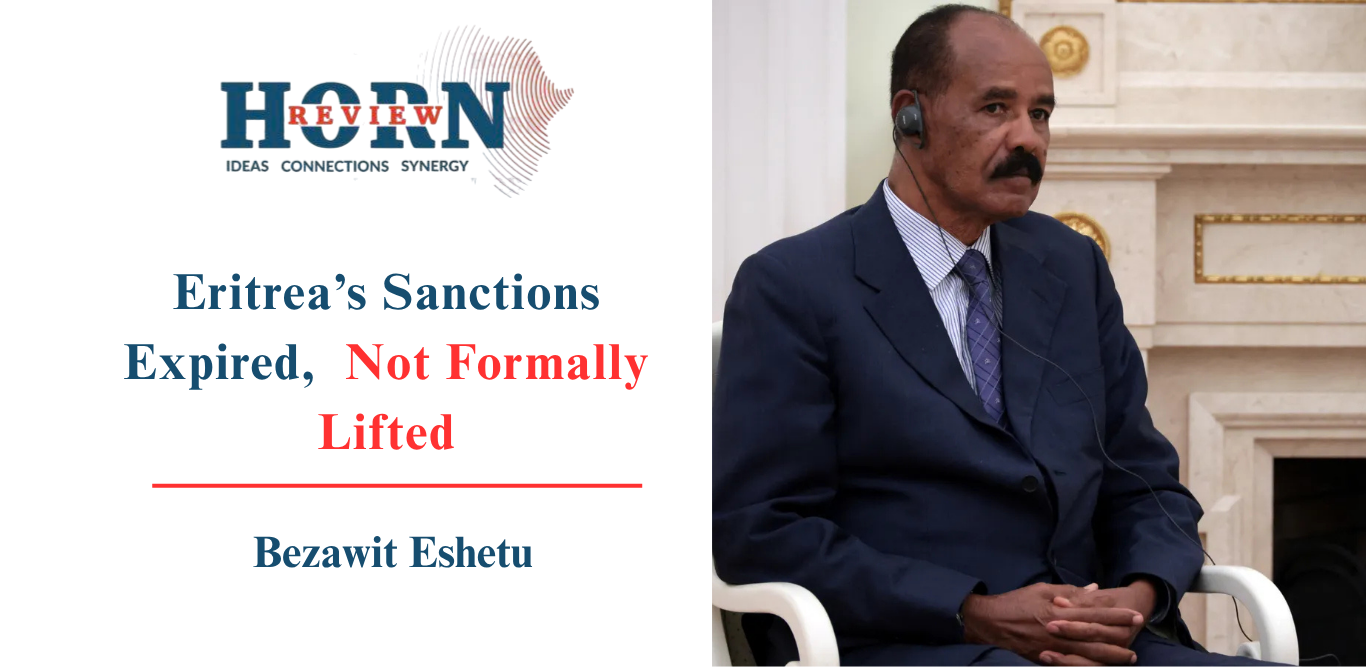
The U.S. sanctions on several Eritrean entities and individuals did not get lifted. They expired. On September 17 the national emergency declared under Executive Order 14046 lapsed, and with it the legal authority for the designations that had been imposed under that order. Two days later the Treasury Department’s Office of Foreign Assets Control simply removed six entries from the Specially Designated Nationals and Blocked Persons List: the Eritrean Defense Forces, the People’s Front for Democracy and Justice, the Hidri Trust, the Red Sea Trading Corporation, and two senior officials, Abraha Kassa Nemariam and Hagos Ghebrehiwet W/Kidan. OFAC stated clearly that the designations were being removed because the underlying national emergency had expired.
By allowing the Executive Order to lapse, no affirmative decision or new policy process was required. Letting it expire was administratively easier than renewing it. The complete silence that followed, no State Department statement, no White House comment, no background briefing, only underscores that this was not presented as a deliberate or proud policy choice.
The legal distinction is essential to understanding what changed. The U.S. sanctions imposed on Eritrean actors in 2021 were targeted sanctions against specific individuals and entities, with the U.S. government linking them to the conflict in Tigray and the broader humanitarian and human-rights crisis in Ethiopia. They were not a broad economic embargo against Eritrea as a country. When Treasury imposed the measures in November 2021, it described them as targeting four Eritrean entities and two individuals that had contributed to the conflict and explicitly stated that Executive Order 14046 was directed at actors contributing to the crisis. The September 18 action therefore ended one Ethiopia-related sanctions framework after its legal authority expired. It did not amount to a wholesale removal of U.S. restrictions on Eritrea. A separate Global Magnitsky designation remains against Eritrean military commander Filipos Woldeyohannes, who was sanctioned in August 2021 over alleged serious human-rights abuses in Tigray.
The distinction also matters for how the opening should be interpreted politically. Washington has a practical reason to keep communication with Asmara open as instability around the Red Sea increases, but that does not make Eritrea a trusted strategic partner. The expiration of the affected designations is better understood as a recalibration that gives the United States greater room to engage Eritrea while preserving substantial reservations about its political system, regional conduct and strategic orientation. Geography creates a reason for pragmatism. It does not erase mistrust, create policy convergence or guarantee that Asmara will act in accordance with U.S. interests.
Washington has long understood the geographic relevance of Eritrea. The United States recognized Eritrea’s secession in April 1993 and established diplomatic relations in June of that year, while engaging the Eritrean government throughout the 1990s. The significance of Eritrea’s Red Sea position was therefore never unknown to Washington. What has changed is the strategic context in which that geography is being assessed. The worsening security environment around the Red Sea gives the United States greater reason to maintain a working relationship with Asmara, even as the political and strategic problems that have complicated the relationship for decades remain unresolved.
The security relationship became more visible after the September 11, 2001 attacks. Defense Secretary Donald Rumsfeld visited Asmara in December 2002 for discussions on defense and counterterrorism. Eritrea’s position opposite Yemen and near the Bab el-Mandeb made it relevant to wider U.S. thinking about security in the Horn and Red Sea. Yet Washington ultimately concentrated its principal permanent military presence in Djibouti. That history is important because it places Eritrea in its proper context. Its geography gives the United States reasons to maintain contact, while the country’s value is constrained by the political and operational difficulties involved in relying on Asmara.
Those constraints are substantial. U.S. human-rights reporting has described Eritrea as a highly centralized authoritarian state under Isaias Afwerki, with the PFDJ as the sole political party and no national-level elections since secession. The same reporting has documented arbitrary detention, restrictions on political and press freedoms, limits on civil society, and a national service system associated with forced labor. These are not peripheral disagreements between Washington and Asmara. They form part of the structural mistrust that has repeatedly limited the relationship.
The 2017 and 2018 opening demonstrated that those constraints could temporarily recede when regional circumstances changed. The United States supported the Ethiopia-Eritrea rapprochement and saw an opportunity for greater regional stability. In November 2018, the UN Security Council unanimously terminated its sanctions regime against Eritrea, including the arms embargo, travel restrictions and asset freeze. Yet the subsequent deterioration also demonstrated the limits of treating regional openings as durable realignments. Eritrea’s involvement in the Tigray war brought Washington and Asmara back into confrontation and contributed to the sanctions imposed in 2021. The current expiration therefore represents the closing of one sanctions mechanism and not a reversal of the political concerns that produced it.
The deeper obstacle is Eritrea’s conception of its place in the international system. In January 2026, Isaias Afwerki argued that the post-Cold War period had produced a U.S.-dominated unipolar order and said Eritrea had rejected the idea that it should accommodate such an order. He described the decline of U.S. dominance and the emergence of a more multipolar system as central features of the current international transition. That position matters because it places limits on what Washington can reasonably expect from renewed engagement. Asmara’s objective is strategic autonomy and freedom of maneuver, rather than incorporation into a U.S.-led regional architecture.
The deteriorating Red Sea environment nevertheless creates a reason for Washington to engage. The renewed Houthi conflict, attacks on maritime traffic, Iranian involvement and the expanding competition among Israel, Gulf states and other regional actors have increased the value of communication across the African side of the Red Sea. Eritrea’s coastline and the Dahlak archipelago place it close to this security environment. But proximity should not be confused with strategic indispensability. Eritrea is one component of a wider regional security picture that also includes Djibouti, Somalia, Yemen, Saudi Arabia and the Gulf states. The practical U.S. calculation is therefore likely to be about maintaining options and situational awareness and not building its regional strategy around Asmara.
Assab crystallizes the transactional logic that has defined Eritrea’s external relationships for decades. The 2015 UN Monitoring Group report recorded that the United Arab Emirates secured a thirty-year lease of the port for operations against the Houthis, compensating Eritrea with money and fuel deliveries, while simultaneously noting that Asmara had earlier permitted Houthi actors to conduct military activities on its territory. Separate accounts have alleged that Houthi personnel received training inside Eritrea with Iranian assistance, and a 2011 UN report had already documented multiple credible instances of military cooperation between Eritrea and Iran together with ongoing contacts between their respective military officials.
These successive arrangements reveal a consistent pattern. Asmara has repeatedly opened its territory and facilities to competing regional powers when doing so served its immediate interests, including powers opposed to Washington. For the United States, this makes Eritrea a state to approach pragmatically and monitor carefully as circumstances evolve, particularly as the Red Sea becomes more strategically important. The expiration of the relevant designations therefore creates some additional room for Washington to reassess its options and examine whether limited engagement with Asmara could serve U.S. interests, without implying that such engagement or cooperation has already taken shape.
Within that broader context, the policy change itself appears relatively limited. Some Eritrean designations ended with the expiration of the executive order behind them, while a separate Eritrean military designation remains in place. Broader U.S. concerns over Eritrea’s political system and regional conduct therefore continue to shape any future assessment of the relationship. What has changed is the scope for Washington to consider its options with somewhat fewer formal restrictions, while the wider strategic uncertainty surrounding Eritrea remains.
By Bezawit Eshetu, Researcher, Horn Review