
A Saudi-Backed PLC-SAF Pact on the Red Sea
The bilateral security understanding between Sudan’s Armed Forces under Abdel Fattah al-Burhan and Yemen’s Presidential Leadership Council, announced in early August 2026, is a reinforcing bilateral nested inside the much larger Multinational Maritime Defense Alliance that Saudi Arabia declared in Riyadh on 30 July 2026 after hosting military delegations from roughly forty-three of the fifty-one countries it invited.
Fourteen of those states, including Saudi Arabia, Egypt, Sudan, Yemen, Djibouti, Somalia, Jordan, Kuwait, Bahrain, Qatar, Turkey, Pakistan, Bangladesh, and Nigeria, signed the founding statement. Riyadh secured the permanent headquarters, the joint command, and the combined operations centre. Sudan’s participation was confirmed through Deputy Commander-in-Chief Yasir al-Atta’s presence at the summit, and Yemen’s government signed as a founding member in its own right.
What makes this arrangement particularly noteworthy is that both signatories to the bilateral pact operate with contested or partial sovereignty. The Sudanese Armed Forces control Port Sudan and the eastern coastline while still fighting a civil war against the Rapid Support Forces; Yemen’s internationally recognized government holds only a fraction of the country against Houthi control of the north and the key Red Sea approaches. Riyadh has therefore constructed a security architecture whose foundation rests on two governments that are still fighting for their own survival rather than on two settled states projecting power from a position of strength.
This is a familiar pattern in proxy alignment and external legitimation, in which a patron extends institutional recognition and material backing to a client precisely because the client’s weakness renders it dependent, predictable, and available for tasking in ways a stronger, more autonomous partner would not be. Saudi Arabia gains a coordinated presence on both shores of the southern Red Sea chokepoint at a moment when its own oil exports face daily threat, and it gains this presence from partners who need Riyadh’s backing badly enough to accept the terms on offer. Sudan’s SAF converts battlefield weakness into external legitimacy and materiel, while Yemen’s Presidential Leadership Council converts territorial marginality into continued relevance on the regional stage.
The same arrangement simultaneously functions as a signal aimed past the Houthis and toward Abu Dhabi. Saudi Arabia and the UAE have diverged sharply over Yemen since Saudi fighter jets struck the port city of Mukalla in December 2025 after accusing the Emirates of arming the separatist Southern Transitional Council; that divergence has bled into Sudan, where the two Gulf states have long backed opposing sides of the civil war.
A tightened SAF–Yemeni government axis sponsored by Riyadh therefore narrows the operational space available to Emirati-linked networks, whether the Rapid Support Forces in Sudan or the Southern Transitional Council in Yemen, along the southern Red Sea. The resulting power balance consolidates the anti-Houthi, pro-state bloc’s grip on the chokepoint’s African and Arabian shores, yet it does so by wagering institutional durability on two governments whose own hold on power remains genuinely contested.
This architecture is itself an extension of a longer-standing doctrine that Saudi Arabia and Egypt have advanced together: that Red Sea governance and security belong exclusively to the states whose coastlines actually touch the waterway. Egypt has been the more vocal proponent, repeatedly asserting, most recently in official statements through early and mid-2026, that outside powers have no standing to participate in arrangements over the sea, a position that simultaneously protects Suez Canal revenue and blocks Ethiopian ambitions for a naval presence.
The doctrine possesses an institutional pedigree in the Council of Arab and African States Bordering the Red Sea and the Gulf of Aden, founded in Riyadh in January 2020 with eight members (Saudi Arabia, Egypt, Sudan, Somalia, Djibouti, Eritrea, Jordan, and Yemen), a body designed from the outset to exclude both non-littoral states and, notably, the UAE.
The fourteen-nation coalition announced in July 2026 expands the doctrine’s membership while carefully preserving its underlying logic of coastal-state ownership. Pakistan, Turkey, Bangladesh, and Nigeria bring naval capacity and political breadth without holding a seat on the waterway itself, yet the institutional core, the headquarters, the joint command, the operational centre, stays with Saudi Arabia, and the founding signatories still include every Red Sea littoral state Riyadh can currently work with, among them Egypt, Sudan, Yemen, Djibouti, and Somalia.
The UAE and Oman are conspicuously absent, a detail that speaks directly to the same rupture already visible in the Sudan–Yemen bilateral. What emerges is therefore a hybrid model that is a littoral-plus arrangement that recentralizes agency with coastal states while selectively importing outside capacity on Riyadh’s terms.
The absorption of Somalia into the Cairo–Riyadh security orbit provides the most concrete illustration of how the littoral-exclusivity doctrine functions as an active instrument of regional containment. Following the January 2024 memorandum of understanding between Ethiopia and Somaliland, Egypt established a bilateral defense pact with Mogadishu in August 2024. Cairo subsequently executed heavy materiel transfers throughout 2024 and 2025, deploying anti-aircraft systems, heavy artillery, and armored vehicles alongside planned troop commitments under the African Union Support and Stabilization Mission.
In parallel, Turkey advanced its own military cooperation tracks with Somalia, supplying attack helicopters, advanced drone platforms, and institutional force training. These concurrent engagements have deepened Somalia’s security partnerships with Egypt, Turkey, and Saudi Arabia, complicating Ethiopia’s regional port-access efforts and limiting the emergence of a firmly aligned southern partner for Addis Ababa.
In practice, the doctrine of littoral exclusivity operates less as a settled principle of international law than as a pragmatic political weapon designed to enforce state interests. Its selective application reveals the underlying power dynamics. Saudi Arabia seamlessly integrates non-littoral states including Pakistan, Turkey, Bangladesh, and Nigeria into its fourteen-nation maritime coalition while simultaneously invoking coastal geographical rules to delegitimize Israel’s operational presence in Somaliland.
The core function of the doctrine centers on consolidating Arab state authority over vital maritime choke points and preserving sovereign transit revenues flowing through the Suez Canal. By enforcing this framework selectively, the alliance protects the economic and strategic dominance of Cairo and Riyadh while masking geopolitical alignment as legal norm. This arbitrary enforcement guarantees persistent structural friction along the Red Sea corridor.
For Ethiopia the rapid consolidation of this exclusionary Red Sea architecture converts its long-standing landlocked condition into an acute geopolitical crisis that strikes at the foundations of its regional power. Addis Ababa treats its demographic mass of more than 130 million people and its expanding economic base as fundamentally incompatible with permanent geographic confinement, and therefore reads the Cairo-Riyadh doctrine of littoral exclusivity as a deliberate containment strategy intended to lock Ethiopia into subordinate status for the indefinite future.
The Arab-led maritime framework weaponizes geography by aligning the immediate interests of the Horn’s coastal states Eritrea, Djibouti, Sudan and a rearmed Somalia under a shared security umbrella that systematically denies Ethiopia any sovereign maritime foothold. These states fear that Ethiopian demographic weight and military capacity would otherwise project onto their shores and rearrange the regional balance.
Ethiopia’s long-term Red Sea strategy has consequently shifted from pragmatic commercial access through Djibouti to an existential requirement for sovereign naval projection. By pressing to operationalize its fifty-year memorandum of understanding with Somaliland for a naval base, Addis Ababa calculates that only a decisive fracture of the surrounding blockade can prevent permanent strategic subordination in its own maritime backyard. Failure to secure that foothold would leave Ethiopia’s economic expansion and security autonomy permanently hostage to the preferences of littoral actors whose interests are now institutionally coordinated against it.
Israel’s position on the Red Sea has deteriorated from several directions at once. Operating from its solitary southern sovereign outlet at Eilat, the Israeli security establishment faces an operational distance of over one thousand miles from the Bab el-Mandeb Strait. This geographic dispersion creates severe vulnerability against sustained asymmetric interdiction, as demonstrated by persistent missile and drone strikes against maritime corridors that have periodically paralyzed commercial traffic into the Gulf of Aqaba.
Having lost its historical intelligence posture in Eritrea and facing the collapse of the Sudanese normalization track amid civil war, Jerusalem pursued forward operational positioning by granting diplomatic recognition to the Republic of Somaliland. By securing maritime access and early-warning intelligence architecture at the deep-water port of Berbera, Israeli defense planners established direct line-of-sight surveillance across the Gulf of Aden, creating a vital forward defense perimeter against hostile launch corridors and maritime supply lines.
This forward presence, however, provokes sharp friction with the evolving regional security architecture orchestrated by Saudi Arabia. Riyadh pursues strategic autonomy through a bilateral Section 123 civil nuclear cooperation agreement and advanced defense integration with the United States, an arrangement that de-links strategic nuclear concessions from diplomatic normalization with Jerusalem and thereby erodes Israel’s long-standing qualitative military edge without yielding formal security guarantees.
Concurrently, Saudi Arabia consolidates the fourteen-nation maritime coalition across the Red Sea basin while anchoring the Yemen–Sudan security axis. Riyadh strictly applies its littoral-exclusivity doctrine against Israel’s presence in Somaliland, actively delegitimizing Jerusalem’s access to the southern maritime approaches while seeking to insulate the waterway from independent Israeli operations.
The resulting geopolitical friction intersects with structural anxieties in Cairo, where Egyptian leadership interprets any Israeli security footprint in Somaliland through the dual lenses of economic survival and sovereign encirclement. Prolonged disruption of maritime traffic through the southern chokepoints has already degraded Suez Canal transit receipts, intensifying fiscal distress and heightening Cairo’s determination to prevent non-littoral actors from establishing lasting positions that could further complicate navigation or shift the balance of power along the waterway.
Egyptian officials link this vulnerability directly to their upstream dispute with Ethiopia over the Grand Ethiopian Renaissance Dam, viewing Israeli engagement near the southern entrance of the Red Sea as a challenge both to Egypt’s strategic depth and to the principle of littoral exclusivity that underpins canal revenues and regional influence. In response, Cairo has reinforced coordination with Somalia and other partners, framing such engagement as incompatible with the coastal-state monopoly it and Riyadh seek to uphold.
Thus, the new Red Sea architecture under Saudi and Egyptian leadership converts littoral geography into a permanent strategic hierarchy. By embedding contested governments into a formal coalition, the arrangement produces a closed maritime system whose stability depends on the managed weakness of its partners and the systematic exclusion of every non-coastal challenger.
By Bezawit Eshetu, Researcher, Horn Review

RELATED
Posts
9
Oct
Where Somalia’s Federal and Regional Fight Is Going
The 2012 federal settlement was less a constitutional order...

9
Oct
Eritrea’s Post-Pretoria Strategy and the Escalation in Ethiopia
Our latest report examines Eritrea’s post-Pretoria trajectory and how selective...

8
Oct
The Houthi-al-Shabaab Nexus and the Emerging Security Architecture of the Gulf of Aden
The growing relationship between Yemen’s Houthi movement and Somalia’s al-Shabaab...
7
Oct
“Decaffeinated Sovereignty”: Eritrea’s One-Way Street with Ethiopia
There is a peculiar contradiction at the heart of Eritrea’s...

7
Oct
Leaked Documents Allege Sudanese Army Weapons Pipeline to TPLF-Aligned Forces as Tigray War Reignites
Leaked documents alleging a Sudanese army weapons pipeline to TPLF-aligned...
7
Oct
Eritrea Has Officially Invaded Ethiopia, Says Government Communication
Ethiopian Government Formally Condemns Eritrean Territorial Incursion as Its Forces...
7
Oct
Turkey, Somalia and the Transactional Reading of Alamein
The Alamein Declaration functions less as a coherent framework...
7
Oct
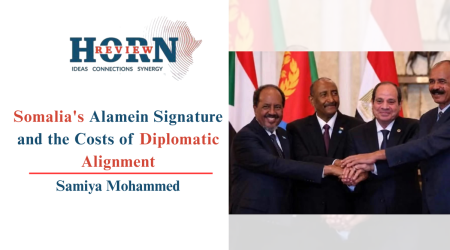
Somalia's Alamein Signature and the Costs of Diplomatic Alignment
The Alamein Declaration between Egypt, Sudan, Eritrea and Somalia...

6
Oct
Egypt's Nile for All, the Red Sea for Some - Except Ethiopia
The contradiction was laid out almost perfectly at El Alamein....

6
Oct
Isaias Afwerki has Long Wanted to Rule Ethiopia, Why He will Never
President Isaias Afwerki is among the most enduring figures in...