
Why Ethiopia Remains the Center of Gravity in the Greater Horn’s Maritime Economy
Horn of Africa maritime politics is conventionally narrated as the story of a landlocked giant in search of a coastline: Ethiopia, cut off from the sea since Eritrean independence in 1993, chasing ports, signing memoranda, and occasionally rattling sabers to secure an outlet its population and economy are assumed to require. That framing casts every coastal neighbor as a gatekeeper and Ethiopia as the supplicant. It is backwards. Examine the actual condition of the six maritime and near-maritime economies that ring Ethiopia, Djibouti, Somaliland, federal Somalia, Eritrea, Sudan, and Kenya’s Lamu corridor, and a different picture emerges. None of them has built, or can build, a viable port economy without Ethiopian cargo. Djibouti’s entire economic model is a function of it. Berbera’s expansion is underwritten by DP World on the expectation of it. Mogadishu is negotiating for the political credit of promising it. Eritrea’s new diversification strategy is designed around the possibility of eventually recovering it. Port Sudan lost its claim to it the moment its hinterland caught fire. And Lamu treats a single Ethiopian fertilizer shipment as a landmark event. The question that whether Ethiopia will get to the sea has obscured a more consequential one: whether any of these states can sustain a real maritime economy without Addis Ababa’s cargo, and what it would actually cost Ethiopia, in committed capital rather than declarations, to make that dependency work in its favor.
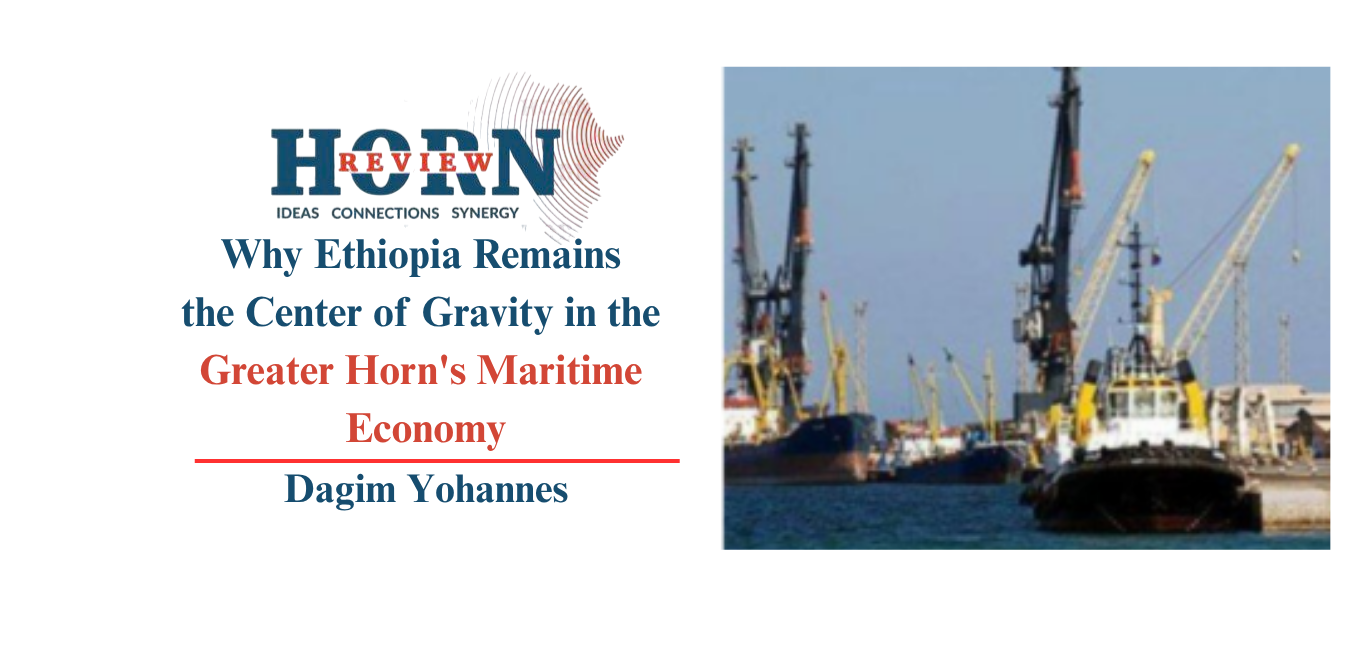
Djibouti is the clearest case because it is the least ambiguous. More than ninety percent of Ethiopia’s import and export trade moves through Djiboutian ports, a share that has held for three decades and shows no sign of falling. The Addis Ababa–Djibouti railway, a $4 billion, 753-kilometer electrified line financed largely by China’s Export-Import Bank and transferred to joint Ethiopian-Djiboutian management in 2024, has cut freight transit from three days to under twenty hours, yet even after that investment, rail carries only about fourteen percent of total cargo, with trucks still hauling the rest over a corridor road that both governments acknowledge is deteriorating under the load. Djibouti’s own port authority has been explicit that Ethiopian cargo gets institutional priority over efforts to build an independent transshipment identity; its chairman has described the country’s ambition in almost defensive terms, preferring not to be “too visible” given the security environment it sits in. That caution is telling. Djibouti is not diversifying away from Ethiopian dependency; it is managing that dependency as carefully as a monoculture economy manages its one crop. Ethiopian officials, for their part, have taken to publicly complaining about the cost of that arrangement, citing an estimated $1.6 billion a year in port fees and terminal handling charges, and pointing out that Ethiopian-bound transit cargo pays a fraction of what non-transit imports through Djibouti pay, a structural admission that Addis Ababa is a captive customer paying accordingly. Djibouti’s economy is deeply anchored in the port revenues generated by servicing Ethiopian trade, creating a structurally asymmetric relationship in which Ethiopia functions as the principal source of throughput and income. Given the scale, consistency, and geographic logic of this linkage, alternative sources of demand are limited and unlikely to offer a comparable substitute in the foreseeable future. As a result, Djibouti’s growth model remains highly dependent on Ethiopia’s continued use of its ports, with few viable diversification options capable of replacing that role.
Somaliland’s Berbera is presented in most coverage as the leading alternative, and on paper the numbers support that: a $442 million DP World-led redevelopment, a new container terminal inaugurated in 2021, and a corridor road linking the port to the Ethiopian border. What often gets overlooked, however, is the central question of Ethiopia’s own role in the project. In 2018, Addis Ababa agreed to take nineteen percent equity in the Berbera joint venture alongside DP World’s fifty-one percent and Somaliland’s thirty percent, with commitments to contribute to corridor infrastructure. By 2022, Somaliland’s finance minister stated that Ethiopia had lost its stake after failing to meet its financial obligations under the agreement. British International Investment, the UK’s development finance institution, later entered as a minority partner within DP World’s broader Africa logistics platform, filling the capital space Ethiopia had vacated. The January 2024 memorandum of understanding, under which Somaliland offered to lease roughly twenty kilometers of Gulf of Aden coastline in exchange for Ethiopian consideration of recognition, triggered the region’s most serious diplomatic crisis in years. Somalia treated it as a violation of its sovereignty, and it required Turkish mediation and the Ankara Declaration of December 2024 to ease tensions. Yet the MoU itself has not translated into a commercial arrangement. Ethiopia has neither fully abandoned it nor implemented it, leaving it largely frozen as a strategic bargaining instrument rather than an operational port agreement. Berbera’s development, therefore, remains primarily a DP World and BII commercial bet on future Ethiopian trade volumes rather than a project Ethiopia has directly capitalized at the level its diplomacy suggests. This reality is reinforced by the economic geography of eastern Ethiopia, whose proximity and growing trade potential provide Berbera with its most realistic pathway toward expansion. Early movements of Ethiopian-bound cargo, including fertilizer imports through Berbera, indicate the potential of the corridor to generate significant logistics growth if larger trade volumes are redirected through the port. In this sense, Berbera’s long-term success depends not on replacing Ethiopia as a factor in regional maritime trade, but on securing Ethiopia as its most important and potentially transformative customer.
To the southeast, Somalia’s pursuit of the same prize operates on a different logic, and it is worth stating plainly: Mogadishu’s interest in offering Ethiopia sea access is driven as much by political objectives as by economic ones. It seeks to reassert sovereignty over Somaliland and draw Addis Ababa back into a security relationship that strengthens the federal government against al-Shabaab, rather than relying on an existing port system capable of absorbing significant Ethiopian trade. The Ankara Declaration committed both sides to conclude technical negotiations on commercial sea-access arrangements within four months of December 2024, yet that timeline has repeatedly slipped. Talks were still described as ongoing during Turkish President Erdoğan’s visit to Addis Ababa in February 2026, and any Somali port under consideration, Hobyo has been mentioned in some accounts, remains at the proposal stage rather than an operational facility. Somalia’s leverage, therefore, is largely political: the promise of sovereignty-compliant access carries diplomatic weight in countering both Somaliland’s position and broader regional alignments. However, this leverage has clear limits. No federally controlled Somali port currently possesses the handling capacity, customs systems, or transport connectivity required to function as a viable corridor for Ethiopian trade at scale. If Mogadishu intends to redirect Ethiopia’s attention away from Somaliland and toward federal Somalia, it must translate political positioning into economic capability by developing port infrastructure that can credibly handle Ethiopian demand. Without that transition from promise to capacity, Somalia’s offer remains a strategic signal rather than a practical alternative.
Ethiopia’s northern neighbor, Eritrea has ambition to transform itself into a “Singapore of Africa”, which rests on the recognition that its geographic position along one of the world’s most strategic maritime corridors provides significant economic potential. However, geography alone cannot create a maritime economy; Singapore’s success was built not only on location but on its ability to serve as a commercial gateway connected to a vast network of trade flows. For Eritrea, the most realistic pathway toward such a transformation lies in reconnecting its Red Sea ports with Ethiopia’s large and growing economy. Massawa and Assab cannot achieve their full potential without access to the Ethiopian hinterland that historically gave them economic relevance. Ethiopia, with its population, import demand, and expanding industrial base, represents the scale of trade required to turn Eritrea’s ports from underutilized infrastructure into functioning regional logistics hubs.
Achieving this vision, however, requires a departure from the zero-sum logic that has defined much of the relationship since the 1998–2000 conflict. A mutually beneficial arrangement between Asmara and Addis Ababa on port access, transit trade, infrastructure investment, and revenue sharing could create gains for both countries. Such cooperation would not only revive Eritrea’s maritime economy but also provide Ethiopia with greater port diversification and reduced logistical vulnerability. The two societies remain deeply connected by history, geography, and human ties despite existing as separate states. A pragmatic dialogue aimed at a win-win economic framework would therefore serve the broader interests of both peoples, turning the Red Sea from a source of rivalry into a platform for shared prosperity.
Turning to Port Sudan, its relevance is particularly evident, when considering northern and northwestern Ethiopia, where its geographic proximity offers a potentially shorter and more practical logistics route compared with the longer Djibouti corridor. Historically, Sudan and Ethiopia recognized this potential and made efforts to expand the use of Port Sudan for Ethiopian imports and exports, particularly for bulk commodities, agricultural inputs, and general cargo. Before Djibouti became Ethiopia’s dominant maritime outlet, Port Sudan served as an important secondary corridor, supported by existing road links and trade networks connecting Sudan’s Red Sea coast with Ethiopia’s western and northern regions. Reviving this corridor would not only provide Ethiopia with greater port diversification but could also integrate Sudan’s Red Sea infrastructure into a wider regional logistics network. However, the success of such an arrangement depends on the restoration of political stability in Sudan and the ability of both countries to rebuild the institutional and infrastructure frameworks that previously supported cross-border trade.
Most instructively, Kenya’s Lamu Port, the anchor of the decade-old LAPSSET corridor, is the most recent entrant and the one whose trajectory most clearly illustrates the broader regional pattern rather than challenging it. Lamu sat largely underutilized for years after its first berths were completed, and its recent throughput surge, from roughly 74,000 metric tons in 2024 to nearly 800,000 metric tons in 2025, owes much to temporary Red Sea shipping disruptions that redirected traffic toward a corridor previously treated as peripheral, alongside a small number of high-profile Ethiopian shipments. The arrival of a single 60,000-ton Ethiopia-bound fertilizer consignment in 2024 was marked by Kenyan officials as a milestone event rather than routine trade, and President Ruto was still presenting a renewed Ethiopia–Lamu usage agreement as a significant development as recently as February 2025. This dynamic reflects the original strategic logic behind LAPSSET itself. From its inception, including Ethiopia’s early engagement under Prime Minister Meles Zenawi, the corridor was conceived not merely as a Kenyan infrastructure project but as a regional integration platform anchored in Ethiopian demand. Recent developments reinforce that logic: Kenya and Ethiopia’s March 2026 agreement to conduct coordinated security operations along the Moyale–Marsabit–Turkana axis underscores that the corridor’s viability depends on sustained joint commitments to both infrastructure and security, areas where implementation remains incomplete, as evidenced by the still-fragile and, in places, flood-damaged Lamu–Ijara road as of early 2025. In that sense, Lamu offers the clearest replicable model for the region: when infrastructure, security, and political coordination align, even limited Ethiopian engagement can generate substantial logistics activity. Yet it also confirms a broader reality. Ethiopia is not simply a participant in the corridor but its indispensable customer, without which Lamu’s long-term viability, and by extension similar regional projects remains uncertain.
Viewed in aggregate, these six cases point not to divergence, but to a shared structural pattern. What appears on the surface as multiple strategies is, in practice, a single regional dynamic: coastal states competing to anticipate and attract Ethiopian demand, and Ethiopia managing that competition without committing to any one outcome. This is the underlying reality of the Horn’s maritime economy. The constraint is not geography in the conventional sense, Ethiopia’s lack of a coastline, but the absence of a binding alignment between capacity and capital. Ports are being built, expanded, or defended in expectation of Ethiopian throughput, yet that throughput remains uncommitted, mobile, and politically leveraged. The result is a system defined less by access than by uncertainty: infrastructure without guarantees, negotiations without closure, and corridors that remain perpetually provisional.
Seen in this light, Ethiopia’s pursuit of maritime access should not be reduced to an expansionist impulse, but understood as the predictable behavior of a rapidly growing economy seeking to diversify risk and reduce cost. The issue is not the presence of that demand, but the fragmented way in which the region has organized itself around it. Until that changes, the equilibrium will hold. No single alternative will displace Djibouti, not because substitutes are unattainable, but because none has secured the scale of commitment required to become one. And no coastal state will fully escape this dynamic, because each remains structurally exposed to the same condition: dependence on a customer that has not been required to decide.
The implication, therefore, is not that the region should resist Ethiopia’s search for access, but that it should respond to it more coherently. What is needed is not an ever-expanding set of competing corridors, but port capacity anchored in credible commitments, capital participation, guaranteed volumes, and coordinated infrastructure sized to Ethiopia’s accelerating import–export demand. Until such alignment emerges, the region’s maritime landscape will remain what these cases already reveal it to be: a system built around anticipated demand, continuously reshaped by it, and ultimately constrained by its absence as a binding commitment.
By Dagim Yohannes, Researcher, Horn Review

RELATED
Posts
7
Oct
“Decaffeinated Sovereignty”: Eritrea’s One-Way Street with Ethiopia
There is a peculiar contradiction at the heart of Eritrea’s...
7
Oct
Leaked Documents Allege Sudanese Army Weapons Pipeline to TPLF-Aligned Forces as Tigray War Reignites
Leaked documents alleging a Sudanese army weapons pipeline to TPLF-aligned...

7
Oct
Eritrea Has Officially Invaded Ethiopia, Says Government Communication
Ethiopian Government Formally Condemns Eritrean Territorial Incursion as Its Forces...
7
Oct
The Northern Ethiopian Crisis has Surpassed the Intra-State Conflict Threshold, Inter-State War is Inevitable
The Eritrean regime and its newly allied TPLF hardliners share...

6
Oct
What Abiy Ahmed’s Parliamentary Address Says About Ethiopia’s Next Five Years
In his reappointment to the premiership, Abiy Ahmed offered a...

5
Oct
Egypt Displays Its Anti-Addis Coalition as Ethiopia Gains Against Rebels. What Comes Next?
Egypt's strategy of cultivating relationships around its chief rival in...
5
Oct
Ethiopia's Press Statements Exposes the El-Alamein Contradiction
The Ministry of Foreign Affairs of Ethiopia issued a clear...
5
Oct
Ethiopia Under Abiy Ahmed's Renewed Mandate
With a new five-year term beginning in October 2026, Ethiopia...
4
Oct
Egyptian Airpower and the GERD: From Strike Capability to Strategic Limits
The Grand Ethiopian Renaissance Dam is within the theoretical reach...

3
Oct
How Should Saudi Arabia Approach the Conflict in Northern Ethiopia?
Saudi Arabia’s position toward the renewed conflict in northern Ethiopia...