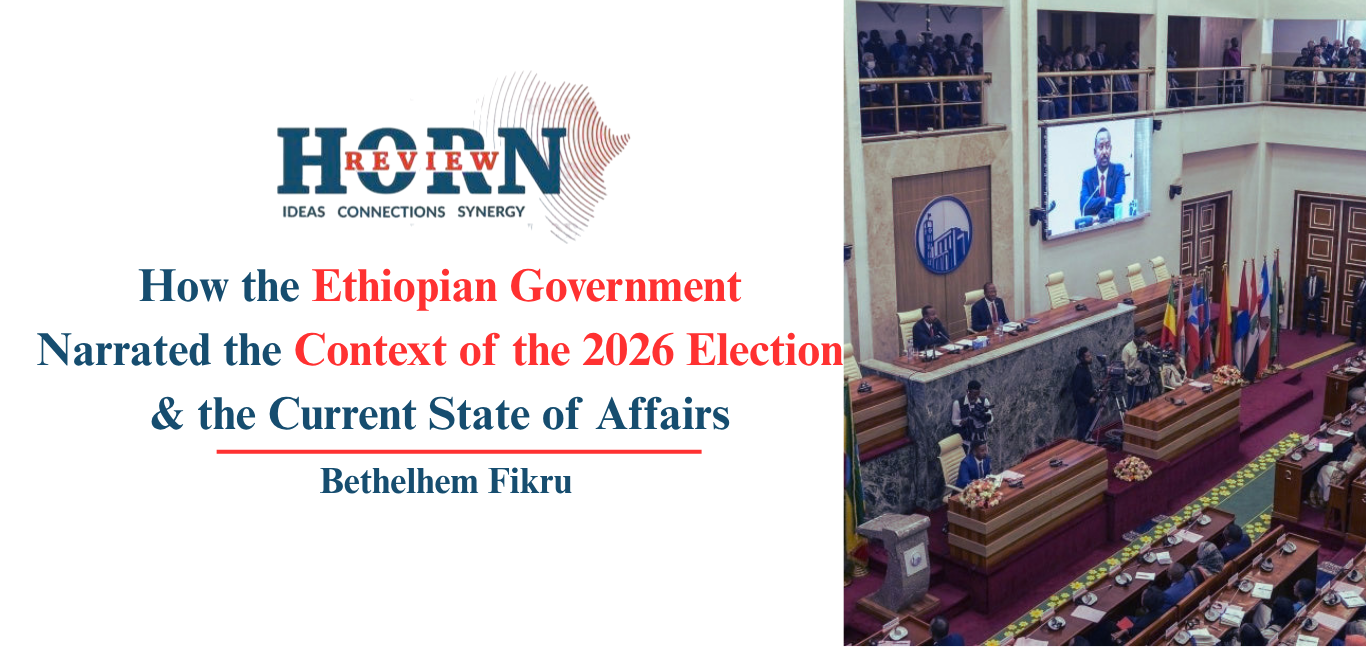
The most revealing aspect of Ethiopia’s latest government communication is not its defense of the 2026 election. Elections come and go. What stands out instead is the broader argument embedded within the statement Ethiopia is increasingly presenting itself as a country that intends to define legitimacy through performance, resilience and national priorities rather than through external approval. For much of the past decade, international narratives about Ethiopia have been dominated by crisis. Conflict, humanitarian emergencies, political polarization and regional instability often became the primary lens through which the country was understood. However, the government’s latest message suggests an attempt to move the conversation elsewhere. The argument is not that challenges have disappeared. Rather, it is that challenges no longer define the totality of the Ethiopian state.
The election is presented within this larger context. Rather than treating democratic participation as an isolated event, the government portrays it as one component of a broader process of national consolidation. More than fifty million registered voters, thousands of candidates, extensive domestic observation networks, and continental observer missions are cited not simply as electoral statistics but as indicators that constitutional politics continues to function despite predictions of fragmentation. The underlying message is clear that Ethiopia rejects the notion that its political future should be interpreted primarily through the expectations of outside observers. The country’s democratic evolution, according to this perspective, will be measured by its own institutional path rather than by imported benchmarks developed under different historical and political conditions.
This represents a broader shift in political thinking that is becoming increasingly visible across parts of Africa. For decades, legitimacy was often treated as something certified externally. Elections were frequently evaluated less by domestic participation than by foreign commentary. Development strategies were assessed through donor frameworks. Political reforms were discussed largely in relation to international approval. Legitimacy is increasingly framed as something generated internally through state performance, public participation, and constitutional continuity. Whether outsiders approve becomes secondary to whether institutions function and citizens engage.This is particularly evident in the government’s treatment of economic development.
The press release dedicates substantial attention to infrastructure, industrialization, energy generation, manufacturing expansion, agricultural transformation, and export growth. These are not presented as isolated projects. Together they form a narrative of national selfreliance. The Grand Ethiopian Renaissance Dam occupies a central place within that narrative. Similar themes appear throughout the government’s discussion of industrial policy. The message is not that Ethiopia has achieved economic transformation. The message is that transformation is underway and increasingly difficult to reverse. This distinction is crucial because many developing states struggle not with launching reforms but with sustaining them through periods of instability. The government is attempting to demonstrate that Ethiopia has crossed a threshold where development is no longer dependent on favorable circumstances alone. Instead, it is becoming embedded within long-term institutional planning.
Equally important is the international orientation reflected in the statement.The government’s emphasis on African Union and IGAD observer missions is not accidental. It reflects a growing tendency to prioritize continental institutions as sources of political legitimacy. Rather than presenting validation from Europe or North America as the primary benchmark, the statement repeatedly highlights assessments from African observers, African organizations, and regional partners. This should not be interpreted as hostility toward the West. Rather, it reflects an effort to rebalance the sources from which political credibility is derived.The same logic extends to security. Perhaps the most significant aspect of the press release is its refusal to separate democratic development from questions of state authority. The government argues that constitutional politics cannot coexist indefinitely with armed movements seeking political outcomes through violence. This is where the discussion of OLA-Shene, extremist networks, and destabilization efforts becomes central. The government’s position is that democratic participation and armed insurgency represent fundamentally opposing political paths. While the others seek legitimacy through ballots; the other seeks leverage through coercion.The statement therefore frames recent attacks not just as security incidents but as direct challenges to constitutional order itself. The reference to coordinated efforts involving insurgent groups, foreign actors, and extremist networks serves a broader purpose. It reinforces the argument that they are portrayed as resistance to an ongoing process of political and economic transformation.The mention of the TPLF must also be understood within this context.
Ethiopia’s modern political history has been repeatedly shaped by armed movements that claimed to liberate the state but ultimately reproduced new forms of domination through force. The Derg emerged from military overthrow, while the TPLF secured power through prolonged armed struggle and governed from a position rooted not in broad democratic consent but in the political realities of wartime victory. Actors seeking to preserve the political leverage, exceptional privileges, or veto power inherited from these insurgent traditions represent a continuation of a historical cycle that has repeatedly undermined national cohesion and institutional development. The central message of the press release is therefore not simply a criticism of particular groups, but a rejection of the longstanding notion that political authority in Ethiopia can be derived from armed pressure rather than constitutional legitimacy.
The government’s argument is that Ethiopia stands at a crossroads between two competing political models: one rooted in institutions, constitutional order, and national development, and another rooted in the legacy of insurgent politics where power is negotiated through coercion, conflict, and ethnic or factional leverage. By explicitly holding the TPLF’s political legacy responsible for perpetuating this latter tradition, the government presents its project as an effort to close a historical chapter in which armed movements repeatedly shaped the state’s direction. The press release thus serves as a broader declaration that Ethiopia’s future should be determined by institutions rather than insurgencies, by electoral and constitutional processes rather than wartime political claims, and by a unified national trajectory rather than competing centers of power inherited from past conflicts.
At a time when global politics is increasingly segmented Ethiopia appears to be advancing a vision of autonomy rooted in three interconnected principles like democratic evolution on its own terms, economic transformation through selfreliance and diversified partnerships and the preservation of state authority against forces seeking fragmentation. Whether one agrees with every aspect of this vision is ultimately secondary.What matters is that Ethiopia is increasingly confident in articulating it.
The central message emerging from Ethiopia is therefore not one of triumphalism. It is one of determination. The country acknowledges the existence of conflict, pressure, and uncertainty. Yet it rejects the assumption that these challenges define its future. Instead, Ethiopia presents itself as a state that has chosen continuity over collapse, development over stagnation, and sovereign decision-making over external prescription. That is the deeper story behind the election. And it may prove more consequential than the election itself.
By Bethelhem Fikru, Researcher, Horn Review