
6
Feb
Eritrea’s War Crimes in Tigray: Strategic Violence & State Fragility
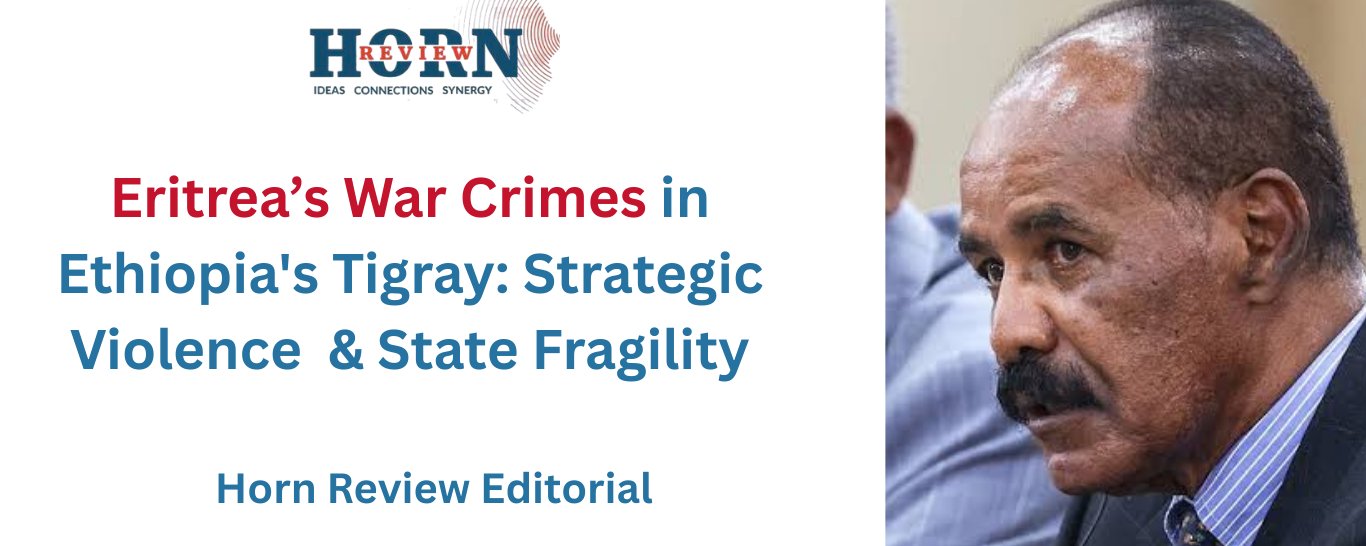
The Tigray conflict of 2020–2022 exposed one of the most consequential and underexamined dimensions of state behavior in the Horn of Africa: the deliberate and systematic targeting of civilians by Eritrean forces. While Eritrea’s involvement was extensively documented by survivors, journalists, and international human-rights organizations, it remained largely absent from formal political discourse. That posture shifted when, in a parliamentary address on Tuesday, 2 February 2026, Ethiopian Prime Minister Abiy Ahmed delivered a speech that referenced atrocities committed by Eritrean troops against civilians in Tigray. The significance of this reference lies not in its novelty, but in the institutional forum in which it was made, providing a formal point of departure for examining Eritrea’s conduct through a political and evidentiary lens.
During the height of the war, the Ethiopian Human Rights Commission (EHRC), a state-funded human rights institution, released a report documenting the Tigray conflict, covering the period from 3 November 2020 – when hostilities began between the Ethiopian National Defence Force (ENDF), Eritrean Defence Force (EDF), Amhara Special Forces (ASF), and allied militias on one side, and Tigrayan Special Forces (TSF), Tigrayan militia, and allied groups on the other. The report called for accountability for violations and abuses by all parties, most particularly implicating the Eritrean Defense Forces (See report here https://ehrc.org/tigray-conflict-report-calls-for-accountability-for-violations-and-abuses-by-all-parties/). Following this, the Prime Minister ordered the withdrawal of Eritrean forces from Ethiopian territory, which the Eritrean regime refused, and also spoke in parliament that ENDF officers identified as responsible for crimes – including gender-based and other abuses – be held accountable, underscoring that all actors engaged in violations of the laws of armed conflict must face responsibility, regardless of affiliation. This stance further situates the examination of Eritrean conduct within established federal standards of accountability and demonstrates that Ethiopia actively sought to protect its citizens from targeted violence, even amid extreme fragility and conflict.
Nonetheless, when addressing why Eritrean forces were in Ethiopian soil to start with, it is critical to situate Eritrea’s actions in the broader context of Ethiopia’s fragility during this period. In 2020–21, Prime Minister Abiy was only two years into a highly delicate political transition, overseeing a state security apparatus that was fragmented and partially incapacitated. ENDF forces had suffered substantial losses up on TPLF’s unprovoked attack against ENDF’s Northern Command that has been stationed in Ethiopia-Eritrea border in Tigray region for more than 2 decades, amounting to more than 60 percent of loss of the ENDF’s general military personnel and over 70 percent loss of its logistical capacity ( https://www.ena.et/web/eng/w/en_39793). The soldiers were massacred, the logistics and weaponry destroyed and confiscated by TPLF forces during a failed attempt at a coup against the federal government ( https://www.sudanspost.com/ethiopias-tplf-admits-it-started-war-with-attempt-to-disarm-endfs-northern-command/). These losses left the state exposed and its military significantly weakened. As the Prime Minister’s current advisor on East African affairs – former TPLF executive committee member and later President of the interim Tigray regional administration post-Pretoria – Getachew Reda, explained in his recent NBC Ethiopia interview, the federal leadership was acutely aware that Eritrea, under Isaias Afwerki, was prepared to exploit any ensuing instability, and the Prime Minister made it clear to TPLF officials though his then National Security Advisor, current Director General of the National Intelligence and Security Services, Ambassador Redwan Hussien, that Ethiopia’s capacity to prevent such opportunistic interventions by Eritrea was constrained by the transitional fragility of the state. Nevertheless, Ethiopia actively defended itself against TPLF aggression, maintaining its sovereign obligations while navigating a transitional and destabilized environment, and Eritrea, as warned by Abiy Ahmed, exploited the chaos to pursue its long-standing vengeance against the TPLF and the people of Tigray.
Eritrea’s military operations in Tigray, therefore, reflect a systematic and coercive pattern of violence that was deliberate and far from random. Reports from Axum, Adwa, Adigrat, Shire and surrounding areas consistently document mass killings, widespread looting, sexual violence, and the destruction of religious and civilian infrastructure. These acts reflect an operational logic aimed not only at defeating armed opponents, but at inflicting lasting harm on the civilian environment in which political and social life is embedded – and most importantly – consolidating a lasting fracture and resentment between the people of Tigray and the Ethiopian state. Such conduct aligns with the Eritrean regime’s long-standing posture toward the Tigray region, the Tigray People’s Liberation Front (TPLF), and with its broader strategy of weakening Ethiopia and ensuring persistent cycle of violence between the Ethiopian state and ethno-nationalist radicals – added to its underdeveloped approach to power projection in the Horn of Africa, one that treats civilian populations as instruments within political and military strategy – including its own citizens..
This pattern is corroborated by large-scale empirical research. Among other reports by Ethiopian Human Rights Commission, Human Rights Council, UN Human Rights Council, the Sentry.org etc, a comprehensive study conducted by Mekelle University’s Institute of Environment, Gender and Development Studies, the College of Health Sciences and Ayder Comprehensive Specialized Hospital, the Legal Aid Centre, and the Global Society of Tigrayan Scholars and Professionals documents widespread, systematic, and non-random sexual and gender-based violence during the war. Drawing on a survey of 458,558 respondents, the study found that 11.29 percent were survivors of gender-based violence, with over 40 percent of these survivors experiencing sexual violence, primarily rape – predominantly by Eritrean forces which almost all study and findings identifies as the principal perpetrators. More than 74 percent of documented sexual violence cases were attributed to Eritrean soldiers, who were consistently identified by survivors through uniforms, footwear, language and dialect, and physical characteristics. Sexual violence peaked between November 2020 and March 2021, coinciding with the largest and most sustained Eritrean military presence. The brutality documented was extreme.
Survivors reported that Eritrean soldiers frequently initiated assaults, coordinated gang rapes, sexual slavery and at times directed the participation of other armed actors, including ENDF personnel, reflecting situational authority and coercive dominance rather than an integrated or systemic command structure with in the ENDF. These findings indicate that sexual violence was organized, patterned, and systemic rather than the result of indiscipline or isolated excess. Targeted rape was common against women accused of political or civic affiliation with TPLF political structures. The use of foreign objects, genital mutilation, and genital burning with hot iron – reported in thousands of cases – demonstrates the deployment of sexual violence as a weapon of terror, humiliation, and long-term bodily destruction by Eritrean Forces.
And this is beyond the mass killings and massacres of civilians in Aksum and other conflict ridden areas, the looting and destruction of both civilian and government property and infrastructure (health, education, transportation and electricity), the destruction of cultural and religious sites – including churches, monasteries, and schools, forced displacement and mass exodus of civilians to settle Eritreans in bordering towns such as Irob, Zalambesa etc, Economic devastation, including confiscation of assets and collapse of livelihoods and the psychological trauma and social disruption they caused both to the Tigray region and the Ethiopian state. These findings substantively corroborate the reference made by Abiy Ahmed in his parliamentary speech, grounding it not in isolated allegations but in large-scale, methodologically rigorous documentation of Eritrean conduct during the war. Legally, the documented acts meet more than the average thresholds for war crimes and crimes against humanity, and in several respects align with acts prohibited under the Geneva Convention on the Laws of War.
Viewed historically, Eritrea’s actions in Tigray are not an aberration. Since independence in 1993, the Eritrean state has pursued a governance model characterized by militarization, centralized authoritarian control, and extraterritorial political engagement. Its intervention in Tigray fits within a broader pattern of projecting power beyond its borders to shape political outcomes while remaining insulated from accountability. The use of systematic violence against civilians is thus best understood not as a wartime deviation, but as an extension of a political strategy that privileges coercion over legitimacy. Hence its only logical to say Eritrea’s conduct has revealed this deeper strategic and operational dynamics. At one point during the conflict, senior Eritrean military and intelligence figures – including leaders from both the defence and intelligence apparatus – were reportedly summoned by the ENDF’s Army Chief to Addis Ababa to address concerns about the conduct of Eritrean troops. According to Horn Review findings, these Eritrean representatives indicated that their forces were ideologically predisposed against the TPLF and that their units could not effectively control their own actions on the ground, stating that there was little they could do to curb the abuses. There were incidents where Eritrean forces blockaded the movements of ENDF in areas where they were committing severe violations, also where the two forces battled in an open fire at the height of the Tigray conflict. Eritrean soldiers were reported to have killed both wounded and unwounded ENDF personnel in cold blood, systematically confiscating weapons, looting food reserves, and even seizing military uniforms. This episode underscores an operational disjunction within the Eritrean chain of command and highlights the regime’s difficulty or unwillingness to restrain violent conduct, even when subject to diplomatic pressure or direct summons by ENDF leadership. It demonstrates that Eritrean forces were acting both opportunistically and strategically, exploiting the state’s transitional fragility while pursuing their own objectives.
This conduct must also be understood through the currently prevailing framework often described as Tsimdo: a convergence of tactical coordination, opportunistic alignment, and instrumental rivalry between Eritrean state interests and fragmented Tigrayan political and military dynamics in the post-Pretoria period -a peace process in which the Eritrean regime was effectively isolated due to its lack of political will for genuine reconciliation. Far from being a passive participant in Ethiopia’s internal conflict, the Eritrean regime has continued to treat Tigray and parts of Amhara as a strategic theatre through which to pursue its long-standing objectives: neutralizing perceived historical adversaries, reshaping post-war political outcomes, and asserting regional influence. In this sense, Tigray is not merely a battlefield for Isaias Afwerki, but a medium – a space in which Eritrea projects power, settles historical scores, and shapes Ethiopia’s internal balance without assuming responsibility for governance, reconstruction, or civilian protection, both past and present. The systematic violence documented thus functioned not only as a weapon of war but as a mechanism of political intervention, designed to fracture social cohesion and foreclose the re-emergence of autonomous Tigrayan political agency within Ethiopia’s federal state structure.
To conclude, the central task is to foreground the actions of the Eritrean regime. The record from Tigray on Eritrean war crimes is extensive, statistically corroborated across independent methodologies. It demonstrates a deliberate strategy of coercion, punishment, and intimidation directed primarily and overwhelmingly by Eritrean forces. Recognizing the specificity and scale of these actions, while situating them within the extraordinary fragility of the Ethiopian state at the time, is essential for historical accuracy, informed regional policy, and any credible effort to prevent the normalization of extraterritorial state violence in the Horn of Africa.
By Horn Review Editorial

RELATED
Posts
15
Apr
Sudan's Southern Fault Line: Re-Islamization, Secular Defections, and the Rise of a Peripheral Republic
In April 2026, Major General Hassan Adam al-Hassan, the second-in-command...
14
Apr
The Political Paradox of Maritime Security in the Horn of Africa: Phantom Ports and the Erosion of Local Agency
Global stakeholders keep praising the securitization of the seas, pointing...
14
Apr
Bab el-Mandeb: The Next Global Flashpoint
With the Strait of Hormuz effectively closed amid rising tensions...
10
Apr
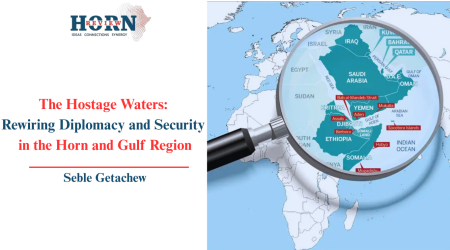
The Hostage Waters: Rewiring Diplomacy and Security in the Horn and Gulf Region
Overview
The unfolding Gulf crisis has become a defining moment in...
9
Apr
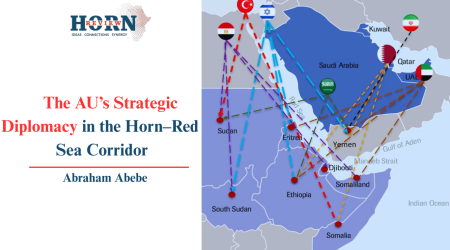
The AU’s Strategic Diplomacy in the Horn–Red Sea Corridor
The African Union’s appointment of a High Representative for...
9
Apr
How Deep Is Egypt in Sudan’s War? The Shift from Support to Battlefield Involvement
Egypt’s military role in Sudan has steadily moved from discreet...
8
Apr
El sisi’s recent rhetoric on GERD
On April 4, 2026, Egyptian President Abdel Fattah el-Sisi used...
2
Apr
Hormuz vs. Bab el-Mandeb: The Yom Kippur Precedent and Closing the Gates of the Sea
How 1973 Yom Kippur War Proved That Bab el-Mandeb...
2
Apr
The New Security Reality of the Horn of Africa and Middle East
For a long time, political analysis treated the Middle East...
2
Apr
Somalia’s Blue Economy Deal with Turkey
The 2026 launch of SOMTURK marks a significant shift...