The two conflicts can also be seen as one continuing politico-historical narrative across the Red Sea, where Yemen’s conflict is the earlier script, and the Sudan conflict is the later one, developing towards what could be described as a “Red Sea challenge trail.” The innovation here is to interpret them not as simultaneous but as successive and mutually constituting paths toward the organization of one Red Sea Horn of Africa security complex, where Yemen is no longer a “Middle Eastern” conflict or a case of “African” conflict but a bastion of one increasingly coherent politico-historical regime of conflict management, and the same for Sudan.
In both Yemen and Sudan, the point of departure is a transitional process that reshuffles the cards at the apex of a pyramidal structure of authority but leaves the base of coercive and rival power unchanged. The post-2011 Gulf Cooperation Council transition in Yemen ousted Ali Abdullah Saleh without effectively dismantling his coercive and clientelistic networks. The Houthis, previously peripheral insurgents, became integral to national politics by merging their insurgency movement with elements of Saleh’s military and administrative networks and taking over the capital, Sanaa, in 2014, effectively relegating President Hadi to a sort of remote front.
The Sudanese transition of 2019, after Omar al-Bashir, similarly reflected this same underlying logic of maintaining an even keel of balance between, rather than finding a solution to, rivalries between the Sudanese Armed Forces and the Rapid Support Forces through a negotiated civilian and military deal. The rhetorical and enacted roadmap of “integration” ensnared a reality of dual sovereignty, wherein each of these rival forces had its own hierarchical systems of command, revenue-generating autonomy, and foreign supporters.
Transitions in Yemen where the precarious equilibrium between Saleh the Houthis and Hadi unraveled in the 2014-15 war and in Sudan where the armed forces the RSF and the civilian leadership witnessed the carefully constructed transition explode into open conflict share two characteristics the first of which is Transition agreements necessarily result in the relocation of power not the destruction of the hard core paving the way for the next confrontation The second is the “paramilitary shock” in which the weaker side the one that is supposedly less institutionalized emerges on top and seizes the capital thus revealing the weakness of the very idea of the state
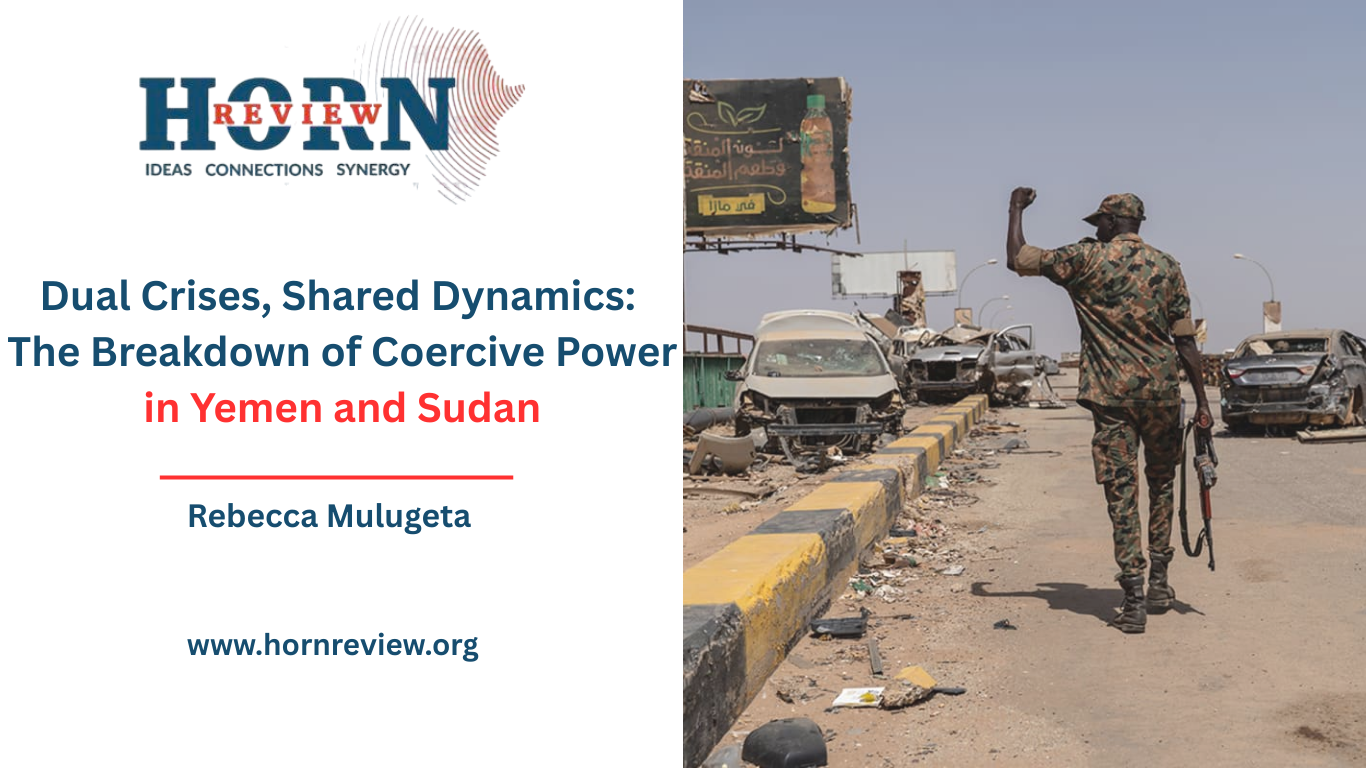
The Houthi move into Sanaa with the support of Saleh followers struck a resonance with both a tired public sentiment and a split military. It served as much a statement of politics as a statement of military might weak as much as force. The RSF’s rapid move into Khartoum in 2023 made a similar statement. A paramilitary organization that had been integrated into the state apparatus but a “militia” in social imagination made a move for the very center of the country and held a significant part of the capital for well over a year.
The pattern is that the paramilitary actor uses speed, urban adaptability, and elite connections to create facts on the ground, exposing the conventional army as a contested, not a unified, institution. This shared sequence is important because it creates the same psychological and diplomatic condition in both cases. External actors can no longer pretend there is a single coherent state authority to back; they are forced to choose among armed elites who hold specific pieces of territory.
The third shared phase is the counter-mobilization and stabilization of front lines under external sponsorship. In Yemen, the Saudi-led intervention from 2015 onwards prevented the Houthis from absorbing the entire state. Air power, an economic blockade, and the sponsorship of anti-Houthi coalitions, including southern forces later aligned with the UAE, turned what might have been a coup consolidated in months into a grinding, multi-front war. In Sudan, there is no open, declared coalition in the same way, but the pattern is similar: the SAF has reconstituted itself with diplomatic, financial, and logistical backing from neighbors and Gulf states who want to preserve the fiction of a sovereign Sudanese state, especially for reasons tied to the Nile and the Red Sea
The RSF, like the Houthis, has adapted to this pressure by entrenching in favorable terrain in Sudan’s case, Darfur, borderlands, and segments of the capital’s periphery rather than seeking to retake the entire institutional center. What emerges in both contexts is an equilibrium where air and artillery power allow the “state” side to prevent outright defeat but not to recover full sovereignty, while the insurgent or paramilitary side embeds deeper in its strongholds, relying on non-conventional revenues and social control.
Once that equilibrium forms fragmentation becomes a rational strategy not a side-effect Yemen has over time broken into three main political–military zones the Houthi-ruled north and northwest centered on Sanaa a southern bloc effectively dominated by the Southern Transitional Council and a political project of renewed southern statehood and an internationally recognized but territorially limited government whose leaders spend much of their time outside the country
Sudan is moving along a similar trajectory The SAF holds much of the northeast and the symbolic levers of “sovereignty” embassies formal recognition seats in international organizations while the RSF dominates Darfur parts of Kordofan and areas of greater Khartoum and other armed movements and local power brokers are positioning themselves to carve out their own zones The Gulf powers play broadly similar but differently distributed roles
across these zones. In Yemen, Saudi Arabia has gravitated toward backing the recognized government and, increasingly, toward a pragmatic modus vivendi with the Houthis to protect its borders, while the UAE has built deep influence with southern factions and some anti-Houthi forces along the coast. In Sudan, Saudi Arabia leans toward the SAF as the formal “state” partner, while the UAE is widely perceived to have closer ties to the RSF and to be interested in long-run influence over Sudan’s Red Sea and resource corridors. The trend here is that external powers hedge: they no longer bet on a single national project, but diversify their influence across multiple sub-state actors.
The war economies in both countries reflect the same logic of diversification, entrenchment, and externalization. In Yemen, the Houthis have transformed from insurgents into rent-seeking rulers, extracting resources through taxation, customs at key ports, manipulation of the currency, and control of fuel imports. Southern factions monetize their control of ports, checkpoints, and parts of the oil infrastructure. Ordinary economic life is subordinated to the needs of military and political elites. Sudan’s RSF behaves similarly, building on its pre-war control of the gold trade to create a multi-layered revenue system that includes cross-border smuggling, taxation of agricultural production, looting and “appropriation” of urban property, and extraction from humanitarian supply lines.
The SAF, like the remnants of the Yemeni state, relies on its influence over formal state institutions, state-owned companies, and international financial channels. In both wars, this creates a deeply perverse but stable situation: elites on all sides develop material interests in maintaining a fragmented landscape in which they can tax, smuggle, and negotiate, rather than a unified state in which they might be constrained by domestic political competition and legal oversight.
One of the most important, and underappreciated, continuities across the Yemeni and Sudanese cases is the way the two wars jointly restructure the politics of the Red Sea and the Horn. Yemen’s coastal geography, and in particular Houthi attacks on shipping, have driven an incremental militarization of the southern Red Sea. Naval deployments, security coalitions, and informal understandings about control of islands and coastal facilities have multiplied. Sudan’s conflict, by destabilizing Port Sudan and the broader coastal strip, adds a second layer of uncertainty. The question is no longer just whether the Houthis will strike ships, but whether Sudan can guarantee secure port operations, customs enforcement, and basic maritime governance.
For the Horn states, this double shock translates into higher import costs, more volatile export routes, and increased incentives to align with one or another external patron promising security guarantees, investment in alternative ports, or protection against rivals. Ethiopia’s interest in sea access, Somalia’s competition between federal center and federal member states over port agreements, remain relevant through strategic facilities all intersect with this evolving pattern.
To frame Yemen and Sudan as part of a single “Red Sea disintegration pathway,” then the forward-looking scenario is not simply “more of the same” but the gradual normalization of fragmented sovereignty as a regional governance model. In this model, what matters is not whether there is one flag over Sanaa or Khartoum, but whether external and local elites can stabilize predictable corridors of extraction and influence corridors that run from interior resource zones to coastal gateways. Yemen’s Houthi north, southern quasi-state, and internationally recognized government can coexist for long periods if each has an external sponsor and access to revenue.
In Sudan, the SAF home front, the RSF within the west, and the new local administrations that have sprung up within the east and south might all be following the same trend. In terms of the Horn of Africa, this means that there will be a future reality within which the regional community will interact more and more with Yemen and Sudan not as fully sovereign actors on the international stage but rather with a patchwork of different leaders who are sometimes formal and sometimes de facto but are all the while supported by different members of the GCC or other outside powers. The danger and at the same time the challenge for analysis is that these trends will self-replicate on the other side of the water. The precedent set by Yemen will easily allow the GCC powers to settle for the Somali-style patchwork of proxy leadership within Sudan. At the same time, the specifics of the Sudanese situation might embolden the elites within Yemen to resist because they will recognize that delay is always rewarded and that they might gain recognition and money without necessarily ceding more actual power on the ground.
The Horn will not sit on the sidelines for this but will rather be pulled into the mix. Wars and refugees are flowing from west to east and then back again, and regional leaders are steadily transforming their own internal struggles into reflections of these wars on the regional level. The larger shift at play is that Yemen and Sudan are not merely two crises with similar geometries it is the prototype for the new fractious and remote-controlled politics of the Red Sea coast that will shape the politics of the next decade and whether the Horn resists also builds towards more unitary politics.
By Rebecca Mulugeta, Researcher, Horn Review