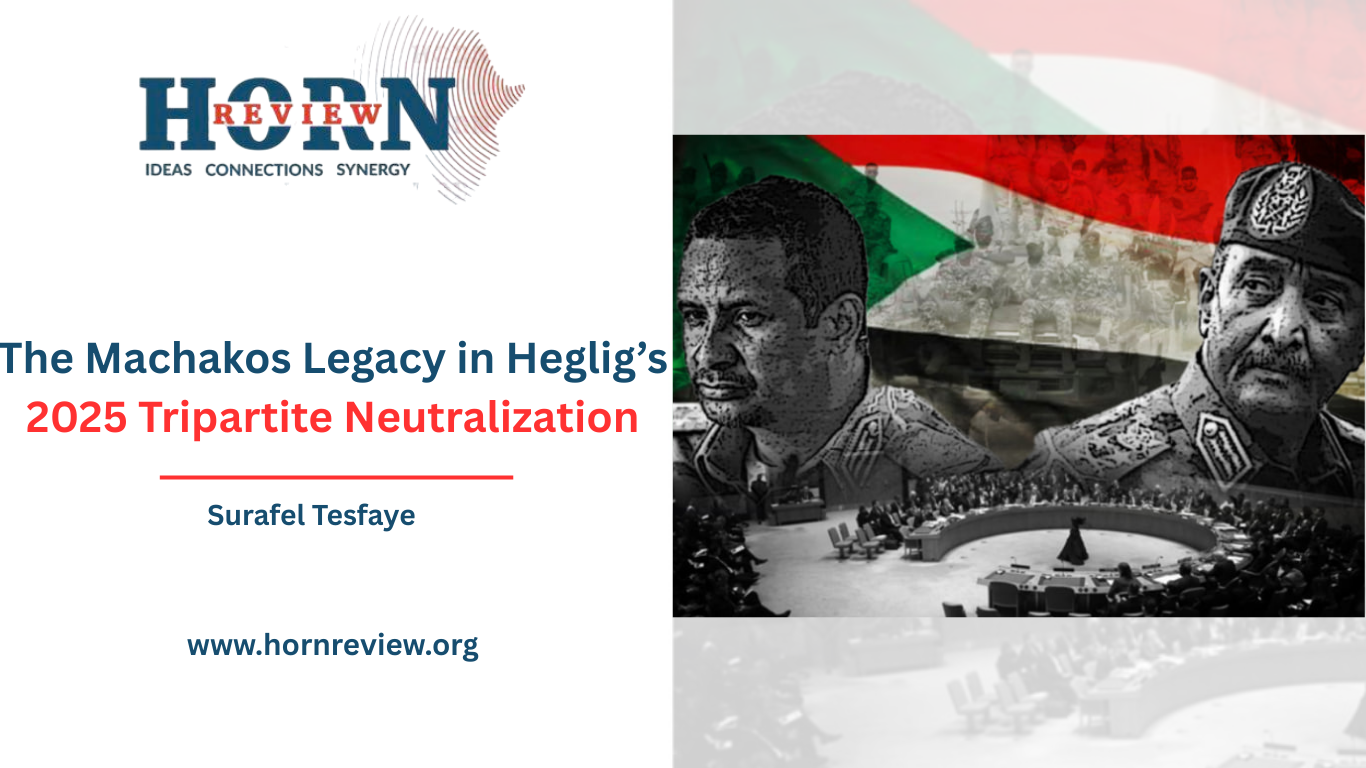
The Machakos Protocol of 2002 marked a decisive turning point in Sudan’s long-running north–south civil war. Rather than attempting to resolve all core disputes at once, the agreement introduced a framework built on interim arrangements self-determination for the south, power sharing at the center, and, crucially, a system for sharing oil revenues during a transitional period. This approach acknowledged the profound economic interdependence between north and south while deliberately postponing the most politically sensitive issue: the precise demarcation of borders in resource-rich regions. Two decades later, the logic embedded in Machakos continues to shape crisis management in Sudan and South Sudan, most visibly in the 2025 neutralization of the Heglig oil complex.
Oil lay at the heart of Sudan’s civil war economy well before Machakos. Discoveries beginning in the late 1970s transformed previously marginal borderlands into strategic assets. Administrative boundaries shaped by colonial convenience and post-independence centralization were repeatedly adjusted in ways that favored Khartoum, deepening southern grievances. By the time negotiations began in earnest, oil fields clustered along the poorly defined north–south divide had become both indispensable to the state and combustible sources of conflict. Machakos responded to this reality by institutionalizing ambiguity: oil revenues would be shared during an interim period, while final border decisions would be tied to the provincial boundaries, as they existed on 1 January 1956.
This deliberate deferral was not accidental. By separating economic cooperation from territorial resolution, Machakos sought to build trust through shared benefits while lowering the immediate political cost of compromise. Yet the absence of prompt demarcation also created structural vulnerabilities. The Comprehensive Peace Agreement (CPA), which followed in 2005, expanded this logic across security, governance, and wealth sharing. Technical committees were tasked with delineating the north–south border, but progress stalled amid mutual suspicion and political maneuvering. In contested zones such as the Muglad Basin where Heglig is located the lack of physical markers allowed rival claims to harden rather than fade.
International arbitration partially addressed this ambiguity but did not eliminate it. The 2009 ruling on Abyei significantly reduced the area under dispute and explicitly excluded Heglig’s main oil installations from Abyei’s boundaries. While this decision clarified one dimension of contention, it stopped short of definitively locating Heglig within the broader north–south border framework tied to the 1956 line. As a result, Heglig remained legally and politically exposed: excluded from Abyei, yet still embedded in an undemarcated frontier whose final status had never been resolved.
South Sudan’s independence in 2011 brought these unresolved questions into sharper relief. The new state inherited the majority of oil production, while Sudan retained control over pipelines, processing facilities, and export terminals. This asymmetry entrenched a fragile interdependence. Disputes over transit fees quickly escalated into shutdowns, depriving both economies of revenue, while brief military confrontations in 2012 demonstrated how easily ambiguity could translate into armed conflict. Temporary agreements restored flows, but sovereignty and demarcation remained deferred, reinforcing the very conditions Machakos had originally treated as transitional.
These historical patterns have gained renewed relevance amid Sudan’s ongoing civil war. By late 2025, fighting shifted southward into South Kordofan, culminating in the Rapid Support Forces’ seizure of Heglig on 8 December. The field is not only Sudan’s largest remaining source of domestic production but also the primary processing hub for significant volumes of South Sudanese crude. Its disruption would have carried severe fiscal consequences for both states and risked irreversible damage to infrastructure built over decades. Government forces withdrew rather than engage in prolonged combat around the facility, underscoring the strategic sensitivity of the site.
Diplomacy moved rapidly to contain the crisis. Within days, a tripartite arrangement emerged authorizing South Sudanese forces to deploy to Heglig and neutralize the area. Both Sudanese factions committed to withdrawing combat units, allowing the deployment to focus on safeguarding installations and maintaining operational continuity. This solution deliberately avoided questions of sovereignty, ownership, or final status. Instead, it prioritized stability and revenue preservation, reflecting the same pragmatic calculus that underpinned Machakos more than twenty years earlier.
The parallel is striking. Just as Machakos relied on interim wealth sharing to sidestep territorial disputes, the 2025 arrangement suspends sovereignty claims in favor of economic necessity. South Sudan’s role as a neutral custodian reflects a recognition that control over the export pathway matters more in the short term than formal jurisdiction. At the same time, the rapid convergence around neutralization points to broader constraints: regional mediators, external stakeholders, and long-standing energy partners all have a vested interest in preventing damage to infrastructure that underpins cross-border flows.
Yet this pragmatism also exposes familiar limitations. Economic interdependence can dampen incentives for immediate confrontation, but it can also reduce urgency for political resolution. Ambiguity, once institutionalized, acquires its own momentum. Interim arrangements generate stakeholders invested in postponement, while technical processes intended to resolve disputes drift indefinitely. Reports of drone incidents following the neutralization agreement highlight the fragility of such fixes and the depth of residual distrust. Local militias, cross-border tribal affiliations, and proxy networks further complicate enforcement, particularly in zones where legal authority remains contested.
Looking ahead, the Heglig arrangement offers a narrow window for de-escalation and revenue stabilization. Continued operations could ease fiscal pressures on all parties and limit the spillover of Sudan’s war into South Sudan. However, history suggests that ad-hoc compromises rarely mature into lasting settlements without deliberate political follow-through. Machakos succeeded in ending a civil war, yet its deferral of borders contributed to secession and enduring friction. The same risk now looms over Heglig: crisis management without resolution.
The enduring lesson is that oil continues to both bind and divide Sudan and South Sudan. The Machakos legacy demonstrates how interdependence can create breathing space in moments of acute danger. It also serves as a cautionary reminder that postponing fundamental questions of boundaries and governance invites their return under more volatile conditions. For the neutralization to become more than a temporary patch, regional mediators must leverage this precarious consensus to revive the long-stalled technical work of border demarcation transforming shared necessity into a foundation for a finally resolved border.” Failure to do so may perpetuate cycles of conflict over the same contested ground.
By Surafel Tesfaye, Researcher, Horn Review