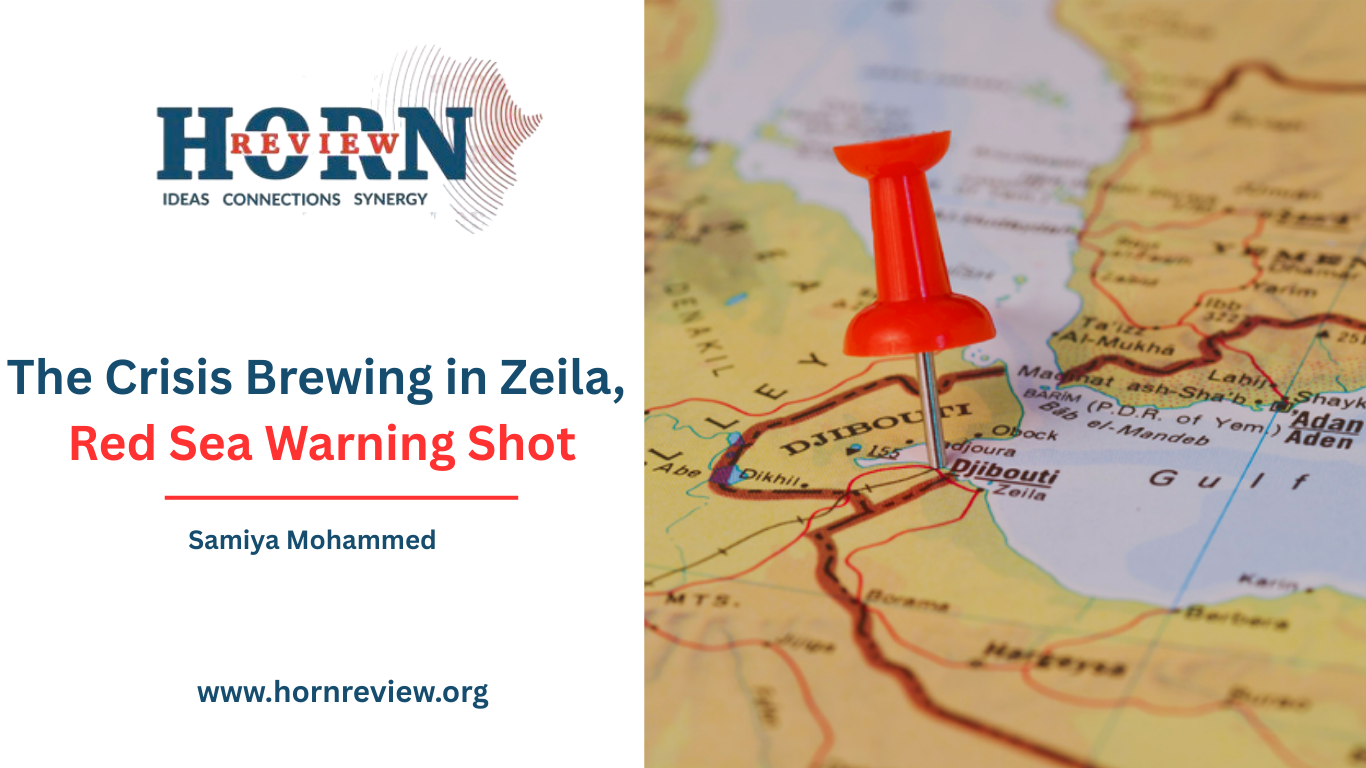
Zeila is a small coastal district at the western mouth of the Gulf of Aden. The renewed unrest in Zeila and the Awdal region of Somaliland is not just another clan dispute on the peripheries of the Horn. It is a direct challenge to Ethiopia’s most important geopolitical objective of this decade, securing diversified, stable access to the sea after three decades of economic and political vulnerability. What is occurring today along Somaliland’s western coast is the clearest reminder that Ethiopia’s security and prosperity remain exposed to decisions made by neighbours who do not always share interests.
The timing of this crisis is particularly destabilizing. Ethiopia’s first serious diplomatic advance toward a secure, long term maritime arrangement since 1998, a development still being negotiated occurred in January 2024. This prospective agreement focused on accessing coastal infrastructure and a potential future naval site in the Berbera corridor. The coastal town of Zeila central to this strategic vision, lies less than fifty kilometers from the Bab al-Mandab Strait just hours from the waters Ethiopia seeks to navigate. Any instability in this immediate area therefore directly threatens the credibility and feasibility of the entire strategic framework, and by extension, Ethiopia’s broader maritime aspirations.
The unrest did not emerge in a nihility. Tensions intensified around a cultural ceremony associated with Issa elders, but quickly spiraled against fears real or perceived of shifting territorial claims, identity politics, and grievances between Issa and Gadabuursi communities. What began as a quarrel over a heritage celebration evolved into street clashes in Borama, militia mobilizations on the Djibouti Somaliland frontier, and accusations that outside actors were exploiting the situation for their own advantage. For Ethiopia, the details of clan dynamics matter less than the broader consequence, a strategic corridor is becoming ungovernable at the exact moment the region can least afford it.
Nearly all of Ethiopia’s trade still moves through Djibouti’s ports. For years this dependency was tolerated as an unfortunate but manageable reality, today however the crisis in Zeila is being interpreted as evidence that Djibouti’s leadership can indirectly pressure Ethiopia simply by allowing instability or as some allege by encouraging it in a neighbouring territory. While Djibouti firmly denies meddling, the perception within Ethiopian is that the port monopoly gives its neighbour a kind of leverage no sovereign state should wield over another.
These suspicions have deep historical memory behind them. Djibouti and Somaliland have clashed indirectly before most notably in 1991 when Issa fighters backed by factions within Djibouti attempted to assert control over areas near Zeila. That incursion ultimately failed but it left scars that today’s developments have reopened. Although the context of 2025 is different, the pattern feels painfully familiar to many in the region. Allegations now circulate that certain militias may again be moving with support or tolerance from Djibouti’s political elites, while new claims speak of Turkish and Qatari-supplied equipment appearing in the area. None of these accusations have been independently verified, but the fact that they are widely believed among local communities shows the mistrust shaping events on the ground.
The question of who benefits from this inevitably extends far of the immediate Horn actors. Ethiopia faces opposition from a coalition that includes Egypt, Djibouti, Eritrea, and Sudan, all of whom have reasons to view a strong Ethiopia with secure sea access as a threat to their own interests. These states have tightened cooperation, with Egypt and Djibouti signing a wide ranging agreement and Cairo deepening its security partnership with Mogadishu. This raises a unsettling question for Ethiopia ,to what extent is Cairo, historically wary of Ethiopian resurgence and currently fixated on the Blue Nile, also playing a part in this coastal destabilization. Could the ignition of a clan conflict in Zeila serve as a low-cost, deniable means to pressure Ethiopia on multiple fronts, from the GERD to the coast? The simultaneous pressure on the Nile and the Red Sea would represent a classic strategic pincer.
In geopolitics, perceptions alone can produce real consequences, and Ethiopia must plan for a world where misperceptions are weaponized as effectively as truth. What makes this crisis particularly dangerous is the way it intersects with its domestic economy. Any uncertainty around Somaliland’s western coast risks price shocks that will ripple through every market. For Ethiopians, the Zeila question is not abstract geopolitics. It is food, fuel, medicine, and the cost of living.
A coherent, confident, and diplomatic strategy is required one that defends Ethiopia’s interests while stabilizing the region rather than inflaming it. Support for de-escalation in Awdal should be stepped up immediately. Ethiopia has long relationships with both Issa and Gadabuursi communities, and its credibility with traditional leaders is often higher than that of regional organizations. Offering facilitation for dialogue without imposing outcomes would not only help defuse the crisis but also demonstrate Ethiopia’s role as a stabilizing force in the Horn.
This also requires a frank conversation with Djibouti. Ethiopia and Djibouti remain partners with decades of intertwined economic fate, but genuine partnership cannot survive on unspoken grievances. They must convey privately but firmly that any action direct or indirect that endangers Somaliland’s stability or Ethiopia’s maritime goals will have consequences in bilateral relations, port usage arrangements, and future infrastructure priorities. Such diplomacy need not be hostile, it simply needs to be clear.
By Samiya Mohammed, Researcher, Horn Review