Osama bin Laden’s years in the Horn,Sudan most particularly Sudan, were less an interlude than an incubation. Invited into Khartoum in 1991 by Hassan al-Turabi’s Islamist network, bin Laden converted personal wealth and the logistics of a construction empire into a parallel state infrastructure: farms, roads and firms that both nourished local elites and masked the movement of men, materiel and money. Those enterprises, from construction companies that won government contracts to stakes in key export chains, bought social legitimacy while providing cover for training, recruitment and smuggling. The Sudan episode ended in 1996 under pressure from Riyadh and Washington, but removing the man did not erase the institutional architecture he seeded: commercial chains, patronage ties and sympathetic cadres inside security services outlived his departure. Durable networks, not charismatic founders, are the real legacy such ideologues plant when they appear to be merely passing through.
The policy lesson is specific: violent movements survive on more than ideology. They depend on embedded economic and bureaucratic enablers. After leaving Sudan, bin Laden did not rebuild from scratch; he drew on networks, assets and financial channels created during the Khartoum years, and those channels contributed to later al-Qaeda operations. The 1990s show how quickly a national economy can be punctured by opaque capital flows that, under the guise of development, normalize an insurgent presence and make political tolerance profitable. Where profit, patronage and permissive politics coincide, insurgency finds purchase.
That historical pattern is dangerously relevant to today. Since April 2023 the Sudanese Armed Forces (SAF) and the Rapid Support Forces (RSF) have contested control of the state and its rents in a war that has shattered institutions and displaced millions. The human catastrophe is vast: humanitarian and UN aggregates now count well over ten million people uprooted, internally and across borders, creating the classic conditions in which militant groups can quickly replenish cadres and exploit grievance. In such an environment, pockets of ungoverned space, collapsed markets and desperate young people are not abstractions but operating capital for recruiters who promise identity, pay and purpose.
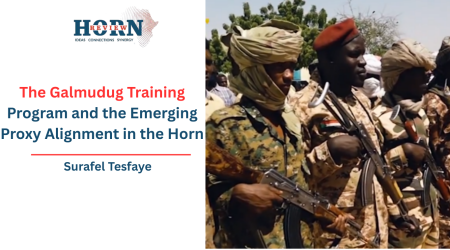
Two dynamics tie past and present in strategically dangerous ways. First, the SAF, the institution that claims to defend the state, now shelters returned or reintegrated Islamists and militias whose loyalties blur between doctrinal affinity and survivalist clientelism. These formations perform both combat and governance tasks, and where they receive semi-official sanction their ideological proclivities can harden into recruitment pipelines and militia-style governance that resembles the permissive space of the 1990s. Second, external patrons have compressed the incentives for violent actors to hold territory rather than bargain it away. Open-source reporting documents deliveries of Iranian drones and related materiel to SAF strongholds, notably Port Sudan, beginning in late 2023. When foreign states supply lethal enablers, they underwrite not just battlefield advantage but the survivability of sophisticated insurgent or proto-state projects, which can in turn create hardened safe havens along strategic littoral corridors.
Geography matters: Sudan’s position on the Red Sea and at the crossroads of north–south Africa can make it a bridge between violent networks in the Sahel, the Horn and the Arabian Peninsula. That is why global jihadist propaganda has begun to orient toward Sudan again. In 2025 the Islamic State’s propaganda organs explicitly urged fighters from neighboring theatres to migrate to Sudan, an unmistakable signal that ideologues are advertising opportunities presented by state fragility and active conflict. Such calls are not proof of operational control, but they are a clear invitation: conflict and fragility create openings that transnational networks will try to exploit.
The risk is not a literal rebirth of 1990s al-Qaeda but a composite outcome: the fusion of old Islamist networks embedded inside state security institutions with newly mobile, externally-sponsored capabilities and active outreach by transnational jihadist centers. One plausible pathway runs like this: SAF-aligned Islamist militias anchored in border garrisons administer services and extract resources; they deepen ties to foreign sponsors and to transnational groups through recruitment, training and small arms transfers; and, over time, a territorially rooted Islamist actor, sharing methods and regional links with known insurgent franchises, emerges as both a local power broker and a node in wider jihadi logistics. That pattern is a synthesis of patronage, capitalized violence and propaganda, the structural DNA of jihadist revival. Evidence that Islamist militias have fought alongside SAF units, and the sanctions imposed on commanders and entities financing the conflict, underscore that this danger is not merely theoretical.
Ethiopia should treat this as a direct warning. Borderlands controlled or contested by SAF units, particularly in the east and along Ethiopia’s long western frontier with Amhara and Benishangul-Gumuz, are frontline vectors of contagion. Refugee flows and the movement of fighters follow roads, river valleys and market ties, not diplomatic lines. Ethiopia already hosts tens of thousands of Sudanese arrivals; significant internal population movements strain local services and create recruitment pools vulnerable to militia and extremist enticement. If an Islamist-aligned force coalesces in SAF border garrisons, the immediate effects would be cross-border pressure: sleeper networks, arms transfers and ideological messaging directed at susceptible Ethiopian communities. Addis Ababa should therefore treat stabilization on the Sudanese side of the border as a national-security priority as well as a humanitarian one, and prepare contingency plans that combine intelligence sharing, community resilience programs and targeted border security measures that avoid collective punishment.
Domestic politics inside Sudan amplifies the danger. General Abdel Fattah al-Burhan’s public rejection of externally mediated roadmaps, most notably his denunciation of the Quad ceasefire proposal, delivered by a U.S. envoy as, in his words, “the worst one presented”, reveals a posture that privileges regime control and military prerogative over neutral mediation. That denunciation was explicitly directed at the U.S.-led plan delivered by a U.S. envoy, and Burhan’s critique made the United States the most salient target of the Quad’s domestic rebuke. That dynamic matters strategically: had U.S. involvement in the Quad not been decisive, Burhan, who enjoys support from Saudi Arabia and Egypt, might have been positioned as a central interlocutor within the Quad framework. Instead, the U.S. role became a focal obstacle that Burhan exploited rhetorically to consolidate internal support and to argue that foreign mediation undermined sovereignty.
Those political stances have deeper roots in the region’s ideological fault lines. The Muslim Brotherhood and allied Islamist networks have long perceived U.S. policy through a lens of suspicion, viewing Washington’s interventions as incompatible with their political projects and as favoring rival elites. That animosity is both cause and effect: it shapes how Islamist actors interpret foreign mediation, and it hardens domestic elites’ willingness to reject U.S.-led proposals. In Sudan’s case, Burhan’s public posture both signals to internal allies that international constraints can be resisted and narrows diplomatic space for disarmament and civilian-led transition. The result is a political environment where demobilization is less likely and militia patronage becomes more attractive.
Preventing a systemic relapse requires measures that are both structural and tactical. Targeted actions, such as sanctions, the designation of specific militias and interdiction of illicit financial flows, are necessary to shrink the logistical and financial space that enables extremist entrenchment. But the longer game is institutional: partners must support credible civilian governance alternatives and conditional reintegration programs that remove incentives for militias to anchor themselves inside the formal military. Practically, that means calibrated leverage: humanitarian access tied to demobilization benchmarks, reconstruction finance subject to transparent civilian oversight, and a cooperative regional security framework that treats Sudan’s neighbors as stakeholders in a stable transition.
There is also a truth about narratives: groups like al-Qaeda and ISIS recruit not only with theology but with a transactional promise of dignity, revenge and belonging. Recruits are drawn by stories and kept by pay, patronage and the promise of state-like order. Breaking that chain requires positive alternatives: livelihoods, legal redress for grievances, and accountability for wartime atrocities. For Ethiopia and other neighbors, policy should follow a two-track logic: fortify border defenses and intelligence cooperation while investing in host communities and cross-border social cohesion to reduce the supply of recruits.
History offers a final, sobering lesson. The 1990s showed that when a fragile state hosts a charismatic organizer who welds economics to ideology, the resulting network can endure beyond the man. Today’s danger is different in shape but similar in logic: networks, not personalities, are the vectors. The combination of SAF-embedded Islamist formations, foreign patronage and material support, mass displacement and jihadi outreach campaigns creates a permissive ecology that, if left unchecked, could produce actors as regionally destabilizing as Somalia’s insurgent franchises were in their time. The remedy must be political, regional and diplomatic: deny space to enablers, dismantle the financial scaffolding of militias, and replace wartime patronage with inclusive, accountable institutions. The window for that work is closing; failure would not simply resurrect a bygone threat but generate a new, regionally integrated hazard whose costs would be borne most acutely by neighbors such as Ethiopia.
By Bezawit Eshetu and Surafel Tesfaye, Researcher, Horn Review