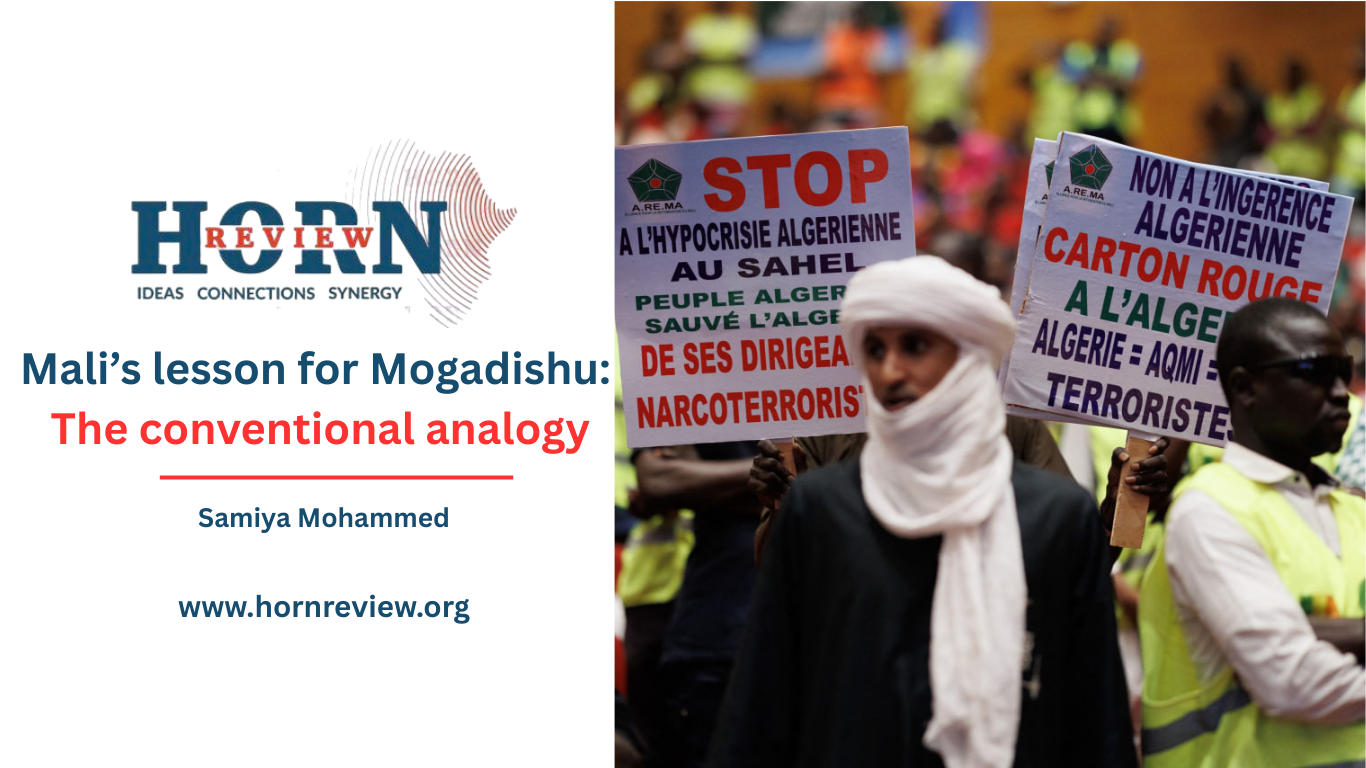
The re-election of Hassan Sheikh Mohamud in 2022 was heralded as a potential inflection point in Somalia’s long war promising a decisive turn against the Al-Shabaab insurgency. Initial tactical successes by enhanced urban security and territorial gains, fostered a portrayal that Somalia was diligently replicating Algeria’s late-1990s counterinsurgency template which is a model predicated on forceful military pressure, surveillance, and economic co-option. However, the path of conflict has complicated this prognosis. By late 2025, the resurgence of Al-Shabaab’s operational tempo, blatant by insolent rural offensives and persistent urban penetrations suggests that the path to an Algerian outcome is fraught and elusive than initially conceived. Indeed, a closer examination reveals Somalia’s predicament as one suspended between a borrowed pattern of success and the grim realities of a Malian style protracted stalemate.
Algeria’s experience was itself an obscure resolution rather than a definitive eradication. The state’s victory emerged from a singular confluence of factors like a historically centralized and military apparatus sustained by substantial hydrocarbon revenues and a political strategy that judiciously blended coercion with amnesty. This combination effectively decapitated the insurgency’s urban networks and incentivized mass defections, domesticating and containing the threat. However, this containment proved imperfect. The residual embers of jihadism, in the form of the Salafist Group for Preaching and Combat just metamorphosed and migrated, pledging allegiance to al-Qaeda and ultimately exporting instability into the Sahelian belt. Thus, the Algerian model was less a conclusive endpoint than a process of violent sublimation transforming a national civil conflict into a regionalized insurgency.
Somalia’s attempt to emulate this approach encounters structural impediments. The Algerian state’s monolithic strength in contrast to Somalia’s political ecology, where federal ambitions are persistently tempered by clan based patronage systems and inter regional discord. The very constitutional policy designed to foster unity through power sharing inadvertently dilutes the concentration of effort necessary for a unified counterinsurgency campaign. While Mogadishu’s security plan engineered by the National Intelligence and Security Agency, has achieved successes in reclaiming the capital’s physical space, this security has proven permeable. Al-Shabaab’s demonstrated capacity for adaptation shifting from massed attacks to targeted assassinations, prison breaks, and financial extortion undermines the notion of irreversible gains and highlights the insurgents social wiring.
The insurgency’s resilience is further evidenced by its rural recalibration. Contrary to narratives of a group confined to marginal lands, Al-Shabaab has executed a repositioning, exploiting the predictable rhythms of dry-season offensives. The group’s governance by default in these areas providing rudimentary services and arbitration continues to offer a functional if brutal alternative to the state’s intermittent presence. This mirrors the efficacy of Mali’s JNIM, which has mastered the art of embedding local grievances within a global jihadist narrative thereby ensuring its persistence despite international military attention.
It is in the Malian comparison that Somalia’s most parallels emerge. Mali instantiate the bankruptcy of a purely militarized approach in a context of brittle statehood. Reliant first on French intervention and later on Russian support, the Malian state failed to cultivate endogenous political legitimacy or military capacity. The insurgents conversely deepened their roots offering a form of order against chaos and capitalizing on ethnic tensions. The result is not victory or defeat but a costly open ended impasse that periodically lean on the capital itself in which a scenario uncomfortably familiar to observers of Al-Shabaab’s 2025 pressures on Mogadishu’s corridors.
The Somali government’s current disavowal of negotiations, framed as a position of strength mirroring Algeria’s final stance, may therefore be a misapprehension. It overlooks the fact that Algeria’s coercive success was underwritten by a concurrent political offer, the Civil Concord which provided a credible off-ramp for combatants. In Somalia, the invitation for militants to reintegrate through clan channels, while constitutionally logical lacks the same coherent state-backed guarantee and is undermined by the very clan fissures it seeks to navigate. This creates a dangerous act where mid-tier commanders, for whom outright military defeat remains unlikely and political reintegration appears uncertain, see little incentive to abandon the insurgency.
Moreover, the international dimensions of the conflict introduce volatile dependencies. The counterterrorism partnership, particularly the program of drone strikes, functions as a potent tactical tool but a insufficient one. It can disrupt leadership and complicate insurgent movements, yet it cannot address the foundational grievances of governance, justice, and economic disparity that Al-Shabaab manipulates. Somalia’s route appears to be converging toward a hybrid scenario a ‘half-Algerian’ outcome married to ‘quarter-Malian’ realities. This would manifest as a sustained suppression of the insurgency’s capacity to hold major urban centers definitively, paired with its enduring entrenchment in rural lands and a low-intensity campaign of terror and extortion in cities. This attrition benefits neither the state which exhausts its limited resources nor the populace which remains trapped between two competing systems of authority.
A sustainable resolution, therefore demands a recalibration of strategy that transcends the false dichotomy of ‘victory’ or ‘negotiation.’ It would involve a more conditional, and locally mediated engagement potentially sequenced and clandestine aimed at fracturing the insurgency’s middle ranks by offering tangible pathways out of violence. At the same time a genuine consolidation of state legitimacy must follow, not just precede, military clearances, ensuring that governance, impartial justice, and basic economic opportunity arrive in tandem with security forces.
The Somali conflict in its third decade defies easy analogy. While the Algerian model offers lessons in the integration of coercion and political pragmatism, and Mali stands as a monument to the failure of outsourced militarism, Somalia’s constellation of clan dynamics, federal ambitions, and insurgent adaptability demands its own sui generis solution. The way forward does not reside in strict adherence to an external model rather in the development of a tailored political settlement that recognizes the insurgents deep integration within Somali society, while fundamentally transforming the incentives that render sustained rebellion an attractive option. The alternative is not a decisive conclusion akin to that achieved in Algeria, but rather a protracted slide toward a course of reminiscent of Mali.
By Samiya Mohammed, Researcher, Horn Review