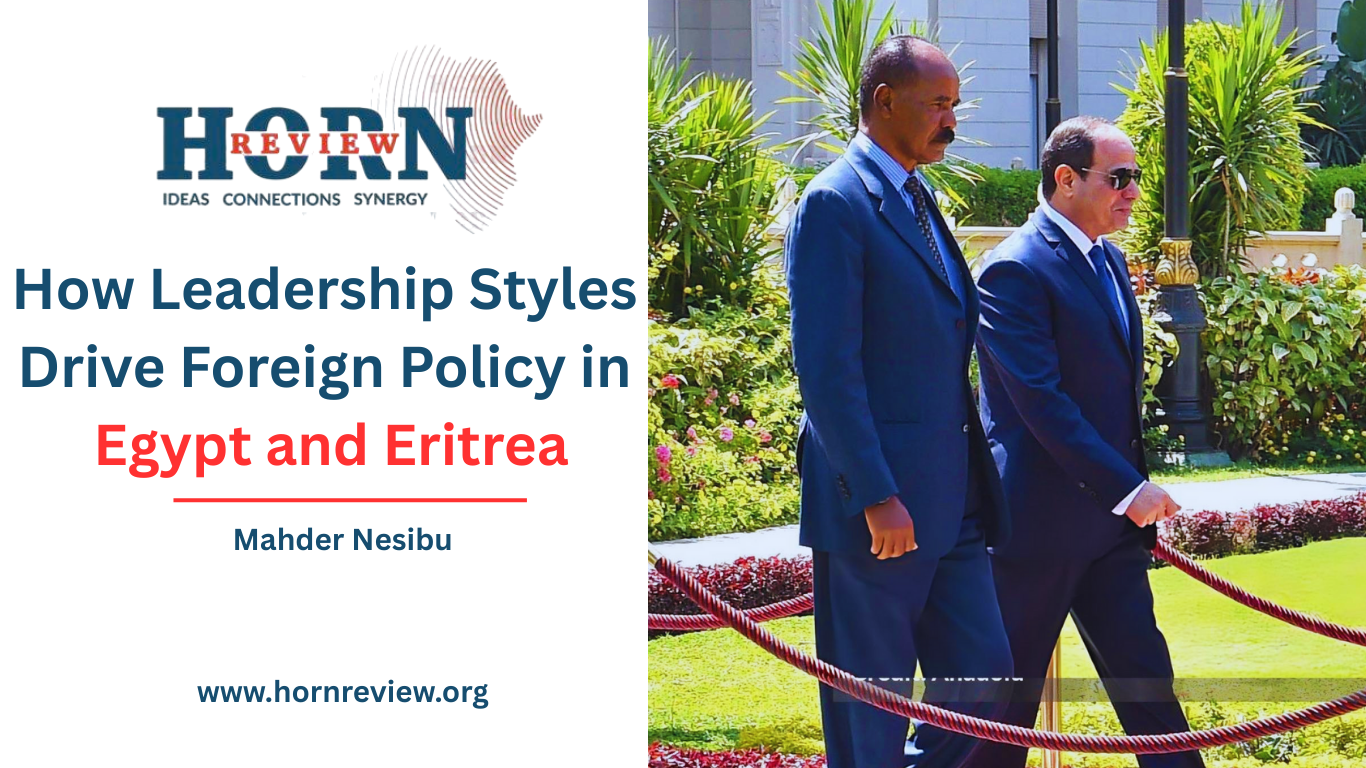
Authoritarianism in contemporary Northeast Africa often appears as a varied landscape of coercive rule, yet particular regimes echo one another in more ways than is immediately apparent. Cairo and Asmara offer a revealing contrast. Egypt possesses an extensive bureaucracy, a military establishment with reach into all spheres of national life and a long tradition of institutional continuity, while Eritrea rests on a brittle architecture produced by a liberation movement that moulded the state and every organ of power into a personalised instrument. The distance between the two systems does not obscure the fact that Abdel Fattah Al-Sisi and Isaias Afewerki rely on comparable political instincts. Their methods differ in sophistication, scope and administrative depth, but the impulse behind their rule converges around a commitment to survival, a suspicion of collective autonomy and a belief that the ruler’s agency must overshadow all other politics. When viewed from this vantage point, their conduct at home becomes inseparable from their behaviour abroad, and Ethiopia becomes the clearest reflection of this alignment.
The conceptual anchor here rests on the agency of autocrats as political actors who shape their environment by orchestrating fear, cultivating greed and rearranging institutions to obstruct constraint. Robert Springborg’s study of Al-Sisi offers a foundation for understanding this pattern. In his reading, the Egyptian president has refashioned the institutions of the state into an extension of personal rule, despite inheriting a system far more structured than anything an Eritrean leader could access. Springborg identifies the ruler’s dependence on fear and greed as engines of control. Fear disciplines the elite and the population by surrounding political life with an atmosphere of uncertainty. Greed is sustained by dispensing selective access to resources. The economy becomes a mechanism not only of enrichment but of obedience. The military’s position inside Egypt’s commercial sectors exemplifies this approach, since its economic ventures generate rents that stabilise loyalty while allowing the presidency to stand above any centre of power that could negotiate autonomy.
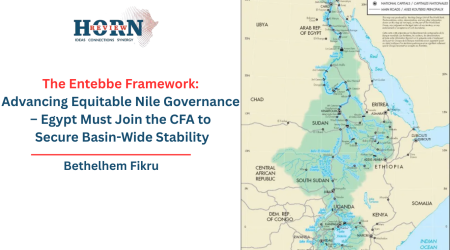
The cultivation of a distorted image is equally central in Springborg’s analysis. The ruler merges his personal authority with the imagined identity of the nation. The fusion of leader and homeland is preserved by propaganda and by the narrowing of public debate to narratives that orbit the presidency. This style of rule produces conspiratorial thinking. The ruler sees threats as ubiquitous and interprets politics as an arena filled with plots against the state. This mindset invites a form of foreign policy animated by suspicion and manoeuvre. For Al-Sisi, this instinct shaped his rise to power, since the coup that removed the Muslim Brotherhood relied on external sponsorship and domestic coalitions that viewed the upheaval of the Arab Spring as a danger. The same instinct colours his conduct in Libya, where his engagement across rival factions serves to maximise the chance that Egypt’s concerns will be accommodated. It is also visible in his approach to the Nile Basin, where Ethiopia is treated not as a negotiating counterpart but as an adversary whose ambitions must be curtailed by pressure, litigation, diplomatic mobilisation and alliance making across the Horn of Africa.
Yet the weight of Egypt’s institutions imposes constraints that neither Hosni Mubarak nor Al-Sisi could completely sidestep. The army is too deeply rooted to be replaced, the bureaucracy too entrenched to be dismissed and the political imagination of Egyptians too expansive for the presidency to erase older traditions of governance. Al-Sisi has reached further than his predecessors in concentrating power, yet he remains embedded within a system that did not emerge from his rule but predates it. This produces boundaries that are felt in his foreign policy. He often hesitates to take actions that expose the regime to domestic fragility, because the state possesses layers of authority that hold historical legitimacy. These layers slow the pace of unilateral decision making and generate a political environment where caution becomes a stabilising principle.
The Eritrean experience unfolds in another register. The liberation struggle crafted a political culture where military discipline, suspicion of external influence and an ethos of perpetual vigilance formed the foundation of statehood. Over time, Isaias Afewerki built a system defined by personal authority without the buffering effect of institutions. Outside the ruling party and the defence forces, the state contains no autonomous structures with a clear mandate. Governance relies on patronage delivered through opaque channels. Senior officers receive privileges that bind them to the presidency and draw them into networks of informal extraction, which include forced labour, resource exploitation and the facilitation of migration routes that generate revenue for military actors. The system rewards loyalty and punishes deviation, not through legal institutions but through direct intervention from the centre.
This arrangement creates an environment where potential rivals fade from the political scene. Those who once shaped Eritrea’s liberation movement have been side-lined or removed, either through purges or gradual marginalisation. The president stands at the centre of a political order that accepts no alternative locus of authority. No institution evolves to restrain him or to form a future leadership. The population is told that Eritrea’s survival depends on remaining vigilant against perceived external hostility. The feeling of siege penetrates social life. The consequence is a population conditioned to expect danger, a military establishment reliant on presidential patronage and a ruling party that has merged entirely with the state. What emerges is a form of governance where foreign policy is less an expression of national strategy and more an extension of the logic that sustains domestic rule.
Foreign policy under authoritarianism becomes an instrument of regime durability. In Egypt, the question of the Nile carries immense symbolic resonance. Al-Sisi uses the anxiety surrounding water security to fortify the notion that only a firm ruler can protect Egypt’s lifeline. Regional developments in the Middle East are navigated with a similar instinct. Alignments with the Gulf, a pragmatic relationship with Israel and calibrated support for Palestinian claims permit the presidency to maintain crucial external sponsorship while presenting the image of a guardian of national interests. The border between domestic politics and foreign affairs collapses, because the same logic of consolidation governs both realms.
In Eritrea, the external environment is interpreted through a lens of continuous threat, with Ethiopia occupying a central place in the national narrative. Even during periods of rapprochement, the political elite treat Ethiopia’s political evolution as a direct challenge to Eritrea’s security. The government inserts itself into the internal affairs of neighbours by exploiting local conflicts, building temporary alliances with armed actors and positioning itself as an indispensable broker of influence. The volatility of the Horn of Africa provides fertile ground for this behaviour. It validates the claim that Eritrea must remain alert and justifies the permanent mobilisation of society. Regional adventurism aligns with the domestic logic of rule, not only because it channels the leadership’s suspicions outward but because it supports the belief that Eritrea’s vulnerabilities are produced by external hostility rather than by the nature of its political system.
When viewed together, the foreign policy trajectories of Cairo and Asmara converge around Ethiopia. Egypt sees the Nile as the axis of its national identity and treats Ethiopia’s infrastructural ambitions as a challenge to its historical standing. The construction and filling of the GERD coincided with the early years of Al-Sisi’s presidency. The leadership in Cairo interpreted the dam as a symbol of shifting regional power. The response was shaped by attempts to mobilise international pressure, secure diplomatic backing and lean on partners around the Red Sea to create a strategic landscape less favourable to Addis Ababa. None of these efforts produced an outcome acceptable to Cairo, yet they reveal the continuity that links domestic authoritarian rule with a foreign policy that prioritises dominance over negotiation.
Eritrea’s confrontation with Ethiopia follows an internal logic anchored in its formative decades. The state defines its mission through a narrative of resistance. Ethiopian politics, whether centralising or federalising, is interpreted as a danger to Eritrea’s autonomy. Asmara seeks openings in Ethiopia’s conflicts, exploits fragmentation when possible and uses influence across borderlands as a buffer for its own insecurities. This behaviour is consistent with a system that sees vulnerability in every direction. Foreign policy becomes a projection of the struggle for survival that governs domestic politics.
Egypt and Eritrea approach Ethiopia from different positions of power and different historical legacies. One commands the resources of a populous state with administrative breadth. The other rules over a country with minimal institutional depth and limited economic capacity. Yet both regimes rely on personalised authority. Both rely on narratives that elevate the leader as the embodiment of national endurance. Both treat Ethiopia as a space where domestic insecurities find external expression. Their strategies differ in complexity and outcome, but their political instincts mirror one another.
Understanding this convergence requires placing agency at the centre of analysis. Authoritarian rulers interpret threats through their own political survival. They construct systems in which institutions serve the ruler rather than the state. In Egypt, the military and bureaucracy remain intact yet are repurposed to serve a presidency that rejects internal checks. In Eritrea, the absence of autonomous institutions produces a more direct form of personal rule. Both systems generate foreign policies that extend the logics of consolidation outward. Ethiopia becomes both a real and imagined arena where these dynamics unfold.
By Mahder Nesibu, Researcher, Horn Review