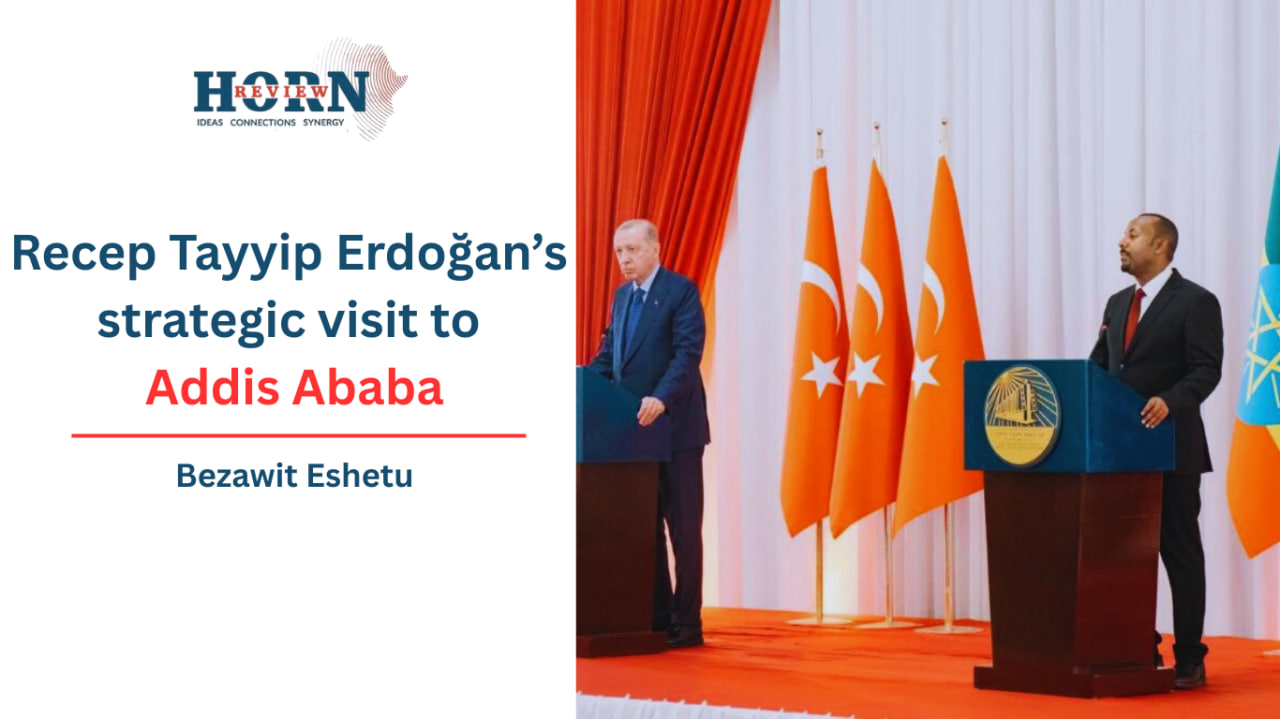
President Recep Tayyip Erdoğan’s one-day visit to Addis Ababa on 17 February 2026, his first in eleven years, marks far more than a ceremonial milestone in century-old bilateral ties. Received with full state honors, Erdoğan signed an energy cooperation memorandum that promises joint projects in production and infrastructure. While official readouts focused on trade, manufacturing, and cultural exchange, the timing, the messaging, and the surrounding diplomatic choreography together reveal a deeper Turkish design: to consolidate a sphere of influence stretching from the Red Sea to the Ethiopian highlands precisely at a moment when external actors are testing the Horn’s fragile equilibria.
The journey caps a deliberately sequenced diplomatic campaign that began in early February. Erdoğan first visited Saudi Arabia and then Egypt, before quietly postponing a planned stop in the UAE on 16 February and replacing it with a telephone conversation with Sheikh Mohammed bin Zayed. These four high-level engagements in roughly six weeks, all touching the Horn corridor, were further reinforced when Saudi Foreign Minister Prince Faisal bin Farhan met Abiy Ahmed just days earlier. The pattern is unmistakable: Ankara is working in concert with Riyadh and Cairo both to limit fallout from Israel’s recognition of Somaliland and to advance its own concrete stakes on the ground. This is coordinated statecraft, not episodic summitry.
Turkey’s regional relationships routinely defy bloc expectations, revealing a flexible pragmatism rooted in tangible interests rather than ideological alignment. For instance, the much-discussed trilateral military pact with Saudi Arabia and Pakistan never materialized and was explicitly limited to a bilateral Saudi-Pakistani framework. Despite ongoing divergences in positions on Somalia and Sudan where Turkey’s stances often align more closely with Saudi Arabia than with Emirati preferences, operational ties between Ankara and Abu Dhabi have historically been warmer than those with Riyadh.
At the same time, relations with Cairo have transformed into a strategic partnership that now includes joint defense-industrial projects, despite Egypt’s ongoing contestation of Ethiopia’s Nile water rights. These shifts are not contradictions but deliberate features of Turkish policy: selective convergence on shared concerns such as Somali territorial integrity and Red Sea security, paired with the autonomy to pursue advantageous partnerships elsewhere when they serve Ankara’s long-term goals.
The broader canvas underscores the visit’s historic weight. When the Justice and Development Party came to power in 2002, Turkey maintained only twelve embassies across the African continent. Today the figure stands at forty-four, an institutional infrastructure for sustained engagement unmatched by most non-African powers. This expansion is not missionary zeal but the deliberate construction of a middle-power sphere of influence, one that leverages economic gravity, military training capacity, and mediation credibility to fill vacuums left by retreating traditional actors.
Turkey’s economic engagement with Ethiopia forms a cornerstone of this strategy, directly bolstering Ankara’s efforts to consolidate influence in the Horn of Africa amid emerging geopolitical challenges. With bilateral trade volumes targeted to reach $1 billion and Turkish investments surpassing $2.5 billion in key sectors such as agriculture, construction, textiles, and infrastructure including railroads built by Turkish firms like Yapi Merkezi, Ankara has emerged as one of Ethiopia’s leading sources of foreign direct investment.
The energy cooperation memorandum signed during Erdoğan’s visit further cements this partnership, focusing on joint projects in renewable energy, energy efficiency, hydroelectric equipment production, and electric turbines, thereby enhancing Turkey’s leverage in Ethiopia’s development trajectory and countering potential diversions toward alternative regional alliances that could fragment Ankara’s carefully built architecture.
That economic foothold gains strategic depth when viewed alongside Turkey’s parallel investments in Somalia. Together, these complementary presences secure control over the maritime and terrestrial arteries linking the Red Sea to East Africa. The Bab el-Mandeb Strait, which carries roughly 12 percent of global trade (some $5 trillion in annual cargo), makes reliable access to this chokepoint existential for any aspiring middle power. To protect and expand that access, Camp TURKSOM, Ankara’s largest overseas military installation, continues to train and equip Somalia’s elite Gorgor commando brigades for combat against al-Shabaab.
However, this carefully constructed influence faces a direct challenge from Israel’s recent recognition of Somaliland, the first by any UN member state which has paved the way for a potential Israeli military and security presence in Berbera, Somaliland’s strategically vital port and airfield on the Gulf of Aden. Berbera’s location, mere kilometers from the Bab el-Mandeb entrance, positions it as a linchpin for monitoring and projecting power across the Red Sea, enabling rapid aerial and naval operations that could counter threats like the Houthis in Yemen while serving as an alternative trade gateway for landlocked Ethiopia, bypassing Turkish-aligned routes in Somalia.
For Turkey, already locked in a protracted rivalry with Israel, exacerbated by Ankara’s vocal support for Hamas, severance of trade ties over Gaza operations, and dismantling of alleged Israeli spy networks in early 2026, this encroachment is profoundly unsettling, as it risks encircling Turkish assets in the Horn of Africa and diluting Ankara’s role as a dominant mediator and security provider.
Compounded by Israel’s alliances with UAE firms that have modernized Berbera under long-term concessions, this development threatens to transform the region into a proxy battleground, where Turkey’s neo-Ottoman ambitions in the Red Sea collide with Israel’s imperative to secure southern maritime flanks against Iranian-backed proxies, ultimately heightening Ankara’s anxiety over losing its hard-won geopolitical leverage in a corridor essential for global energy flows and East African stability.
Israel’s December 2025 recognition of Somaliland has heightened anxieties among Turkey, Egypt, and Saudi Arabia by potentially legitimizing Somaliland’s independence, which could alter Red Sea power dynamics, and encourage Ethiopia to pursue formal ties or port deals with Somaliland as an alternative maritime outlet, prompting Erdoğan’s urgent visit to Addis Ababa to exert pressure and dissuade any such recognition that might cascade into broader fragmentation and undermine Ankara’s regional architecture.
Erdoğan’s public remarks in Addis therefore carried unmistakable edge. “Regional problems should once again be resolved by the countries of the region themselves,” he declared, adding that the Horn of Africa “should not be turned into an arena for the struggle of foreign powers” and that Israel’s recognition of Somaliland “benefits neither Somaliland nor the Horn of Africa.”
This rhetoric, however, masks a deeper irony: while Erdoğan advocates for regional self-resolution without external interference, Turkey’s own extensive military and economic interventions in Somalia such as operating Camp TURKSOM and managing key infrastructure and its involvement in Sudan’s conflicts through arms supplies and political alliances, directly contradict this principle, serving Ankara’s strategic interests in securing Red Sea access and countering rivals rather than upholding United Nations norms of non-interference.
Set against Ethiopia’s own unresolved quest for secure Red Sea access, the statement served as an unambiguous warning: Ankara will not stand idle if Addis edges toward formal engagement with Somaliland. In this way, what began as quiet mediation has evolved into open dissuasion aimed at preventing any cascade of recognitions that would legitimize fragmentation.
Thus, in the wake of Israel’s groundbreaking recognition of Somaliland, which has ignited regional tensions by potentially reshaping Red Sea power dynamics and offering Ethiopia an alternative maritime outlet through Berbera, President Erdoğan’s visit to Addis Ababa following Saudi Arabia’s diplomatic overtures, underscores a concerted effort by Ankara and Riyadh to dissuade Ethiopia from pursuing formal ties or recognition that could legitimize Somaliland’s independence and undermine Somalia’s territorial integrity. This alignment forms a counter-bloc against the emerging UAE-Israel-Ethiopia axis, with Turkish economic investments, military presence in Somalia, and rhetorical calls for regional self-resolution concealing Ankara’s interventions to protect its neo-Ottoman ambitions in the Horn of Africa.
To navigate this complex geopolitical landscape, Ethiopia can adopt a posture of strategic multi-alignment, positioning its pursuit of maritime access as a non-negotiable existential priority, essential for long-term economic security and regional leverage rather than a tradable diplomatic concession vulnerable to external pressures. In practical terms, Addis Ababa could selectively capitalize on the economic incentives extended by Turkey and Saudi Arabia, particularly through high-value energy and infrastructure investments that directly support Ethiopia’s domestic industrialization agenda by enhancing power generation, transportation networks, and manufacturing capabilities, all while implementing safeguards to prevent these engagements from evolving into mechanisms that constrain its sovereign decision-making or foreign policy autonomy.
By Bezawit Eshetu, Researcher, Horn Review