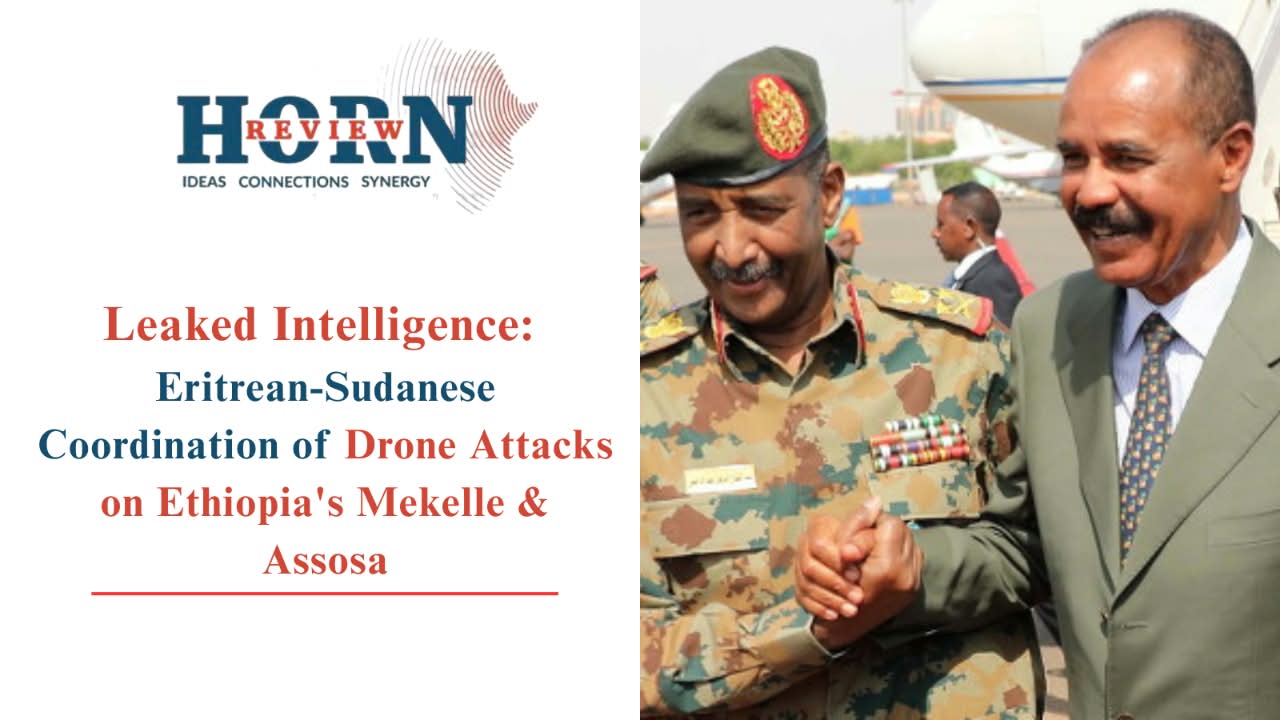
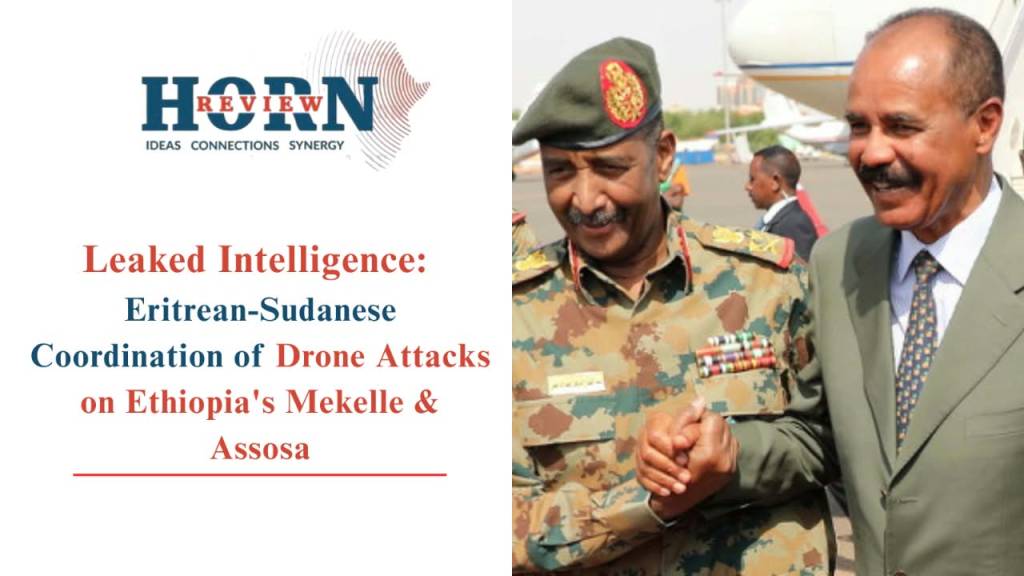
Leaked intelligence pointing to alleged coordination between the Eritrean regime and Sudan’s military leadership under General Abdel Fattah al-Burhan to conduct drone attacks against Ethiopian cities of Mekelle and Asosa raises serious concerns about an increasingly coordinated war campaign against the Ethiopian state. According to the reported intelligence, the two sides have discussed preparations for aerial attacks against the cities, allegedly relying on Ethiopian armed opposition groups sheltered within their respective territories to facilitate ground operations. The reported targeting of civilian populations and civilian infrastructure would mark a particularly dangerous escalation, taking the confrontation beyond the familiar dynamics of proxy warfare and into the direct targeting of Ethiopian population centres.
The allegations cannot be viewed in isolation from the trajectory of the Eritrean regime’s relations with the Ethiopian state over the past four years. The Isaias Afwerki regime has sustained an increasingly aggressive political and diplomatic campaign built around claims that Ethiopia’s pursuit of secure and diversified access to the Red Sea constitutes a threat to Eritrean sovereignty and territorial integrity. Asmara has consistently portrayed Ethiopia’s legitimate maritime aspirations as an existential security challenge. Yet this rhetoric sits uneasily alongside Eritrea’s own record of hostility towards Ethiopia, including its longstanding hosting, support and facilitation of Ethiopian armed opposition movements seeking to undermine the Ethiopian state. This relationship with anti-Ethiopian armed groups predates the current tensions and has been a feature of Eritrea’s regional posture for much of its post-secession history. More recently, incursions by Eritrean forces extending more than 60 kilometres into Ethiopian territory in late September 2026 have added another dimension to an already deteriorating relationship.
The contradiction is difficult to ignore: a government that invokes sovereignty and territorial integrity to portray itself as a victim of Ethiopian ambitions is simultaneously supporting armed movements, invading Ethiopian territory and coordinating airstrikes against Ethiopian cities, seeking to destabilize not only Ethiopia but the wider Horn of Africa and the Red Sea corridor. Hence, Asmara’s sustained sovereignty rhetoric is not merely a response to a perceived threat, but rather part of a broader political narrative intended to legitimize an increasingly confrontational posture against Ethiopia. The latest intelligence allegations suggest that the regime’s preparations further extend beyond rhetorical and diplomatic confrontation to both indirect and potentially direct military action against the Ethiopian state.
Sudan’s military regime is following an increasingly troubling trajectory of its own. Despite repeated Ethiopian efforts to prevent the deterioration of bilateral relations, facilitate an end to Sudan’s devastating internal conflict and encourage an inclusive civilian-led political transition, SAF under al-Burhan has increasingly adopted hostile rhetoric towards Addis Ababa. Ethiopia has consistently advocated a negotiated settlement to Sudan’s war, maintained humanitarian solidarity with the Sudanese population and continued electricity supplies to its neighbour. It has also refrained from officially taking sides in the conflict between SAF and the Rapid Support Forces (RSF). Rather, Ethiopia’s Prime Minister was the first world leader to visit Port Sudan after SAF was driven out of Khartoum by the RSF, offering solidarity and support for the peace process in Sudan. Yet SAF rejected it, and has continued advancing allegations that Ethiopia is supporting the RSF, constructing an increasingly elaborate narrative around claims that Addis Ababa categorically rejects.
Ethiopia has had legitimate security and strategic considerations that could inform its position on the Sudanese conflict, particularly given the implications of armed movements operating along its western borders and the regional consequences of Sudan’s fragmentation. Nevertheless, Addis Ababa has maintained its declared neutrality rather than formally aligning itself with either belligerent. The persistence of SAF’s accusations, despite Ethiopia’s stated diplomatic efforts and restraint, raises questions about whether the allegations are genuinely intended to address security concerns or are increasingly being used as instruments of political and diplomatic pressure against Ethiopia.
That contradiction became particularly evident when Sudan submitted its letter to the United Nations Security Council on 30 October 2026, invoking Article 51 of the UN Charter and claiming the right to self-defence against Ethiopia. In its communication, circulated as document S/2026/872, Khartoum accused Addis Ababa of facilitating drone attacks against Sudanese territory and supporting the RSF. Ethiopia rejected the allegations in its response of 6 November, document S/2026/892, describing them as unfounded and presenting its own account of SAF’s hostile activities, including alleged cross-border military violations, support for Ethiopian armed opposition movements and cooperation with forces seeking to undermine the Ethiopian government. Ethiopia also accused SAF of providing logistical assistance, weapons and equipment to TPLF-linked armed formations operating from Sudan.
The invocation of self-defence is particularly consequential. Article 51 is not a diplomatic instrument to be invoked simply to elevate political accusations into claims of imminent military confrontation; its application rests on specific legal and factual conditions. Sudan’s decision to invoke it against Ethiopia, despite Addis Ababa’s declared neutrality and the absence of any established Ethiopian armed attack against Sudan, stands in sharp contrast to Ethiopia’s account of SAF’s own conduct and its substantiated coordination with hostile actors.
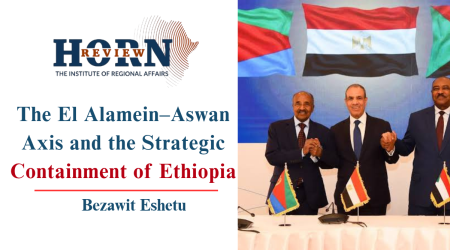
These developments are unfolding alongside the growing political and diplomatic convergence between Egypt, Eritrea and Sudan. The October 4 quadrilateral summit in El Alamein, attended by Egypt’s Abdel Fattah al-Sisi, Eritrea’s Isaias Afwerki, Sudan’s al-Burhan and Somalia’a Hassan Sheikh Mohamud, was followed by the November 21 trilateral meeting of the Egyptian, Eritrean and Sudanese foreign ministers in Aswan. The convergence of strategic interests among these governments warrants close scrutiny, particularly against the backdrop of their increasingly difficult relations with Addis Ababa.
Egypt’s longstanding strategic competition with Ethiopia over the Nile and the Grand Ethiopian Renaissance Dam, Eritrea’s sustained hostility towards the Ethiopian state, and SAF’s increasingly confrontational posture create an alignment of interests with potentially serious consequences for regional stability. The reported Eritrean-Sudanese coordination over possible attacks against Ethiopian cities, coming days after the Aswan meeting, makes the timing particularly concerning. The broader pattern also raises legitimate questions about whether political coordination could increasingly translate into security cooperation and the use of proxy networks to exert pressure on Addis Ababa.
What emerges is a troubling regional picture in which Ethiopia’s internal security challenges are increasingly intersecting with the strategic calculations of neighbouring governments. And the ongoing preparations to target Mekelle and Asosa represent a serious escalation with implications far beyond Ethiopia’s borders. Any attack on Ethiopian territory or civilian infrastructure would constitute an act of war and risk drawing the wider Horn of Africa into a far more dangerous confrontation.
Ethiopia has repeatedly maintained that it seeks peaceful relations with its neighbours and a negotiated resolution to regional disputes. But restraint should not be mistaken for an absence of resolve. A state cannot be expected to indefinitely absorb external pressure, proxy destabilization or threats to its territorial integrity without exercising its inherent right to defend itself. The consequences of turning regional rivalries into direct aggression against Ethiopia could prove far greater than anticipated.
By Horn Review Editorial