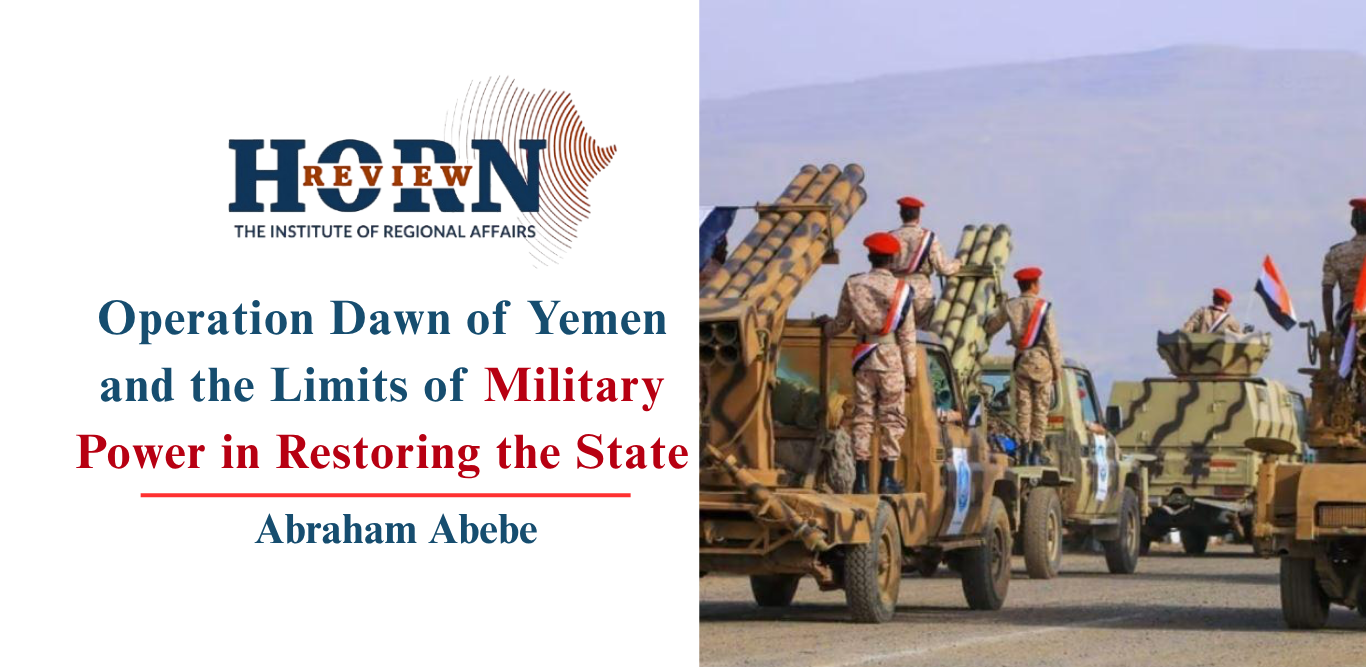
On 5 October 2026, Rashad al-Alimi, Chairman of Yemen’s Presidential Leadership Council, announced the launch of Operation Dawn of Yemen. He presented the campaign as a decisive shift towards restoring state institutions, recovering Houthi-held territory, liberating Sana’a, and returning decisions over war and peace to legitimate authority. The move ended years of relative military restraint. Yet within weeks, the distance between these ambitions and the realities on the ground became increasingly apparent. Government forces demonstrated their willingness to resume large-scale operations. But the results raised fundamental questions about military cohesion, territorial control, and the political capacity required to translate battlefield activity into lasting state authority.
The offensive emerged against a deteriorating security environment. Houthi forces had expanded along the Red Sea coast and increased pressure on government-held areas. Their advances towards Bab al-Mandeb threatened both government positions and international maritime traffic. Supported by Saudi-led coalition air power, government-aligned units, including the Southern Giants Brigades and the Nation’s Shield Forces, initially generated optimism. They announced the capture of large parts of Dhubab district and positions overlooking Bab al-Mandeb, in addition to claimed progress toward Mokha. These developments suggested a recovery of initiative. Yet control around Mokha remained uncertain, and renewed clashes soon revealed that these early gains had failed to secure the broader western front. The distinction between entering a location and establishing durable control quickly became central to assessing the operation’s effectiveness.
Fighting in the following weeks exposed the limits of those early gains. Rather than producing a sustained reversal of Houthi expansion, the offensive unfolded alongside continued Houthi pressure on multiple fronts. Taiz became particularly vulnerable as the group sought to consolidate positions around the city and restrict government movement and supply routes. The capture of al-Turbah in early October intensified pressure on the routes connecting Taiz with government-controlled territory. Temporary Houthi advances around al-Misrakh, followed by government efforts to recapture lost positions, further exposed the vulnerability of government forces. This produced a fragmented military landscape: government forces launched offensives and claimed progress in certain areas, even as the Houthis steadily expanded their influence on other fronts.
The clearest sign of this imbalance emerged in early November. On 2 November, Houthi forces had advanced to within approximately 80 kilometres of Aden, the temporary capital. The group had captured Al-Maqatirah district after several days of fighting, threatening the critical road between Taiz and Aden. This escalation intensified pressure on the government’s temporary capital and principal political stronghold at a critical moment, when its forces should have been asserting greater territorial control. Although this does not mean Aden is about to fall, it demonstrates that the defensive conditions necessary to prevent further Houthi advances have not been secured. An offensive intended to reverse territorial losses has therefore coincided with growing insecurity around one of the government’s most important positions.
This contradiction reveals a deeper structural weakness. One of the central difficulties is not only Houthi military strength but also the fragmented character of the forces opposing them. Yemen’s anti-Houthi camp comprises formations with different political affiliations, regional interests, command arrangements, and relationships with external patrons. Despite their common opposition to Houthi rule, anti-Houthi forces have failed to establish a unified national military structure. The Supreme Military Committee, established in January 2026 under the leadership of the Saudi-led Coalition to Support Legitimacy, represents a formal attempt to address this problem. Nevertheless, having a coordinating body does not necessarily establish effective command over forces with separate political interests and operational priorities. Coordination on selected fronts is not equivalent to a national chain of command, capable of directing sustained operations, administering recovered territory, and enforcing state authority.
For al-Alimi, this distinction is decisive because the campaign’s stated objectives extend beyond defeating Houthi units. Restoring state institutions requires a political and security order in which armed formations operate under accountable national authority rather than maintaining independent centres of power. Even if more districts are retaken, those gains will carry little strategic weight unless the government can bring local military actors under a unified command structure. Without addressing this contradiction, the operation risks producing territorial changes while leaving intact the institutional fragmentation that has long prevented effective governance in government-held areas.
Saudi Arabia’s role adds another dimension; Riyadh’s military and logistical support, particularly air operations against Houthi positions, has been a major factor in sustaining the offensive. Its intervention has helped government forces challenge Houthi positions and recover areas along the western coast. Saudi Arabia also has direct security interests in preventing further Houthi advances, protecting its territory and energy infrastructure, and limiting threats to maritime commerce. Nevertheless, ongoing Houthi attacks and their advance towards Aden indicate that military pressure has not produced a decisive reversal. External assistance can weaken Houthi capabilities and improve the government’s operational position, but it cannot independently resolve Yemen’s internal political divisions or establish a unified national command. The sustainability of military gains will ultimately depend on the government’s ability to translate external military support into stronger domestic security institutions and effective territorial control.
Humanitarian consequences further complicate the strategic assessment. Taiz illustrates the direct relationship between territorial confrontation and civilian hardship. Fighting, movement restrictions, and disrupted supply routes have intensified shortages of food, fuel, and medicine among an already vulnerable population. The encirclement of Taiz had displaced more than 100,000 people, while shortages of essential supplies continued to worsen. On 9 October, UN Special Envoy Hans Grundberg warned that Yemen had returned to full-scale war, emphasising that military developments could not replace negotiations for a sustainable settlement. A campaign presented as restoring state authority risks undermining its own legitimacy if it cannot protect civilians and maintain access to essential services.
The feasibility of liberating Sana’a remains an open and sobering question. The capital is the administrative, political, and military centre of Houthi authority. Its recovery would require secure supply networks, sustained ground operations, coordinated command arrangements, and the capacity to administer recovered areas, conditions the government has not yet demonstrated it can sustain simultaneously. The Houthis have held Sana’a and large parts of northern Yemen since 2014, surviving years of military pressure and external intervention. Their continued ability to organise attacks, mobilise forces, and exploit weaknesses across multiple fronts indicates substantial remaining military and political resources. Announcing Sana’a as the ultimate objective without demonstrating these prerequisites risks creating expectations that the current military balance does not yet substantiate.
Yemen’s conflict cannot be resolved simply by replacing Houthi territorial control with the authority of competing anti-Houthi factions. The internationally recognised government must establish a credible political framework capable of accommodating the country’s diverse communities and regional constituencies. Its ability to consolidate authority in the south, maintain cooperation among military partners, and restore confidence in public institutions will shape the prospects of any wider national campaign. The Houthis have consistently exploited their rivals’ fragmentation and have continued to benefit from divisions within the opposing coalition. Success therefore requires more than military cooperation against a common adversary. It requires political and institutional arrangements capable of sustaining national authority beyond the immediate confrontation.
Operation Dawn of Yemen has reshaped both the tempo and nature of the conflict. Government forces have demonstrated that they can conduct large-scale operations, receive external support, and challenge Houthi positions. However, continued fighting around Taiz, the threat to Aden, fragmented military command, and the worsening humanitarian situation expose the gap between battlefield activity and strategic progress. The government has shown it can launch an offensive, but it has not yet established that it can reverse Houthi territorial expansion or consolidate the areas it seeks to recover.
Al-Alimi’s central challenge is therefore not simply to sustain the offensive but to ensure that military operations produce a state capable of governing what its forces recover. Without unified command, effective civilian administration, and a credible political framework, even significant territorial advances could leave Yemen with a different distribution of armed power rather than a restored national government. Operation Dawn of Yemen may create opportunities to shift the military balance, but those opportunities will matter only if they lead to lasting political and institutional change. For now, the campaign represents an attempt to reverse Houthi dominance, not yet a demonstrated pathway towards restoring the Yemeni state.
By Abraham Abebe, Researcher, Horn Review