Ethiopia’s initiative at Sodere brought Somalia’s rival factions into a common political process at a time when the country lacked a central authority capable of negotiating on its behalf. Convened in late 1996 under IGAD’s newly established conflict-resolution mandate, the talks culminated on 3 January 1997 in the creation of a 41-member National Salvation Council, with representation allocated to the four major clan families and smaller communities. Although Sodere did not produce a lasting government, it established a broad-based framework for political representation that subsequent reconciliation efforts would revisit
The collapse of the Somali state in January 1991 left political authority dispersed among armed factions, while successive international efforts failed to establish a national government capable of consolidating control. The Addis Ababa Agreement of 1993 brought leading factions into a common framework, but agreement on paper did not resolve the struggle for power in Mogadishu; by the time the last United Nations troops withdrew in March 1995, the underlying competition remained intact. Rivalry between Ali Mahdi Mohamed and the Aideed camp, which passed to Hussein Aideed following General Mohamed Farah Aideed’s death in August 1996, continued to obstruct the emergence of a national political authority.
The consequences extended beyond the capital. In the border region of Gedo, Al-Itihaad al-Islamiya (AIAI) established a presence centered on Luuq, roughly ninety kilometers from Ethiopia, which Addis Ababa regarded as a base for a movement responsible for attacks inside Ethiopia and linked to other armed groups opposed to its government. Somalia’s fragmentation thus presented Ethiopia with a problem that international mediation alone had not resolved, the absence of a functioning state was not merely prolonging conflict within Somalia but also leaving neighboring territory exposed to armed networks that could operate across the border. This gave Ethiopia a direct security interest in the restoration of Somali political authority.
The expansion of regional institutions in 1996 provided an important foundation for a more coordinated response to Somalia’s political fragmentation, creating a framework through which Ethiopia could address its security concerns while contributing to a regional effort to restore Somali political dialogue. Founded in 1986 as the Intergovernmental Authority on Drought and Development, with a mandate centred on drought and desertification, the organization was reconstituted as the Intergovernmental Authority on Development (IGAD) following the amendment of its founding instrument in Nairobi on 21 March 1996 and its relaunch at the Djibouti summit of 25–26 November.
The revised charter incorporated the prevention, management and resolution of inter-state and intra-state conflicts through dialogue, placing peace and security alongside food security and economic cooperation among the organization’s priorities. This change reflected a broader recognition that the conflicts confronting the Horn of Africa required regional mechanisms capable of addressing their political and security dimensions. For Ethiopia, whose border security was directly affected by the absence of effective authority in Somalia, IGAD’s expanded mandate offered a legitimate avenue for supporting reconciliation through regional diplomacy. The framework connected Ethiopia’s immediate security concerns with the wider regional interest in reducing conflict and restoring political order in Somalia, giving its diplomatic engagement an institutional foundation and a shared regional purpose.
Although divisions among IGAD members, including the severance of relations with Sudan by Ethiopia, Eritrea and Uganda during the preceding year, complicated regional cooperation, the organization’s expanded mandate established an important basis for renewed engagement. OAU strengthened this framework in July 1996, when its Yaoundé resolution recognized Meles Zenawi, then outgoing OAU chairman, as holding a special mandate to facilitate peace in Somalia and supported efforts by IGAD member states to reactivate their initiatives. This endorsement connected the emerging regional effort to the OAU’s broader diplomatic role and reinforced the legitimacy of renewed attempts to bring Somali factions into negotiations. Ethiopia subsequently informed the United Nations Security Council that it had convened the Sodere conference in November 1996 in accordance with an IGAD mandate.
Operating within this reinforced regional framework, Ethiopian conduct in the second half of 1996 ran along two tracks that differed in instrument yet converged through local partnerships. On the military track, Ethiopia acted against Al-Itihaad al-Islamiya (AIAI), an Islamist group that had established a presence in the Gedo region centered on Luuq, roughly ninety kilometres from the Ethiopian border. Addis Ababa regarded AIAI as a direct security threat, holding it responsible for attacks inside Ethiopia and linking it to other armed networks opposed to the Ethiopian government. Ethiopian forces therefore crossed into Gedo on 9 August 1996 to attack AIAI bases, and fighting continued through December. The fourth major assault on the group, launched on 11 June 1997, captured Luuq and Buulo Haawo and deprived AIAI of its last major bases in the region. This military campaign ran in parallel with a political initiative that sought to harness Somali opposition to AIAI and embed Ethiopia’s border-security objectives within a broader reconciliation process.
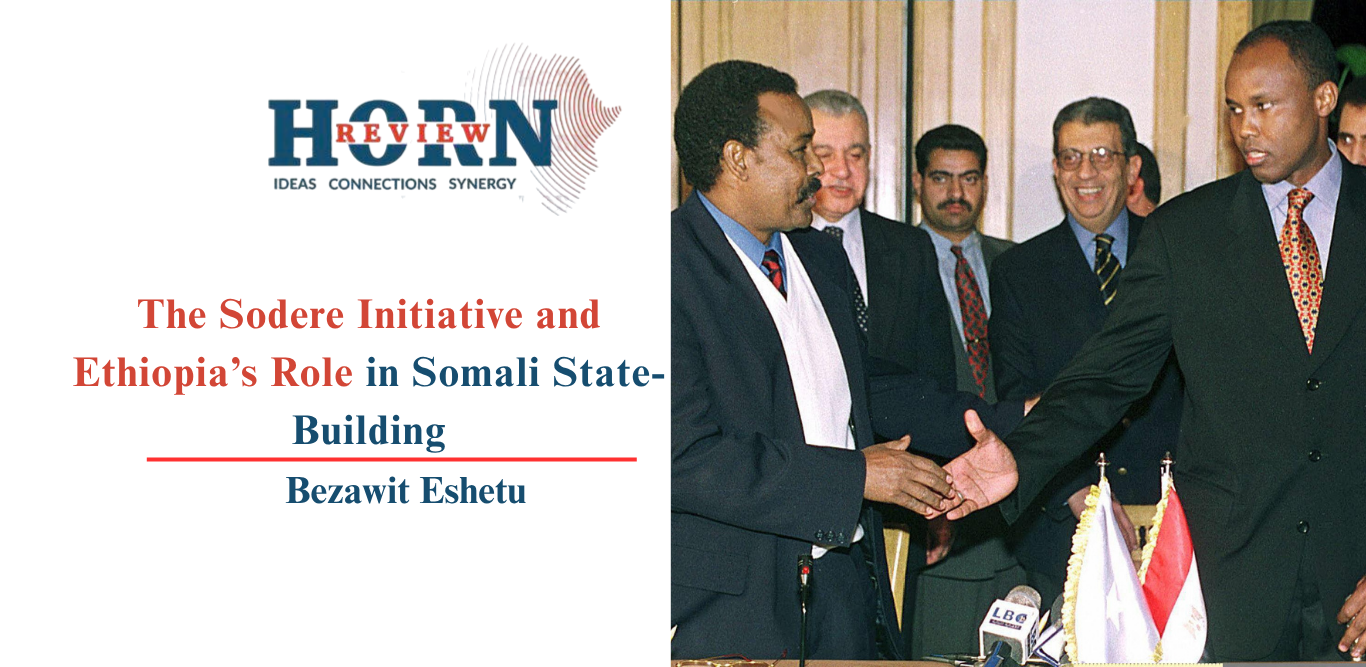
On the political track, Ethiopia convened Somali leaders at the Sodere resort for roughly six weeks of talks, which ended on 3 January 1997 with a declaration signed by 27 leaders representing 26 factions. The declaration created a National Salvation Council of 41 members and a National Executive Committee of 11 members led by five co-chairmen, with authority to speak for the Council and to prepare a Transitional Central Authority or Provisional Central Government, and it committed the signatories to a National Reconciliation Conference at Bossaso. The Somali National Front, a competitor of AIAI for control of Gedo, was among the signatories. That overlap offered Somali opponents of AIAI an institutional route to national standing and tied a border security objective to a political process that Somali actors could own.
The composition of the Council contains the process’s most durable contribution. Nine seats went to each of the four major clan families, Darod, Hawiye, Rahanweyn and Dir, and five to smaller groups, a distribution that totals 41 and approximates the half-share later formalized for minorities under the 4.5 formula. For the first time the Darod accepted parity among the main clan families. That principle of clan-family parity, first given institutional expression at Sodere, was subsequently formalized at the Arta conference in 2000 and then applied at scale by the Mbagathi process, which in 2004 allocated 61 seats to each of the four major families and 31 to the minority bloc within a 275-member Transitional Federal Parliament. By converting a contest over who speaks for Somalia into a bounded negotiation over who sits within each family’s allotment, parity supplied the mechanism through which Sodere moved Somali politics from open military competition toward transitional institutions.
Sodere’s significance extended beyond the representational framework it helped establish to the regional diplomacy through which that framework was pursued. Ethiopia’s subsequent involvement in Somali reconciliation formed part of a recurring pattern that included hosting the 1993 Addis Ababa conference, convening Sodere in 1996 and 1997, participating in the IGAD-mediated Mbagathi talks that produced the Transitional Federal Charter in 2004, and contributing troops to the African Union missions in Somalia, AMISOM and ATMIS, and now AUSSOM. The Mbagathi record offers particularly clear evidence that Somali actors themselves regarded Ethiopia’s participation as consequential. In February 2004, six faction leaders of the Somali Restoration and Reconstruction Council announced that they would stay out of the final phase of the talks while Ethiopia was absent from the table. Hussein Aideed, who had succeeded his father General Mohamed Farah Aideed in 1996 and had remained outside the Sodere process the following year, now argued that a regional peace process required consensus among neighbouring states as well as among Somalis. His position marked a shift from contesting Ethiopia’s involvement in 1997 to treating the participation of neighboring states as a condition of a credible settlement, illustrating how the regional approach embodied at Sodere became an established feature of subsequent Somali peace negotiations.
This historical experience has direct relevance as Somalia confronts a demanding security transition, with Al-Shabaab continuing to threaten state consolidation, domestic political negotiations remaining unsettled after the inconclusive May 2026 talks, and AUSSOM’s operational future facing growing financial uncertainty following Washington’s announced intention to end its support for UN logistics and operations from 2027. Ethiopia’s renewed commitment to AUSSOM, reaffirmed at the August 2026 troop-contributing countries summit, provides an important basis for strengthening this regional security relationship.
Somalia’s current security transition increases the strategic importance of sustained coordination with Ethiopia. Al-Shabaab retains a presence in areas of Gedo and Bakool near the Ethiopian frontier, while Washington’s decision to end funding for UN logistical support to AUSSOM after December 2026 adds pressure to the mission’s operational continuity. These developments connect Somalia’s internal security challenges directly to the management of its western border, where gaps in territorial control can enable armed groups to move, reorganize and exploit weaknesses in coordination between security forces. Ethiopia’s direct exposure to these threats, its existing security involvement in Somalia and its capacity to operate along the shared frontier make bilateral cooperation consequential to how these risks are managed.
For Mogadishu, the practical priority is to establish predictable arrangements with Addis Ababa for intelligence exchange, border threat assessment, troop coordination and consultation over operations affecting Somali territory. These mechanisms would help align Ethiopian security activities with federal priorities, improve continuity between bilateral cooperation and AUSSOM, and give Somali authorities greater influence over the regional response to threats within their jurisdiction. As Somalia assumes greater responsibility for its own security amid uncertainty over international support, the quality of its coordination with Ethiopia will directly affect its capacity to manage cross-border threats and sustain security across its western regions.
By Bezawit Eshetu, Researcher, Horn Review