Ethiopia’s renewed conflict has changed the security significance of its western frontier. Fighting between the TPLF-led armed coalition and the Ethiopian federal government has resumed in northern Ethiopia while Sudan’s war continues across a border that has long allowed fighters, weapons, and armed networks to move between the two countries. This creates a credible possibility that two separate conflicts could begin operating within the same security space and the concern rests on documented cross-border movements, competing accusations of external support, established military relationships, and the precedent of earlier frontier advances during periods when the ENDF was heavily committed elsewhere.
Egypt’s posture is central to this possibility. Cairo’s focus on Nile water security and its sustained opposition to the Grand Ethiopian Renaissance Dam have placed the dam and Ethiopia’s wider strategic position at the centre of a prolonged contest over influence in the basin. Documented patterns of Egyptian diplomatic and security support for the Sudanese Armed Forces and the consistent framing of Nile questions as matters of national security provide the empirical basis for examining Egypt as the architect of a containment architecture directed against Ethiopia. Within this configuration the Sudanese Armed Forces function as a cultivated instrument. Cairo supplies diplomatic lobbying, international legitimacy, and security assistance at a moment when Sudan’s military leadership requires external backing to sustain its position. In return the SAF has aligned elements of its frontier posture and operational priorities with Egyptian preferences concerning Ethiopia, effectively converting Sudanese military capacity into a conduit for pressure along the shared border. These relationships raise a measurable and increasingly coherent possibility that the conflict could extend beyond the current frontier, with the SAF joining the other proxies cultivated by Egypt, namely Eritrea and the seven-group coalition in Ethiopia.
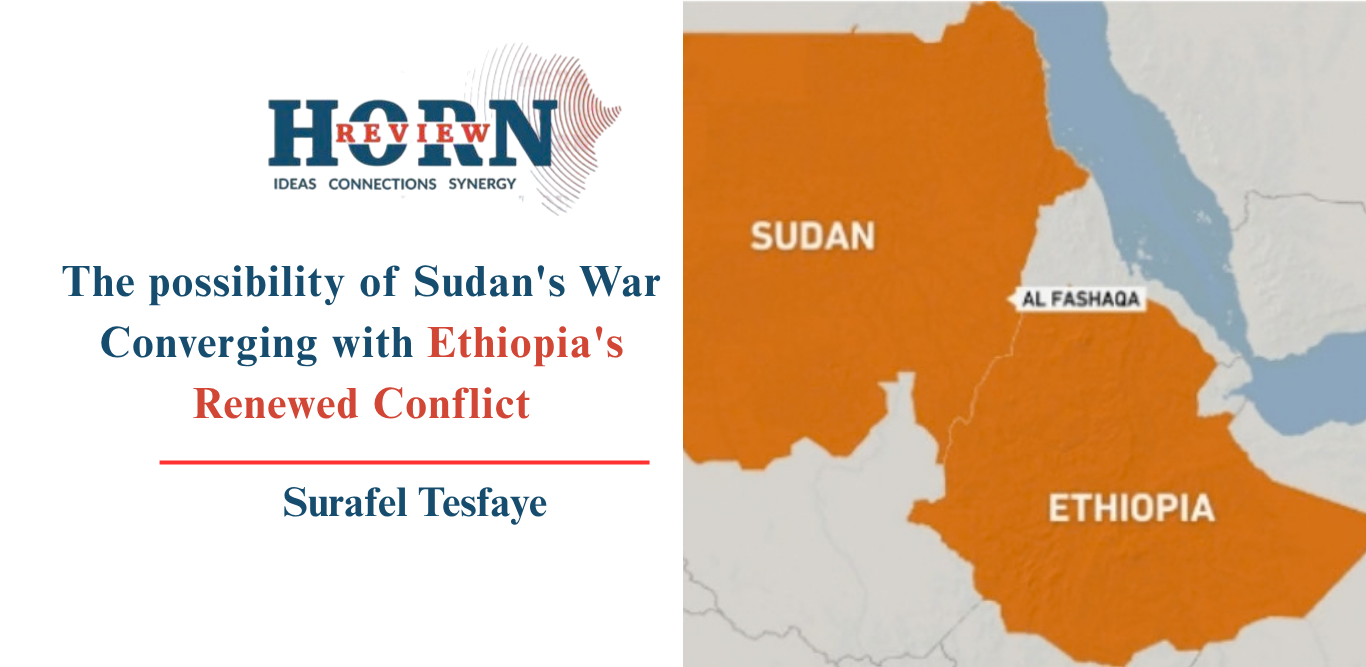
A second concern arises from the SAF’s repeated allegations that Ethiopia is supporting and hosting the Rapid Support Forces, claims advanced without the presentation of concrete public evidence. Ethiopian officials have in turn alleged that Sudanese territory is being used to host and facilitate armed groups operating against the federal government. These competing claims have become embedded in the wider political contest surrounding Sudan’s civil war and have heightened the security sensitivity of the shared border. Their significance derives in part from their timing, particularly when military pressure is intensifying elsewhere in the region, and from the clear historical precedent of the Al-Fashaga advance. During the 2020 to 2022 period, while the Ethiopian National Defense Force was fully engaged containing the Tigray People’s Liberation Front in the north, the Sudanese Armed Forces moved into the disputed agricultural zone, displaced Ethiopian cultivators, and established military control over nearly the entire contested area.
A third concern is the Egypt-SAF relationship operating through Eritrean territory and networks. Asmara has maintained relationships with eastern Sudanese armed groups through arrangements involving training, hosting, and logistical support, while also seeking to secure its own frontier and increase its leverage around developments in Ethiopia. Reports of coordination involving SAF-aligned figures, Eritrean participants, and Ethiopian opposition actors have added to the picture. The deterioration in relations between Addis Ababa and Asmara since the Pretoria Agreement has given these relationships greater significance. TPLF-aligned elements have also been reported in connection with military networks operating from eastern Sudan, creating another avenue through which pressure on the ENDF could develop while federal forces remain engaged in the northern conflict.
That geography brings the risk into sharper focus along the Ethiopia-Sudan frontier, particularly around Kurmuk and Geissan, where fighting has shifted control between armed actors during 2026 and increased the possibility of further movement toward Ethiopia’s Benishangul-Gumuz region. A major SAF or RSF operation in this direction could push armed activity closer to the border, creating direct pressure on Ethiopian territory and increasing the potential for cross-border incidents. Any escalation affecting areas near the Grand Ethiopian Renaissance Dam would raise the stakes further. In this context, shifting territorial control can facilitate armed movement toward the border, cross-border pressure can draw Ethiopian security forces into a wider response, and any resulting instability near the dam could extend the consequences well beyond the immediate frontier.
The Metema-Gedaref corridor presents a different problem because of the movement of armed groups, weapons, and personnel across a border that remains difficult to monitor comprehensively. Cross-border movement has long formed part of the security environment, while the continuation of Sudan’s war has increased the military significance of the corridor. For Ethiopia, activity through this area can create avenues for armed groups to operate toward Amhara and Tigray from Sudanese territory. A route used for trade, migration, and local economic activity can therefore acquire an additional military function during periods of conflict. The security challenge comes from the permeability of the frontier and the difficulty of controlling movement across a long border while fighting continues on both sides.
The Humera-Shererina-Kassala axis presents another point where developments in Sudan could intersect with the renewed conflict in northern Ethiopia. TPLF-aligned forces operating from eastern Sudan have previously moved toward western Tigray, demonstrating how Sudanese territory can provide a staging area for renewed fighting in northern Ethiopia. In August 2026, TPLF-aligned forces crossed from Sudan toward Humera and were pushed back to Shererina, where the fighting escalated to artillery. This continued presence of experienced TPLF-aligned formations on the Sudanese side, together with their previous operational links to SAF units, gives this corridor particular importance as the conflict in northern Ethiopia develops.
Farther north, the Kassala-Beni Amer area brings together another set of relationships involving eastern Sudanese communities, Eritrea, and SAF logistics. Cross-border social and political networks have long operated across this area, while Eritrean engagement with eastern Sudanese armed groups has given the zone an additional military dimension. For Ethiopia, the concern is that these relationships could provide another channel through which armed pressure develops along the western flank.
The significance of these zones is their potential to connect developments that have so far remained within separate conflict systems. The renewed fighting in northern Ethiopia has placed the federal government and the ENDF under renewed military pressure at the same time that Sudan’s war continues to produce armed activity near Ethiopia’s western frontier. The SAF’s relationship with Egypt, Eritrean networks in eastern Sudan, the continued presence of TPLF-aligned formations, and the precedent established in Al-Fashaga each create a separate channel through which the two conflicts could begin to interact. Their convergence depends on decisions by the actors involved, yet the underlying conditions for interaction are already present.
Should these operational theaters fully converge, the Horn of Africa could begin to resemble the regional conflict system that emerged around the Great War of Africa in the Democratic Republic of the Congo, where insurgencies and civil wars became intertwined across state borders and transformed local struggles into a wider confrontation. A coordinated alignment among the Sudanese Armed Forces, Cairo’s Nile containment doctrine, Asmara’s cross-border networks, and anti-federal Ethiopian factions would fundamentally alter the regional security environment by linking military pressure across several fronts.
Ethiopia’s western periphery would consequently face a multi-vector proxy challenge while the Grand Ethiopian Renaissance Dam would assume even greater strategic importance as a potential pressure point. In such a setting, forward buffer zones would serve as an instrument of deterrence as much as defense. By denying armed actors the space to assemble forces, move supplies, establish firing positions, and prepare incursions close to Ethiopian territory, they would raise the cost and reduce the predictability of any attempted cross-border operation. The Al-Fashaga, Metema-Gedaref, and Kurmuk axes therefore matter because control over these approaches would determine how much operational depth an adversary can exploit before Ethiopian forces are brought directly into the confrontation. The larger danger lies in the gradual fusion of separate conflicts into a durable regional war system in which sovereignty becomes increasingly mediated through proxy networks.
By Surafel Tesfaye, Researcher, Horn Review