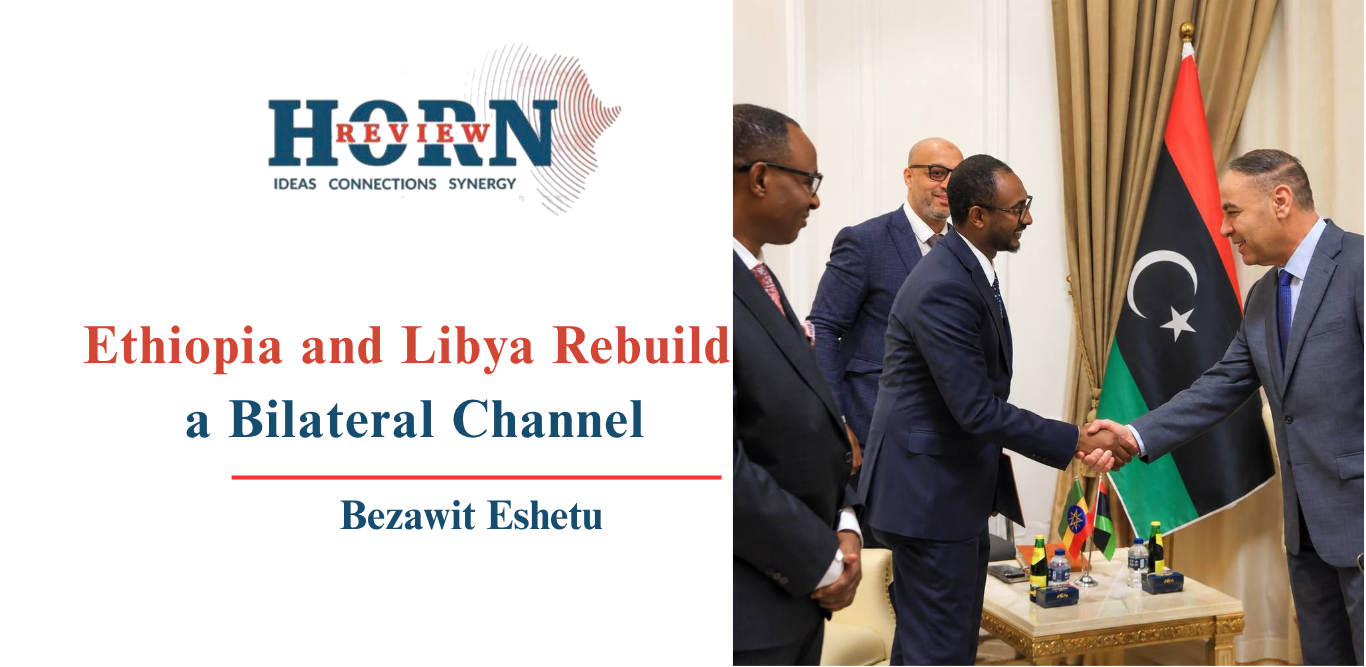
In late September, Ethiopian Ambassador Zerihun Abebe Yigzaw met Libya’s Acting Foreign Minister Taher al-Baour in Tripoli and delivered a message from Foreign Minister Gedion Timothewos. The meeting advanced preparations for the second session of the Joint Ministerial Committee, marking a renewed effort to place bilateral relations on a regular institutional footing. The timing is significant. Ethiopia is expanding its diplomatic reach across North Africa as Libya’s Tripoli-based Government of National Unity seeks to deepen its ties with African states and institutions. Their interests converge around diplomacy, migration, security, and economic cooperation, giving the revived relationship a strategic purpose that extends beyond the immediate exchange of official visits.
The relationship is older and more complicated. During the Gaddafi era, Ethiopia and Libya moved between ideological disagreement and practical accommodation. Reports in the late 1990s described Libyan support for Eritrea during the Ethiopia-Eritrea conflict, while Muammar Gaddafi also cultivated direct links with Asmara and Addis Ababa and presented himself at times as a mediator in the dispute. In 2004, Meles Zenawi declined Gaddafi’s mediation initiative, highlighting the political limits of the relationship. Yet the same year saw the two countries conclude agreements on investment protection, commerce, media, and cultural, youth, and sports cooperation, showing that political disagreements coexisted with practical economic engagement. The relationship subsequently lost its state-to-state momentum as Libya entered prolonged political turmoil after 2011, while many of the practical links between the two countries, particularly those involving migration and consular affairs, continued to generate a need for official coordination.
The renewed Joint Ministerial Committee is significant in this context because it provides the institutional mechanism for rebuilding that coordination. It brings officials from the relevant government ministries and agencies together to review existing agreements, identify areas for additional cooperation, follow up on outstanding issues, and prepare matters for consideration at the ministerial level. The September 2026 preparatory meeting therefore marked more than a diplomatic exchange between senior officials. It began restoring a regular government-to-government process through which Ethiopia and the Tripoli-based Government of National Unity can manage issues across migration, security, investment, transport, and consular affairs. In a country where political authority remains divided, embedding the relationship in multiple ministries gives it a degree of continuity that personal ties between individual leaders cannot provide.
Ethiopia’s decision to conduct this renewed engagement through Tripoli reflects the institutional channels available to it, while Libya’s political division makes the wider regional context more complex. The Tripoli-based Government of National Unity remains internationally recognized, while eastern Libya remains under the influence of the Libyan National Army and associated institutions. External powers have themselves maintained relationships across these divisions, with Türkiye developing contacts in the east alongside its longstanding ties with Tripoli and Egypt maintaining close relations with eastern actors while participating in wider diplomatic efforts on Libya. Ethiopia’s engagement with the GNU should therefore be viewed within the broader pattern of diversified external relations around Libya. Its purpose can be understood as establishing a direct government-to-government channel with Tripoli while retaining space for its wider diplomatic relations to develop independently of Libya’s internal political alignments.
That channel carries practical value for both sides. For Ethiopia, direct engagement with the Tripoli-based Government of National Unity creates a regular governmental link with North Africa and provides access to Libyan institutions dealing with migration, consular affairs, transport, investment, and economic cooperation. For the GNU, the significance of the Ethiopia relationship lies in the additional diplomatic space it creates. Addis Ababa brings an established role in African and multilateral affairs, giving Tripoli a useful channel for building support beyond the states and institutions that have dominated Libya’s external engagement in recent years. Ethiopia’s endorsement of Libya’s campaign for a non-permanent UN Security Council seat for 2028–2029 demonstrates that this relationship can extend into wider diplomatic contests, while the reopening of the African Union Liaison Office in Tripoli points to a broader effort to reconnect the GNU more closely with continental institutions.
Yet the relationship also rests on a more immediate set of practical concerns. Migration provides the clearest material foundation for sustained engagement between Ethiopia and the GNU. Both sides have a direct interest in managing the movement, employment, documentation, protection, and return of Ethiopian nationals in Libya. IOM identified more than 950,000 migrants across Libya in May and June 2026, with migrant activity spread across western, eastern, and southern municipalities. Libyan authorities continue to conduct detention and deportation operations involving Ethiopian nationals. The bilateral committee’s inclusion of migration and expatriate affairs therefore links diplomacy to an operational problem that produces recurring administrative demands. Consular coordination, identity documentation, legal procedures, repatriation arrangements, and cooperation against trafficking and smuggling all require sustained contact between institutions. This helps explain why migration sits near the center of the revived relationship.
Economic cooperation adds a second material layer, although the public record still points to potential more than implementation. When GNU Prime Minister Abdul Hamid Dbeibah visited Addis Ababa in April 2024, the two sides discussed organizing Ethiopian workers, restoring airline activity, rescheduling Libyan loans to Ethiopia, and investment opportunities in agriculture and animal production. The September 2026 meetings expanded discussion to economic cooperation, investment, and air transport and included draft memorandums for possible consideration at the next ministerial session. These developments identify mutual interests without establishing new projects. Agriculture and livestock could connect Ethiopia’s production base with Libyan demand and capital. Air transport could reduce practical distance between the two markets. Reconstruction is also a plausible commercial field given Libya’s damaged infrastructure and economic diversification agenda. Yet announced opportunities remain different from executed projects. The partnership remains exploratory, with outcomes dependent on financing, regulation, security, and implementation.
Security gives the relationship its wider regional dimension. Ethiopia and the GNU occupy different points along an increasingly connected arc running from the Horn through Sudan into North Africa and the Sahel. Sudan is especially important because the war there has altered migration patterns, border pressures, armed-group activity, and regional alignments. IOM reports that Libya’s migrant population increased by 35 percent between April 2023 and mid-2026, with the Sudan conflict contributing to this transformation. Libya’s southern and eastern corridors connect it to Chad, Niger, Sudan, and routes through which people, commodities, weapons, and illicit networks move. Ethiopia faces exposure to Sudan’s instability through border security, displacement, armed networks, and regional competition. These shared cross-border pressures give the bilateral relationship an institutional logic. The two governments have recurring practical reasons to maintain contact across several fields, and the Joint Ministerial Committee provides a structure through which those issues can be handled within a continuing state-to-state relationship.
Thus, the revival of Ethiopia-Libya relations points to a broader change in how bilateral diplomacy can function amid regional uncertainty. Libya’s unresolved political fragmentation, Sudan’s continuing instability, and the growing movement of people, capital, and security pressures across North Africa and the Horn are creating incentives for governments to build institutional channels. The Ethiopia-Libya relationship is developing within this environment, and its significance will depend on whether the structures now being restored become durable enough to carry political and practical cooperation across changing circumstances. That process could give the relationship an institutional logic of its own, with successive rounds of coordination creating expectations, procedures, and points of contact that become increasingly difficult to displace. The Joint Ministerial Committee is therefore important as an indicator of a wider diplomatic pattern in which African states are deepening direct state-to-state mechanisms to navigate a more interconnected and fluid regional system.
By Bezawit Eshetu, Researcher, Horn Review