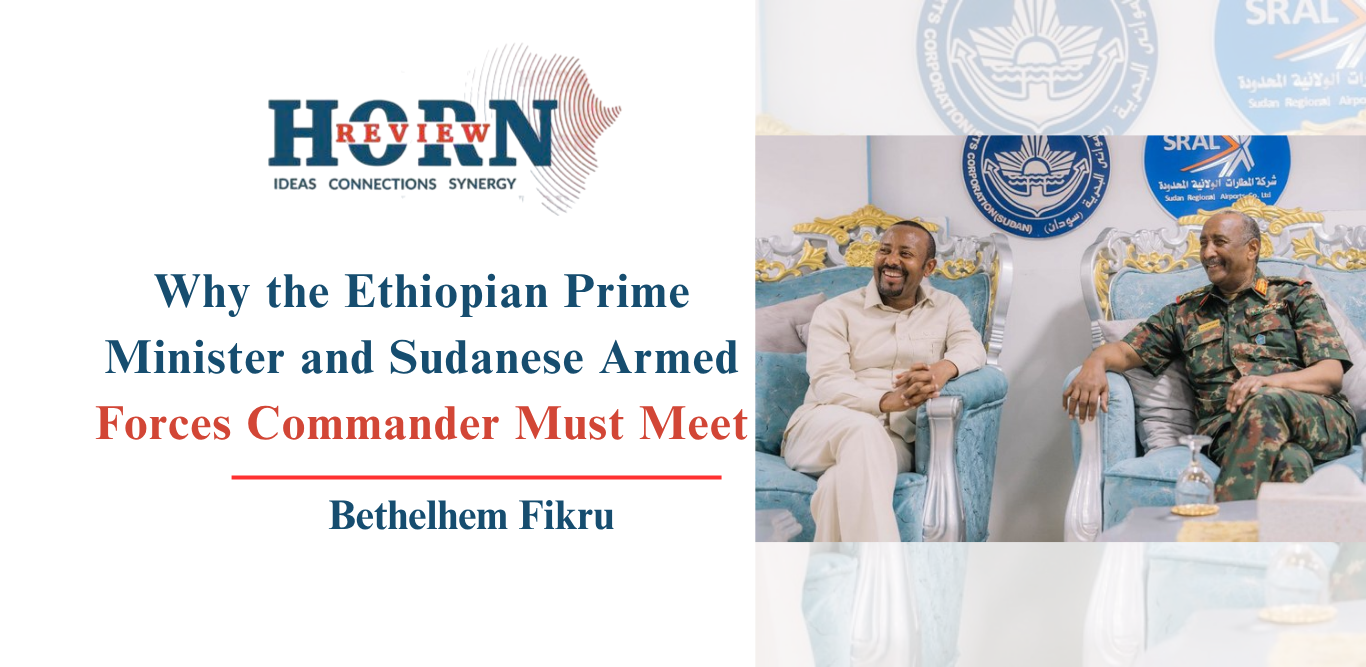
A direct meeting between Ethiopian Prime Minister Abiy Ahmed and General Abdel Fattah al-Burhan, the commander of the Sudanese Armed Forces, has become a matter of urgent regional interest. The northern Ethiopian frontier and Sudan’s civil war are no longer fully separate theatres. Contested claims of cross-border support, the movement of weapons and fighters, a long and porous shared border, and the involvement of external actors have created conditions in which localized friction can rapidly generate wider damage. From a realistic assessment of both capitals’ interests and constraints, the two leaders share a clear incentive to lower the temperature before the situation hardens into a more destructive, multi-front conflict.
The region stands at a point where further escalation risks severe, regionalized consequences. Sudan remains locked in a costly civil war that has already produced one of the world’s worst humanitarian crises. Ethiopia faces renewed fighting in the north involving a newly announced alliance of armed groups. Allegations of mutual interference, claims of cross-border facilitation and the use of neighbouring territory in support of armed actors on both sides continue to circulate in the public record and in official statements.These claims remain contested; neither side has produced conclusive public proof that settles the matter. What is clear is that the absence of high-level communication allows such allegations to shape threat perceptions and force postures. A direct meeting between PM Abiy Ahmed and General Abdel Fattah al-Burhan,representing the Sudanese Armed Forces, would provide the most direct channel to address or clarify them and reduce the scope for miscalculation.
External patronage and proxy dynamics amplify the danger. Egypt and Eritrea maintain their own strategic interests in the Horn and the Red Sea, while their increasingly close alignment with Khartoum adds another layer to Ethiopia’s security calculations. Eritrea’s relationship with Sudan provides it with political and geographic space through which its interests can intersect with wider networks involving Ethiopian opposition groups, including the TPLF and other actors within the emerging opposition alignment. The formation of a multi-group Ethiopian opposition alliance and the reciprocal accusations that followed illustrate how quickly domestic conflicts can acquire a regional dimension when external interests converge around the same strategic space. The concern is therefore not simply whether one external actor is directly directing another, but whether overlapping relationships can create an environment in which weapons, political support and armed networks reinforce one another beyond the control of the governments initially involved.
Sudan’s internal calculus reinforces the case for de-escalation. The Sudanese Armed Forces have registered advances, particularly in reclaiming ground in North Kordofan and applying pressure toward remaining RSF-held areas in Darfur and South Kordofan. This relative military momentum creates a practical window in which resources and attention can remain concentrated on the internal war rather than allowing it to spill across Sudan’s borders and further regionalize an already unstable security environment. In the present circumstances, the priority of consolidating gains inside Sudan and managing the severe humanitarian burden already carried by the country is the more rational course. An expanded frontier confrontation would dilute focus, strain logistics and risk drawing the conflict into a wider regional configuration that neither side can easily control. Keeping the emphasis on internal stabilization therefore serves as the clearest path to limiting further escalation across the Horn.
The Ethiopia–Sudan border is consequently becoming a potential corridor for the regionalization of Ethiopia’s internal conflict rather than simply a boundary between two states. Its vast and porous terrain provides space through which external actors and armed groups can develop political relationships, facilitate logistics and connect otherwise separate theatres of conflict. This is particularly significant as Ethiopia’s tensions with Eritrea and Egypt deepen while Khartoum maintains important strategic relationships with both countries. The emergence of a broader Ethiopian opposition coalition, including the TPLF and other armed and political groups, further illustrates how Ethiopia’s internal conflicts can acquire a regional dimension when external interests overlap around the same frontier.
Ethiopia has accused Eritrea, Sudan and Egypt of supporting elements of this alignment, allegations that the governments concerned have rejected. The significance of the allegations, however, lies not only in whether each claim can ultimately be substantiated, but in the security environment they are producing: a border containing large quantities of weapons, multiple armed actors and competing external interests becomes increasingly vulnerable to escalation. The danger is therefore not necessarily a deliberate Sudanese decision to enter Ethiopia’s conflict, but the gradual transformation of the frontier into an enabling environment where external support, armed networks and military resources can interact.
Broader regional fragility compounds these risks. Climate-related stresses such as drought, flooding and the lingering effects associated with El Niño cycles, already strain food security and displacement systems across the Horn. Adding a regionalized military confrontation on top of existing crises would make recovery far more difficult. South Sudan’s own unresolved tensions, including the potential for renewed activity by opposition elements, mean that a wider Horn conflict would expand the field of opportunity for spoilers and further complicate mediation efforts. In short, regionalization would leave the Horn with diminished capacity to stabilize or rebuild.
Ethiopia’s earlier record of engagement with Sudanese stakeholders provides useful context. In the years preceding and following the 2019 transition, during the civilian-military partnership under Abdalla Hamdok and in subsequent consultations linked to regional and international mediation efforts, Ethiopian platforms hosted or facilitated Sudanese political and civilian dialogue. Ethiopian positions have repeatedly emphasized Sudanese sovereignty and political settlement. This history of engagement demonstrates that the bilateral relationship has previously contained a diplomatic dimension capable of operating even during periods of political uncertainty. Reopening such a channel would therefore not represent an entirely new departure but a return to an established mechanism of crisis management.
Recent diplomatic signals underscore the urgency. The reciprocal expulsion of diplomats and the severing of ties with Eritrea, together with parallel actions involving Egyptian representatives, reflect a sharp deterioration in the regional atmosphere. Moves to position forces or equipment nearer the frontier, whatever their immediate operational rationale, feed perceptions of preparation for wider confrontation. These developments occur against a background in which external actors can more easily justify or expand their involvement when bilateral communication is absent.
A meeting between Prime Minister Abiy Ahmed and General Abdel Fattah al-Burhan should therefore be understood less as an attempt to resolve their broader political disagreements than as an urgent exercise in strategic risk management,but as a necessary step toward an actual bilateral resolution mechanism. Both governments are already dealing with internal conflicts and possess substantial military capabilities, including increasingly sophisticated drone and long-range strike capacity. Under these conditions, neither side can afford to allow its internal battlefield to become connected to the other’s security environment. The immediate objective should be to establish a practical understanding that prevents the Ethiopia–Sudan frontier from becoming another active front: maintaining direct military and political communication, preventing the movement of armed networks and military resources across the border, investigating serious incidents before retaliation, and making clear that neither government will permit its territory to be used to widen the other’s internal conflict.Such an understanding would move the relationship beyond crisis management toward a mechanism through which the two governments can address their disputes, restore confidence and contain the wider regional pressures surrounding them.
This is particularly important because the presence of external strategic interests and multiple armed actors creates opportunities for escalation that neither Addis Ababa nor Khartoum may fully control once they begin to interact. The objective, therefore, is not to prevent regional dynamics from emerging, as these are already present, but to prevent them from hardening into a wider interstate conflict. A direct meeting between the two figures would be a significant step toward establishing limits, clarifying red lines, and reducing the space for further escalation. Their meeting would therefore be valuable precisely because it could establish those limits while there is still diplomatic space to prevent the situation from escalating further.
By Bethelhem Fikru, Researcher, Horn Review