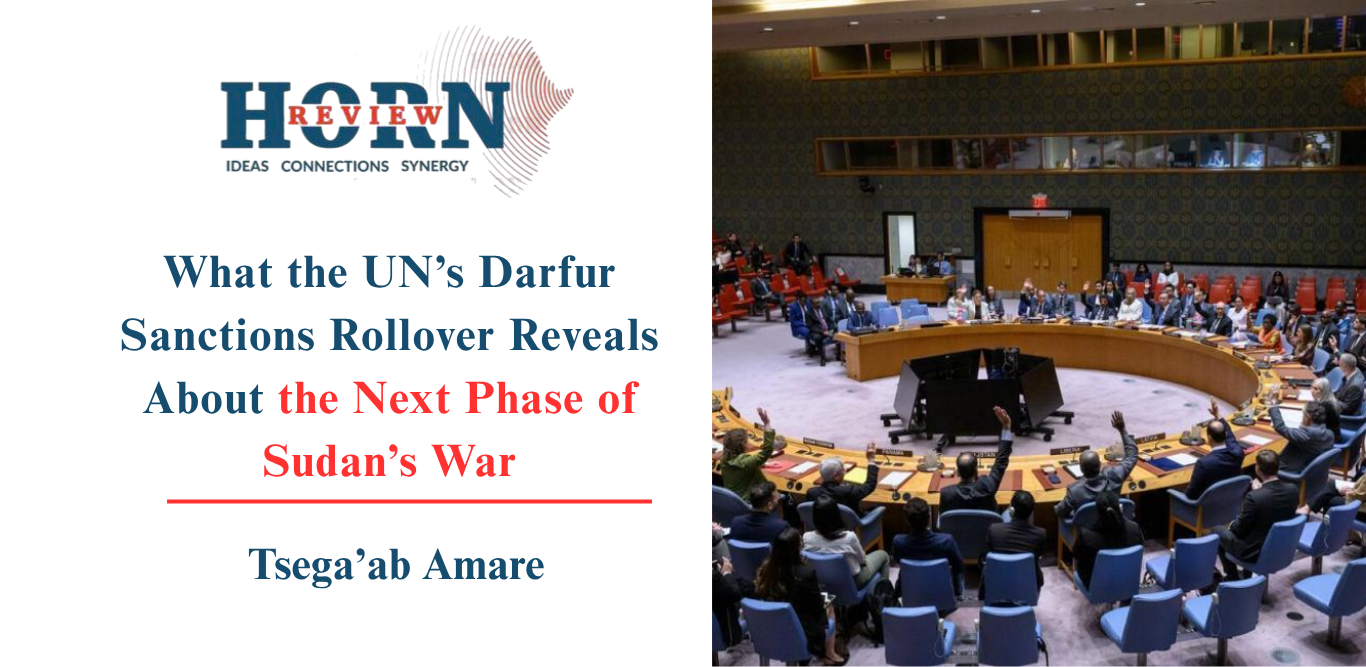
On paper, Resolution 2828 is a housekeeping measure. It extends the Darfur arms embargo and asset-freeze regime, first created under Resolution 1591 in 2005, by one month, pushing the new deadline to October 9 and giving the Panel of Experts until November 9 to keep working. In practice, however, the Security Council did not so much renew the sanctions regime on September 11, as defer a more consequential question: whether a sanctions framework designed for Darfur can still address a war that has spread across Sudan. That deferral, and the positioning around it, most visibly in a statement from U.S. Senior Advisor for Arab and African Affairs Massad Boulos laying out Washington’s terms, is the more consequential development.
The mechanics behind that deferral are straightforward: council members were unable to agree on substance before the mandate’s expiry, leading to a one-month extension. But the positions advanced during the negotiations reveal a genuine three-way split.
The United States, represented in the chamber by Ambassador Jeffrey Bartos, used the session to call the twenty-year-old Darfur-only framework outdated. Bartos pressed for expanding the arms embargo across all of Sudan, tightening the Panel of Experts, and adding new listing criteria for conflict-related sexual violence, kidnapping, and attacks on aid workers. Russia and China both supported the one-month rollover as a means of preserving the existing sanctions framework and preventing its expansion. Sudan’s envoy, representing the SAF-aligned government, rejected the wider embargo outright, which meant the one-month extension became the narrowest point of agreement the Council could reach without resolving the underlying dispute.
Washington did the most to widen that dispute: the substance of its position, as Boulos framed it in a public statement and Bartos echoed at the Council, marks a real shift from the Darfur-centric posture Washington has held for two decades.
Two elements of that shift stand out. The first is geographic, built on an airstrike that Bartos cited as having destroyed more than 50 metric tons of World Food Programme aid in South Kordofan. He argued that a Darfur-bound sanctions regime leaves civilians in Kordofan, Blue Nile, and elsewhere with no equivalent protection, even though the fighting, and the worst of the atrocities, have long since spread beyond Darfur’s borders. The second is leverage: Boulos was explicit that Washington regards a full-year, unchanged rollover as unacceptable, and he warned that any member blocking an expanded embargo risks “abetting those who are destroying Sudan.” He paired that warning with a restated commitment to a humanitarian truce, the Quad Roadmap, the Berlin Declaration, and the Quintet track toward a civilian-led transition. All this taken together is less a sanctions proposal than a threat, one meant to make the next month costly for anyone content with the existing status quo.
One detail, however, complicates Washington’s case: neither Bartos nor the WFP attributed the South Kordofan strike to a specific party. The WFP statement stopped short of assigning responsibility, while some Sudanese monitors attributed the attack to the RSF rather than the government’s air force. That uncertainty highlights a limitation in the existing Darfur-focused sanctions framework: its geographic scope and designation architecture are poorly suited to incidents whose perpetrators may be contested and whose location falls outside Darfur. It also strengthens the case for conduct-based listing criteria, particularly for attacks on humanitarian operations, that can be applied regardless of the faction responsible or the province in which an incident occurs.
Khartoum’s rebuttal met that expansive case in kind, through its UN ambassador, Al-Harith Idriss al-Harith Mohamed, who did not simply object to an expanded embargo but reframed it as an assault on sovereignty. That formulation elides a real distinction, the inherent right of self-defense under international law is not the same as an unrestricted entitlement to acquire weapons. Washington has also accused the SAF of using chemical weapons, a charge Khartoum rejects, which further complicates the government’s effort to frame restrictions on its military capabilities solely as an infringement of its right to self-defense. The combination of these issues makes Khartoum’s legal argument more contested than its framing suggests.
The Ambassador tied his objection to two older grievances: the international community, he said, never backed the 2020 disarmament and integration framework that the RSF ultimately rejected. He also argued that two decades of Council measures have done more to hamstring Sudanese law enforcement than to stop Darfur’s armed groups from looting the country’s resources. Beyond those two grievances, he took a pointed, unnamed swipe at states pursuing “national interests over multilateral diplomacy” while a militia is “backed by one of its regional partners.” The subtext is not subtle: Khartoum wants the Council’s attention on external enablers of the RSF, not on a blanket embargo that would also constrain the SAF’s own procurement.
That is the crux of why a nationwide embargo is fundamentally different from a Darfur-only one for the Sudanese government. A regional embargo has, in practice, mostly criminalized flows to non-state actors in one province. A nationwide embargo would therefore constrain not only non-state armed groups but also the procurement activities of Sudan’s internationally recognized state authorities and armed forces. And it would do so at a moment when, as Russia’s delegate pointedly noted, government forces hold the battlefield advantage.
Khartoum found ready allies for that argument, and the structural arithmetic here favors the status quo. Russia’s Anna Evstigneeva was unusually direct, describing “clear red lines” against expansion and aligning Moscow explicitly with Khartoum’s position. She pushed instead for a straightforward one-year rollover of the existing text. That stance is consistent with Russia’s effort to preserve its standing with the SAF-aligned government, including a long-running and repeatedly stalled bid for a naval facility at Port Sudan. China’s Sun Lei was more measured but arrived at a similar place, warning that forcing through a contentious text could fuel Sudan’s fragmentation and insisting sanctions should not substitute for diplomacy. Since any of the five permanent members can veto a binding Chapter VII text, Washington’s expansion proposal needs a level of buy-in that, as of this vote, neither Moscow nor Beijing shows any appetite for.
Beneath this standoff over votes lies a deeper mismatch, the legal architecture has not kept pace with the war’s geography. The same week as this vote, drone strikes hit Ed Damazin in Blue Nile state, and arms seizures were reported on the Red Sea coast. Both are reminders of how far the conflict’s front lines and smuggling routes have moved from the Darfur-bound instrument the Council keeps renewing. A regime built in 2005 around one region’s militia is being asked to regulate a national war economy it was never designed to reach. That mismatch, more than any single statement from Washington or Khartoum, is what will keep this fight alive past October regardless of how the veto math resolves.
None of this resolves itself by October 9, but four dynamics are worth tracking in the meantime. Washington has a track record of pairing UN-level pressure with its own OFAC designations, including recent sanctions tied to chemical weapons use and to networks recruiting foreign fighters for the RSF. If the Council text stalls again, expect the U.S. to lean harder on that bilateral channel rather than wait on consensus. There is also a question of whether expansion gets redefined as targeting. The listing-criteria proposal on conflict-related sexual violence, kidnapping, and attacks on aid workers is a narrower, atrocity-based mechanism that could survive even where a blanket nationwide embargo cannot, which makes it the most plausible fallback compromise. A third question is whether Russian and Chinese redlines hold under pressure. Either could loosen its position if the humanitarian case built on incidents like the South Kordofan strike becomes harder to deflect or harden further as the SAF’s battlefield position improves. Finally, Gulf-track diplomacy may matter more to the war’s trajectory than the Council text itself. The Quad framework gives Washington leverage over external backers on both sides, and how that plays out bilaterally is worth watching independently of what happens in New York.
Tsega’ab Amare, Researcher, Horn Review