Eritrea appears, in recent years, to be making diplomatic strides. Within the United Nations in particular, the country has found a warmer reception since 2018, when the Security Council lifted sanctions imposed over Asmara’s support for al-Qaeda’s affiliate al-Shabab. The lifting came as part of the broader rapprochement with Addis Ababa. Only two years earlier, a UN Commission of Inquiry had accused Isaias Afwerki’s regime of committing crimes against humanity against its own population. Asmara now campaigns openly within the Human Rights Council to dismantle the special rapporteur mandate on Eritrea, one of the last remaining mechanisms with any capacity to hold the regime to account.
On the surface, these shifts in Asmara’s relations may signal a decline in its isolationism and a supposed reintegration into the international community. However, realities on the ground signal that Asmara’s seclusion, rather than a symptom of punishing measures taken on by the international community as advocates for engagement outline, remains structural to the regime that has exclusively run the country since its emergence.
Notably, Sweden’s foreign minister, Maria Malmer Stenergard, made a historic visit to Asmara in 2025, ostensibly to rekindle relations between the two states. Her Eritrean counterpart, Osman Saleh, clarified Asmara’s position, stating that the engagement should concern developing the relationship rather than the case of Dawit Isaak, a Swedish-Eritrean journalist jailed in Eritrea since 2001. The same sentiment has been echoed by Asmara’s diplomats across the globe. In African and international forums, they speak of independence and self-reliance, and attack the international system for its interference in Eritrea’s “internal issues”. The same sentiment was echoed when the United States hinted at its desire to lift sanctions imposed in 2021 to chart possible engagement with Asmara. Eritrea’s ministry of information responded by attacking the rationale for the sanctions and calling on the US to rectify its “misguided policies”.
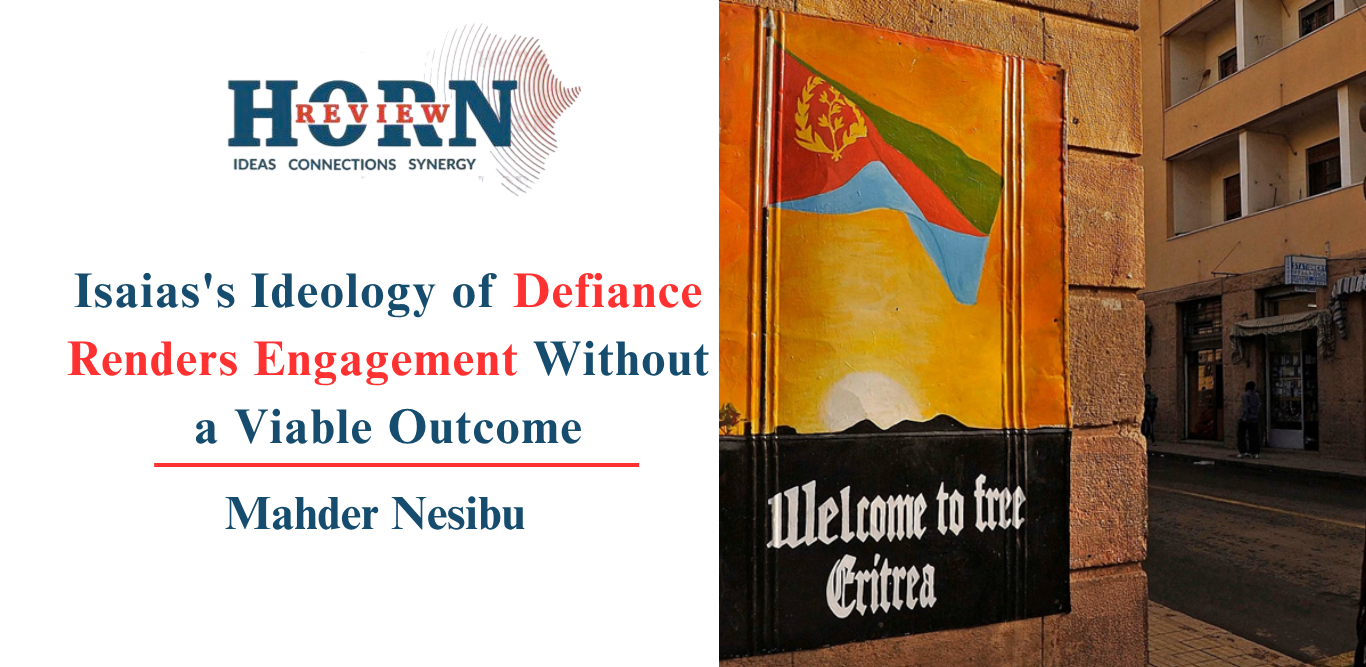
This posture of defiance is one President Isaias holds firmly, to the point of functioning as an ideological doctrine for the regime. In his framing, the international order amounts to a Western system of dominance, and criticism of his government’s human rights record or its record as a spoiler in the Horn of Africa another instrument of that system’s imposition. At home, the same reasoning underwrites a doctrine of “self-reliance” and sustains the country’s near-permanent wartime footing, one in which ordinary aspirations for normal life are subordinated to a liberation struggle with no declared end.
This doctrine is a load-bearing pillar of the regime’s authoritarian architecture. The People’s Front for Democracy and Justice, the ruling party, fought a three-decade insurgency against a far larger Ethiopian army to secure Eritrean secession, and that struggle demanded a rigid internal discipline that has never really been stood down. The same structural logic carried into Eritrea’s statehood. War with Ethiopia in 1998 produced a permanent state of hostility with Eritrea’s neighbour, and the resulting logic of struggle justified a further narrowing of the political space. By 2001, a crackdown within the PFDJ’s own ranks, paired with the closure of the independent press, had consolidated the system that governs Eritrea today.
Whether the target is Addis Ababa, the UN and African Union, or Western capitals, Eritrean foreign policy has been built around resisting what is identified to be outside interference. That resistance gives Isaias his primary rationale for sustaining a garrison state. Democratic rule is treated as a luxury the country cannot afford, and so is economic growth or freedom of movement. Eritreans, subject to indefinite national service, are expected to defend the country against these adversaries and, in doing so, to defend the regime that claims to embody it.
These structural features show no sign of loosening. The current appetite for engagement has little to do with the human rights record or the regime’s totalitarian grip, the two conditions the international community once treated as prerequisites for normalisation. It reflects instead a changing international system. The UN’s declining relevance and the erosion of consensus among its member states have left it with limited leverage over governments like Eritrea’s, pushing it toward accommodation rather than pressure. A related calculus shapes the approach of Europe and the United States. Eritrea’s coastline along the Red Sea, a critical maritime corridor, has made protecting shipping lanes a higher priority than pressing for reform in a country whose politics remain deeply troubled.
Little of substance has followed from the engagement itself. Washington’s prospects for a genuine reset face real limits, since Asmara remains distrustful of American intentions, and much the same holds for Europe. Within the AU and the UN, Eritrea’s place has amounted to little more than a platform from which Asmara projects its narrative of victimhood and self-reliance.
For Eritreans, the practical effect has been continuity. Authoritarian rule persists with no meaningful accountability to the international community. Human rights and democratic governance remain out of reach, and the economy continues its long decline.
The lifting of sanctions by the UN in 2018 had not resulted in Eritrea’s move toward economic opening up and rehabilitation. Instead, it allowed the regime to push for a rearmament of its military forces, which it sent into Ethiopia’s Tigray region in 2020 to engage in a brutal conflict. Isaias now operates with increased confidence, and the role of his country as a spoiler is in resurgence, with the Horn of Africa and the Red Sea serving as arenas for power projection and geopolitical competition.
By Mahder Nesibu, Researcher, Horn Review