
The Ontological Eclipse of the Horn: Eritrea’s Meddling as a Cry for Reintegration
By Abdi Zenebe (PHD), Deputy Director, FDRE Institute of Foreign Affairs.
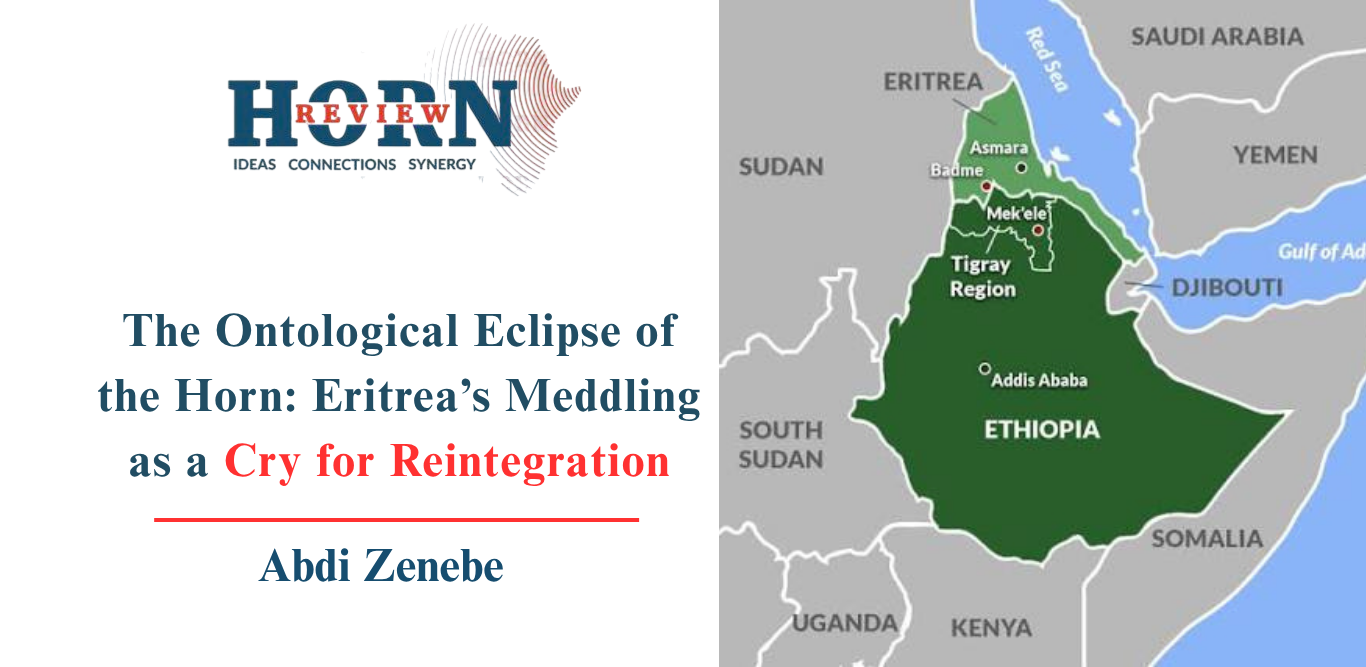
In the theatre of Ethiopian affairs, Eritrea has long occupied the peculiar position of the perpetual critic – a restless B to Ethiopia’s A. From the highlands of Asmara, its political elite have issued an almost continuous stream of commentary on Addis Ababa’s ethnic federalism, its foreign alignments, its security architecture, and its experiments, however imperfect, with internal political order. Every Amhara mobilization, every Oromo grievance, every Tigrayan overture, every negotiation concerning access to the Red Sea appears to invite Eritrean scrutiny. Few developments within the Ethiopian political sphere escape the penetrating, and frequently condescending, gaze of Eritrean officials and analysts.
Yet if this phenomenon is examined through the philosophical framework we have termed “The Inauthentic Solicitude of the Leap-In,” a more unsettling inversion becomes visible. Eritrea’s persistent criticism of Ethiopia is not necessarily the posture of a secure and self-confident sovereign neighbor. It may instead be understood as the anxious expression of an entity that has lost the ontological ground from which its political self-understanding was historically constructed and that now seeks, however indirectly, to re-enter and co-author the only narrative within which it once experienced itself as historically consequential: the Ethiopian narrative.
When Eritrea existed within the Ethiopian imperial and federal configurations – first as a federated unit under Haile Selassie and later as a province following the formal abolition of the federation in 1962 – it possessed a peculiar psychological luxury. As the maritime frontier of a geographically expansive political order, Eritrea could project itself outward as the seaward face of a larger African civilization. Its port cities, cosmopolitan intelligentsia, commercial networks, and strategic position along the Red Sea permitted its elites to experience themselves as indispensable to a political and civilizational project considerably larger than the territory itself. Eritrea could imagine itself as Ethiopia’s “gateway,” and through that role as an intermediary between the African interior and the wider world.
Formal independence in 1993 fundamentally disrupted that projection. Eritrea was no longer the distinguished maritime limb of a larger political body but a small, arid state of approximately 3.6 million people, situated between a demographic giant – Ethiopia, with a population exceeding 120 million – and an unstable maritime neighborhood encompassing Sudan, Yemen, and the strategic chokepoint of the Red Sea. The rupture was therefore not merely territorial or institutional. It was also ontological. The political elite suddenly confronted the possibility that their inherited self-image of regional consequence had been sustained, at least in part, by a greatness that exceeded the independent state itself – a greatness associated with the Ethiopian mass of which Eritrea had once formed an integral part.
Jean-Paul Sartre’s famous proposition that “Hell is other people” acquires an almost inverted significance in this context. For Eritrea, the more unsettling condition may be the absence of a defining other against which its political identity can continually constitute itself – except Ethiopia, which stubbornly refuses to become merely the shadow against which Eritrea defines its existence. Hence the difficulty of detachment. To detach fully from Ethiopia would require Eritrea to confront a far more disquieting question than that of territorial sovereignty: Who are we when we are no longer perpetually responding to Ethiopia?
The pattern is difficult to miss. Across virtually every major Ethiopian dossier, Eritrea repeatedly inserts itself. On the question of ethnic politics, whenever Ethiopia revisits or reforms its ethnic federal arrangement, Eritrea – despite operating domestically as a highly centralized and effectively mono-ethnic authoritarian order – issues warnings about “Balkanization,” frequently adopting the rhetorical posture of a guardian of Ethiopian unity. Yet beneath the overt geopolitical concern lies a more intimate anxiety: if Ethiopia fragments, against what does Eritrea constitute itself? If the Ethiopian political narrative dissolves, what remains of the external reference through which Eritrea has continued to define its own political significance?
The same logic appears in the realm of foreign relations. Whenever Ethiopia seeks access to the Red Sea through arrangements involving Somaliland or Djibouti, Eritrea responds with warnings concerning encirclement, sovereignty, historical rights, and regional security. Such objections can certainly be interpreted through conventional geopolitical categories. Yet they may also reveal something deeper: the resentment of a former maritime center of an Ethiopian political order confronted with the prospect of Ethiopia re-entering the Red Sea arena without Eritrea occupying the privileged position it once held within that relationship. The objection is therefore not simply to Ethiopian maritime access; it is also to the possibility of an Ethiopia that can rediscover the sea without requiring Eritrea as its indispensable intermediary.
The Tigray conflict provides an even more revealing manifestation. During the war of 2020–2022, Eritrea did not merely assist Ethiopia militarily. Its conduct frequently appeared to transcend the ordinary boundaries expected of one sovereign state intervening on behalf of another. Eritrean forces operated with a pronounced sense of proprietorship, as though they were exercising disciplinary authority over a wayward internal province rather than participating in the affairs of an external sovereign state. Whatever the strategic calculations behind that intervention, its political psychology is difficult to separate from the older conception of Eritrea and Ethiopia as components of a single historical space.
Across these domains, Eritrean commentary repeatedly assumes the posture of superficial grandeur: the tone of a senior counsellor admonishing a junior pupil. But this is precisely where Sartrean bad faith becomes analytically useful. The projection of political grandiosity becomes most insistent where the material and demographic realities of the independent state most forcefully undermine it. The performance of regional centrality consequently becomes a defense against the experience of marginality.
The philosophical tragedy is therefore not simply that Eritrea struggles to consolidate the material foundations of independent statehood. It is that it appears unable to project an autonomous future in genuinely positive terms. Heidegger’s account of authentic existence, Dasein, requires a projection into futurity: an assumption of finitude, an acknowledgment of one’s thrown condition, and the active appropriation of one’s own possibilities as a project. Eritrea, by contrast, appears trapped within an inauthentic projection in which its future remains conceptually tethered to Ethiopia. It can imagine Ethiopia as adversary, cautionary example, regional rival, political failure, or moral object lesson, but it struggles to imagine a future whose meaning is not relationally constituted through Ethiopia.
This is the deeper reason detachment remains so difficult. Genuine detachment would compel Eritrea to ask a question that is more demanding than the conventional language of sovereignty allows: What can Eritrea become, on its own terms, over the next fifty years? The answer, stripped of ideological embellishment, is necessarily modest: a small Gulf-aligned state sustained by a diaspora economy and governed through a repressive military apparatus. That may constitute survival. It does not, however, constitute the greatness toward which Eritrean political memory continues to gesture.
The paradox is that the very potential for greatness that Eritrea once possessed – its maritime position, commercial function, cosmopolitan networks, and cultural significance – acquires its fullest strategic meaning within a broader Ethiopian political and economic framework. A federal Ethiopia incorporating Eritrea as a highly autonomous, special-status maritime region, comparable in functional terms to a Hong Kong-like arrangement or a free economic zone, would restore to Eritrea the very form of significance that its political memory continues to invoke. Within such an Ethiopian configuration, Eritrea would become the bridge between the African hinterland and the Arabian maritime world. Outside it, the argument suggests, Eritrea risks remaining an isolated garrison state whose strategic importance exceeds its economic and demographic weight.
It is at this point that the argument becomes deliberately provocative. Ethiopian elites, who ordinarily interpret Eritrean meddling as a direct challenge to sovereignty, should consider the possibility of reversing the conventional response. If Eritrea’s criticism is indeed a veiled petition for ontological inclusion, then the appropriate Ethiopian response may not be rejection but what might be called therapeutic encouragement.
Such encouragement would serve several strategic and philosophical purposes. By inviting Eritrea to comment more extensively, to participate in additional negotiating forums, and to engage more directly in Ethiopian regional dialogues, Ethiopia would force Eritrea to confront the limits of its independent agency. The more Eritrea behaves as a co-pilot, the more difficult it becomes to sustain the illusion that it can fly the plane alone. Such Socratic midwifery would gradually compel Eritrean elites toward an uncomfortable recognition: that their most consequential seat at the regional table may ultimately lie inside the house they insist upon treating as foreign.
The second transformation would involve converting critique into co-responsibility. At present, Eritrea can criticize Ethiopia’s ethnic tensions from the relatively protected position of an external observer. But once Eritrean participation in processes of ethnic reconciliation were formally encouraged, Eritrea would acquire a stake in the consequences of the prescriptions it advances. Responsibility alters the moral position of the critic. It generates the possibility of humility, and humility, in turn, creates the conditions for recognizing interdependence.
The final objective would be to create the political scaffolding for a renewed federal compact. Ethiopia need not – and arguably could not – seek to annex Eritrea militarily. The historical trauma associated with such a project, together with its profound political unviability, makes that path untenable. But Ethiopia could instead invite Eritrea into a confederal or specially constituted partnership: a “Two-State Continental Union” or a “Maritime-Interior Federal Covenant” in which Eritrea retains its flag and its seat at the United Nations while progressively reintegrating its economic, security, and diplomatic strategies with Ethiopia. Under such an arrangement, meddling ceases to be merely an irritant. Institutionalized and redirected, it becomes the scaffolding through which reunification can gradually be imagined.
The unspoken truth, then, is that Eritrea cannot fully “become” alone – not because independent statehood is inherently impossible, but because Eritrea’s political imagination remains profoundly relational. Its incessant commentary on Ethiopian ethnic politics, its obsessive comparison of developmental indicators, and its persistent security warnings are difficult to understand solely as the behavior of a confident independent state. They may instead be read as symptoms of what Heidegger described as Geworfenheit, or thrownness, experienced without a corresponding sense of existential home. Eritrea has been thrown into independence, but it has never fully transformed independence into a positive, self-sustaining project. Instead, it continues to define itself negatively, through the perceived failures, dangers, and contradictions of Ethiopia.
This is the point Ethiopian elites must learn to recognize. When Eritrea criticizes Ethiopia’s handling of the Oromo question, the intervention may signify more than conventional meddling. It may implicitly declare: Your internal affairs continue to matter to me because, at some deeper level of historical consciousness, I continue to understand myself as internally connected to you. When Eritrea comments on Ethiopian port arrangements, the objection may likewise express more than strategic jealousy. It may contain the unresolved memory that the sea was once a shared political horizon, and that Eritrea cannot comfortably contemplate Ethiopia touching that horizon again without itself occupying a place within the relationship.
The tragedy of contemporary Eritrea is therefore that it speaks as though it were a great power while steadily confronting the demographic and economic constraints of a small state. The comedy, if one dares to describe it as such, is that its political elites can devote extraordinary attention to Ethiopian cabinet reshuffles, ethnic controversies, and strategic realignments while remaining comparatively constrained in the transformation of their own economic and agricultural foundations. This is ontological displacement in its most concentrated form: political energy directed outward because the inward project remains insufficiently compelling.
Yet tragedy is not necessarily destiny. It can become the precondition for reconciliation. Ethiopia should therefore reconsider the instinct to treat Eritrea exclusively as a hostile and meddlesome neighbor and instead recognize the possibility that the very persistence of Eritrean criticism reflects the unresolved desire for a seat within a political and historical table from which Eritrea formally departed but psychologically never entirely withdrew. By encouraging, institutionalizing, and ultimately integrating this meddling, Ethiopia would offer Eritrea a pathway toward a more authentic form of political becoming – not as a dwarf state performing the gestures of a giant, but as the essential maritime lung within the federal body of a rising African colossus.
Let Asmara continue to speak to Addis Ababa in the language of grievance. But let Ethiopia listen with the knowing patience of a political actor that understands the deeper grammar of the exchange. For beneath every reproach from Asmara may lie, beneath the geopolitical vocabulary, a quieter recognition: “I have not found my place without you. Take me seriously again.” Ethiopia should not dismiss that contradiction. It should understand it. For sometimes the most revealing foreign-policy statements are not those a state makes deliberately, but those it makes despite itself.

RELATED
Posts
9
Sep
The USS Ross in Mombasa and the Shifting Maritime Geopolitics of the Horn of Africa
On September 5, 2026, the Arleigh Burke-class guided-missile destroyer...
8
Sep
TPLF's Obasanjo Complaint Masks a Leverage Deficit, Not a Neutrality One
The Tigray People’s Liberation Front’s September 6 statement accusing...
8
Sep
Clan Realism and the Capture of Somalia's Intelligence
The National Intelligence and Security Agency of Somalia occupies a...
7
Sep
Somalia's Centralization Drive and Kenya's Potential Response
The confrontation in the Horn is frequently distilled into simplistic...
7
Sep
Somaliland Recognition and the Limits of Bureaucratic Risk Aversion
The United States position on Somaliland is one of the...
2
Sep
Drought, Flood, and War: The Greater Horn’s Narrowing Room for Failure
A moderate to strong El Niño is now settling over...
2
Sep
AQAP Mediation and the Normalization of Cross Sectarian Jihadi Logistics
The relationship between the Houthi movement in Yemen and...
2
Sep
The Ilemi Triangle and South Sudan's Aspirations
The recent pronouncements by South Sudan's Vice President Taban...
2
Sep
Radical Shifts in Somalia's Security Space Are Taking Place, Addis Ababa Should Be Alarmed
The presidency of Hassan Sheikh Mohamud, who returned to Villa...