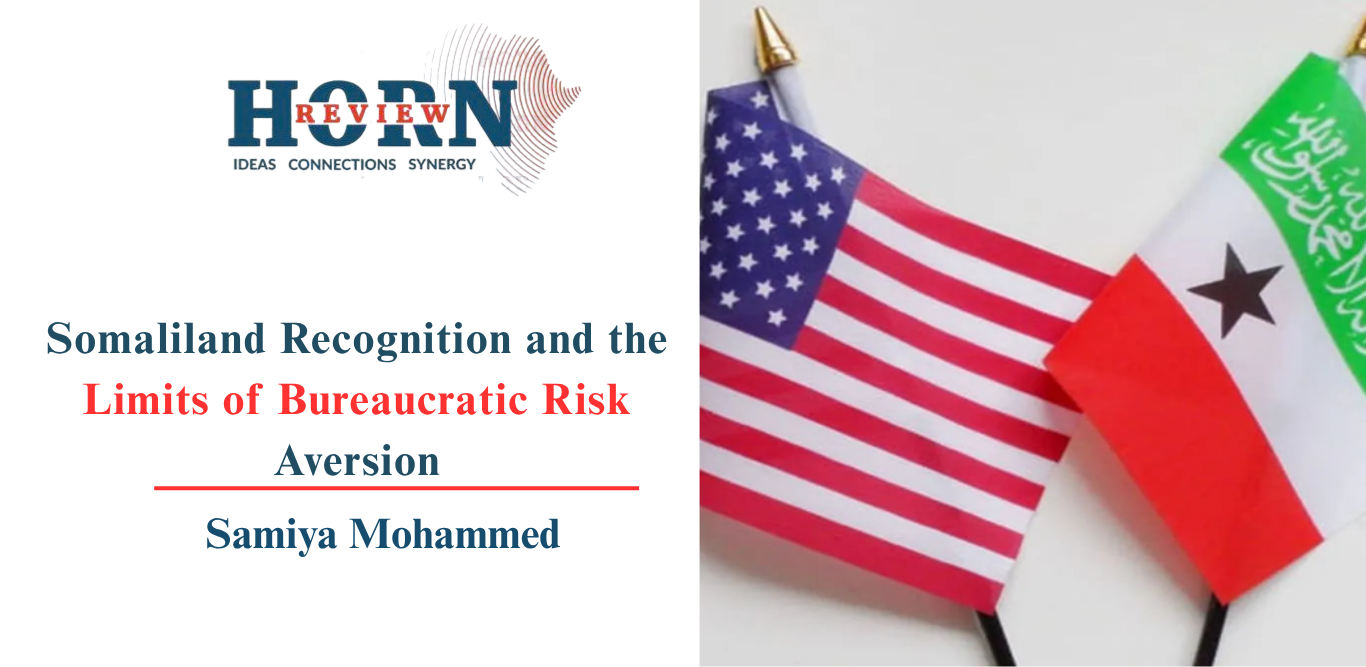
The United States position on Somaliland is one of the examples in contemporary foreign policy of how bureaucratic inertia and diplomatic convenience can override demonstrable national interest. Nearly nine months have passed since Israel extended formal recognition to Somaliland in December 2025 however United States has declined to follow suit. This official reticence however masks a reality that bears little resemblance to the legalistic or moralistic arguments that frequently dominate public discourse. The question of American recognition is neither a seminar on international jurisprudence nor a referendum on democratic virtues however it is a pure assessment of geopolitical utility where the inertia of established policy frequently outweighs the allure of advantage.
The geography of the Horn lends immense weight to the case for recognition. Somaliland possesses over 850 kilometers of coastline overlooking the Bab el-Mandeb strait. In an environment of persistent maritime insecurity the value of a reliable partner on this becomes self evident. President Abdirahman Mohamed Abdullahi Irro during his current visit to the United States has explicitly showed his government’s willingness to offer military facilities, presenting the port and airfield at Berbera as a potential asset that could provide options beyond those currently available in Djibouti. With Djibouti hosting both American and Chinese military bases the prospect of an alternative, dedicated partner who is not beholden to competing great power interests offers a tangible enhancement to operational flexibility. This is not a matter of abstract diplomatic principle but of hard, practical capacity for power projection and logistics in a region where freedom of navigation is directly connected to American security and economic well being.
Opponents of recognition have reflexively invoked the spectre of illegality and the dangerous precedent of redrawing African borders and this position relies on a selective application of principle that is difficult to sustain under scrutiny. The historical argument against recognition is particularly weak as the territory’s status is in a distinct colonial history as a British protectorate in which a brief period of independence in 1960 and a subsequent failed voluntary union with Somalia that collapsed into a decade of civil war.
The African Union’s doctrine of non alterability of borders designed to protect states from internal fragmentation is a rule that is selectively enforced and the continent has witnessed numerous territorial changes and the endurance of de facto independent entities over the decades making the absolute opposition to recognition a matter of expediency rather than a foundational pillar of continental governance.
The opposition to recognition is more transparently in the self interest of regional actors than in any coherent commitment to international law or continental stability. Turkey for instance has invested heavily in Somalia viewing it as a strategic presence for projecting influence across the Horn and into the broader Middle East. The objection from Egypt is similarly tied to its anxieties over the Grand Ethiopian Renaissance Dam on the Nile. These are not principled stances against the violation of territorial integrity and they are efforts to preserve spheres of influence. The objection from Saudi Arabia is similarly in a desire to manage regions without the complication of an independent, non-Arab actor that has established ties with Israel. The common thread across these objections is not a genuine attachment to Somali unity but a concern about how recognition would reshape the regional order to their perceived disadvantage.
The narrative that recognition would be a destabilizing reward for chaos or a threat to Somali unity also fails to account for the realities on the ground. The federal government in Mogadishu is not a reliable partner worth protecting at all costs hence its capacity is limited, its politics are fractious and its control over its own territory remains tenuous. To continue pretending that Mogadishu legitimately represents the will or administers the affairs of a region that has been de facto independent for over thirty years is a performative act that does little to stabilize the country. Recognition would certainly anger the federal government but the current policy of non recognition has not stabilized Somalia nor has it resolved the fundamental political and security challenges that plague the state. The real fear of African leaders is not about the legal precedent itself but the practical precedent it would set for their own restive regions. This is a defensive posture aimed at insulating regimes from their own separatist movements not a genuine reflection of justice for Somaliland’s unique historical case.
While some Western outlets have framed the debate in terms of rewarding a little democracy versus risking chaos, this romanticization is both inaccurate and counterproductive. Somaliland is not a pristine, flawless liberal democracy and it is governed by a clan based system with periodic elections, where political contestation occurs but where civil liberties can be constrained and tensions over contested eastern territories persist. Over romanticizing Somaliland as a pure success story risks creating an unrealistic bar for recognition and subsequent disappointment. The argument for recognition does not rest on a moral assessment of its perfection however it rests on its net utility as a partner. The question is one of utility and leverage and not the endorsement of a political model.
The argument that the United States should hold its position to avoid angering allies is a manifestation of a declining power mindset that elevates the preferences of mid tier regional actors over direct American interests. These states pursue their own agendas, which often do not automatically advance American priorities concerning Iran, or maritime security. Treating their opposition as a binding veto is a choice born of inertia and risk aversion and not strategic necessity. The bureaucracy in the state department steeped in the default position of one Somalia resists change while institutional memory and the fear of immediate diplomatic fallout. This explains the current path of limited engagement where practical cooperation on security and development continues without the political cost of formal recognition, a classic half-measure that maintains the status quo while failing to capitalize on the full spectrum of opportunities that a formal partnership would unlock.
The prospective economic dimension of recognition is another factor that merits serious consideration yet it is frequently overlooked in policy discussions. Somaliland’s territory contains prospective oil and gas basins analogous to those found in Yemen as well as deposits of gold, copper, base metals, and potential critical minerals including lithium and others. These resources remain largely underexplored due to the absence of legal clarity that formal recognition would provide. Development requires capital, security and the kind of legal certainty that only international recognition can confer. Somaliland has signalled willingness to offer preferential access and even base rights in exchange for recognition presenting a direct economic incentive for the United States to move forward.
The counterterrorism cooperation that exists between the United States and the federal government in Somalia is often cited as a reason to maintain the status quo yet this cooperation has not prevented the persistence of militant groups or the continued fragility of the state. The partnership with Somalia is valuable but it is not a reason to foreclose cooperation with Somaliland which has demonstrated a more effective capacity to maintain internal security and disrupt extremist networks within its own territory. The argument that recognition would somehow undermine counterterrorism efforts ignores the reality that a stable Somaliland is better positioned to contribute to regional security than a fractious Somalia that cannot control its own territory. The net effect of recognition on counterterrorism would likely be positive, as it would empower a partner that has shown greater capacity for governance and security provision.
The precedent risk is both overstated and unevenly applied. The recognition of Somaliland would undoubtedly be cited by other separatist movements across the continent, from Biafra in Nigeria to Cabinda in Angola and beyond. The historical distinctiveness of Somaliland’s case in its colonial borders, brief independence and long de facto success provides a basis for distinguishing it from other cases. The bigger hypocrisy is the selective application of self determination by Western powers, celebrated in some cases such as Kosovo and ignored in others when inconvenient. The legal arguments against recognition are not as absolute as their proponents suggest and the practical consequences are likely to be more manageable than the dire predictions of opponents.
The American decision not to follow suit is not a matter of principle but of bureaucratic inertia and the instinctive preference for the status quo. The Israeli move has demonstrated that recognition is politically feasible and that the consequences are manageable. The opposition has been vocal but not transformative and the diplomatic fallout has been contained. The United States could follow without facing the full brunt of opposition that would have been directed at a first mover yet it has chosen not to, reflecting the risk averse nature in a region where the default is to avoid immediate headaches rather than pursue long term advantage.
The visit of President Irro to the United States in September 2026 represents a critical opportunity for re-evaluation. His meetings with members of the house and senate and the possibility of a meeting with the president provide a platform for making the case for recognition directly to American policymakers. The agenda focused on strengthening relations expanding cooperation on security and economic affairs and promoting investment is precisely the kind of engagement that should precede formal recognition. Yet the question remains whether American policymakers will have the courage to move beyond the comfortable inertia of the status quo and recognize the strategic value of a willing partner in a critical region. The costs of recognition while real are manageable and the benefits while not immediate compound over time.
By Samiya Mohammed, Researcher, Horn Review