Between Sovereignty and Territorial Reality: United States Relations with Somaliland, Puntland, and Jubaland
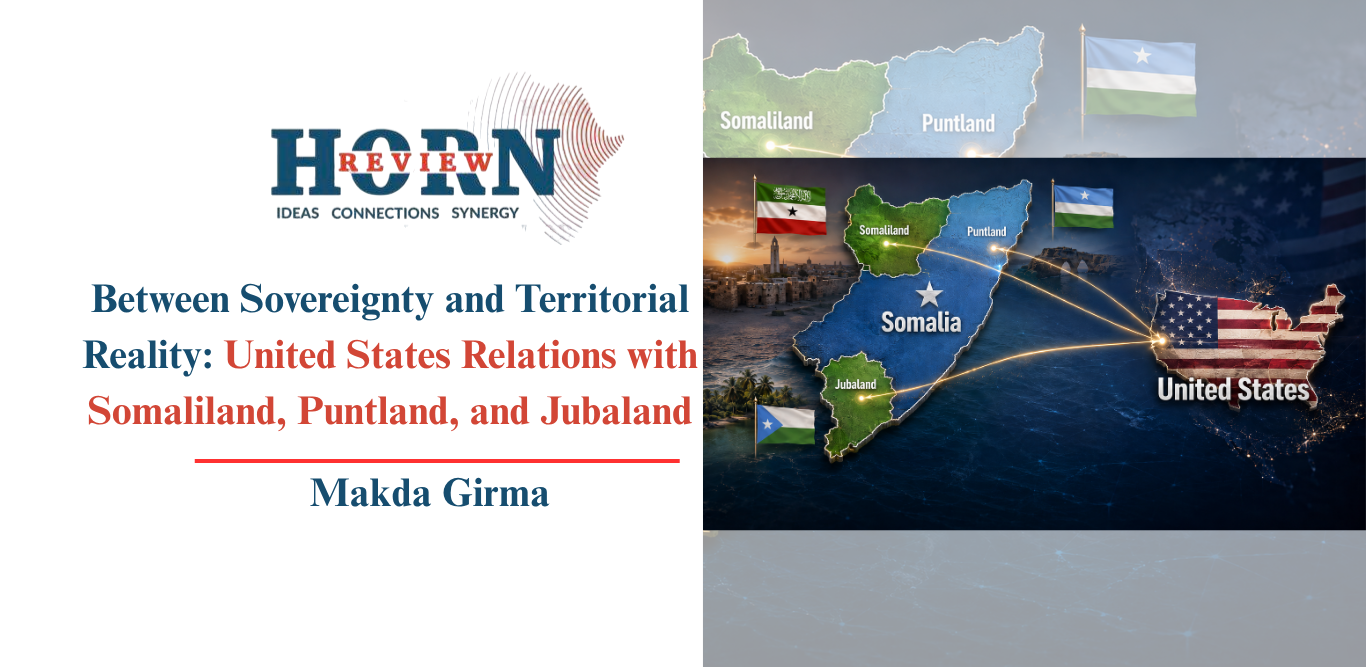
The developing relationships between the United States and Somaliland, Puntland, and Jubaland reveal a layered pragmatic to Somalia. Washington continues to recognize the Federal Government in Mogadishu as Somalia’s sovereign government while also engaging authorities that exercise effective control over strategically important territory, ports, airfields, security forces, and intelligence networks. This does not by itself demonstrate American support for Somalia’s territorial division. It reflects the practical difference between internationally recognized sovereignty and the fragmented distribution of authority inside the country, while the formal United States diplomatic relationship remains with Somalia.
An important political distinction must be established. Somaliland declared the restoration of its independence in 1991 and continues to seek international recognition. Puntland and Jubaland, despite serious disputes with Mogadishu, remain federal member states and have not formally adopted Somaliland’s objective of permanent separation. Somaliland can therefore be described as a self declared state or separatist administration, whereas Puntland and Jubaland are more accurately understood as highly autonomous participants in Somalia’s incomplete federal system. The uncertainty surrounding their powers originates partly from the unfinished allocation of federal and regional responsibilities under Somalia’s constitutional order.
The main similarity among the three relationships is geographical. Somaliland administers Berbera, Puntland administers Bosaso, and Jubaland administers Kismayo. These ports connect Somalia’s peripheral regions to the Gulf of Aden, the Red Sea approaches, the Indian Ocean, and several active security theatres. The regional authorities also control the roads, customs systems, local forces, and surrounding communities necessary for the use of those facilities. This reality became especially visible when Mogadishu reportedly offered Washington access to Berbera and Bosaso, even though neither facility is directly administered by the Federal Government. The proposal illustrated the difference between a national claim of sovereignty and the regional control required to implement it through local political authorities.
The United States nevertheless engages the three administrations for different reasons. Somaliland offers Berbera’s maritime location, long airfield, and relative administrative continuity. Puntland provides forces actively confronting ISIS Somalia in the northeastern mountains. Jubaland controls Kismayo and territory near some of Al Shabaab’s strongest southern operating areas. American engagement is therefore structured around specific capabilities rather than a uniform policy toward three politically equivalent entities. The operational distinction between the counter ISIS campaign in Puntland and the counter Al Shabaab campaign in southern Somalia is reflected in the 2026 regional security assessment.
The relationship with Somaliland is the most political and strategically maritime of the three. Berbera lies near the route linking the Indian Ocean, the Gulf of Aden, the Bab el Mandeb Strait, and the Red Sea. Its port and airfield could support logistics, maritime surveillance, emergency access, and regional security operations. This makes Somaliland relevant not only to Somalia policy but also to wider concerns involving Yemen, Red Sea shipping, Djibouti, and strategic competition around the Horn of Africa. Congressional proposals have explicitly identified Somaliland’s location beside the Gulf of Aden as a possible basis for a deeper security partnership.
Somaliland has also received more sustained congressional attention than Puntland or Jubaland. The bipartisan Somaliland Partnership Act proposed closer security assessment while expressly avoiding formal recognition. A later Republic of Somaliland Independence Act, introduced in the House in June 2025, went further by proposing that the United States recognize Somaliland as a separate country. However, that measure remained only an introduced bill referred to committee. It did not become law and should not be treated as official executive policy. The difference between these proposals shows that American political debate ranges from practical cooperation without recognition to support for independence, rather than reflecting a single settled congressional position on Somaliland’s status.
This also reveals an institutional difference within the American system, although it should not be overstated as an open bureaucratic conflict. Congress contains lawmakers seeking stronger political ties with Somaliland, while diplomatic policy has traditionally emphasized Somalia’s sovereignty and territorial integrity. The Department of Defense and AFRICOM concentrate more narrowly on access, intelligence, maritime security, and counterterrorism capabilities. These are different institutional responsibilities rather than conclusive evidence that the Pentagon and the State Department are pursuing opposing policies. The clearest contrast is between congressional proposals for a Somaliland partnership and the diplomatic position that the Ethiopia Somaliland memorandum risked disrupting regional security and Somalia’s territorial integrity.
Puntland’s relationship with the United States is more directly connected to active military operations. Puntland forces have led the ground campaign against ISIS Somalia in the Golis and Cal Miskaad mountain areas, while the United States has supplied air support and intelligence, surveillance, and reconnaissance. Puntland’s value consequently derives less from an international recognition campaign and more from its ability to mobilize forces and sustain operations in territory that federal forces cannot easily control. This makes Puntland the clearest example of a regionally based battlefield partnership within the broader American relationship with Somalia, as described in the AFRICOM posture assessment.
American operations in Puntland are still described as being coordinated with the Federal Government, preserving a national legal framework around them. On the ground, however, Puntland provides the forces, local intelligence, and immediate territorial access needed to confront ISIS. This dual structure allows the United States to cooperate with the authority controlling the battlefield without taking a position in support of Puntland’s separation. It also strengthens Puntland’s claim that its security institutions can produce results independently of Mogadishu, particularly while relations between Puntland and the Federal Government remain strained following the disputed constitutional amendments of March 2024.
The reported security arrangement concerning Bosaso may indicate a deeper phase of cooperation, but its precise legal character remains unclear. Puntland sources have presented it as an expansion of counterterrorism, maritime, and security cooperation, yet the complete agreement, duration, command structure, and relationship with federal authority have not been published. It is therefore safer to understand the development as evidence of expanding operational engagement rather than as a conclusively documented sovereign treaty between the United States and Puntland.
Jubaland represents a third pattern. Its cooperation with the United States is centred on Al Shabaab, but it is more closely connected to Somali national forces, Danab units, Kenya, and the African Union security architecture. Kismayo offers a platform for intelligence, logistics, and possible operations toward Jilib and the Juba River valley. Unlike Somaliland’s politically distinctive relationship or Puntland’s concentrated campaign against ISIS, Jubaland’s role is embedded in overlapping regional and national arrangements. Direct American contact with Jubaland’s administration therefore strengthens Kismayo’s operational relevance without necessarily separating it from the broader Somali security framework.
Jubaland’s political environment also creates legitimacy and coordination risks. Ahmed Madobe’s disputed reelection for a third term contributed to a serious confrontation with Mogadishu, including clashes between federal troops and Jubaland forces near Raskamboni. Electoral disputes, clan competition, and disagreements over control of local institutions can affect how reliably regional forces operate as national partners. These issues do not eliminate Jubaland’s strategic importance, but they demonstrate that cooperation with a regional leader cannot be separated from the local political disputes surrounding that leader and the contested electoral process.
The same caution applies to Somaliland’s reputation for stability. Somaliland has maintained institutions, elections, and peaceful transfers of presidential power that distinguish it from much of southern Somalia. However, the conflict around Las Anod demonstrated that its authority and independence project are not uniformly accepted across all the territory it claims. Dhulbahante leaders established SSC Khatumo after rejecting rule from Hargeisa, and Somaliland forces lost control of Las Anod in 2023. The dispute concerns not merely a border incident but competing political identities, clan representation, and whether communities in Sool regard themselves as part of Somaliland or Somalia.
The territorial issue became still more significant when the administration based in Las Anod was transformed into the North East State and recognized by the Federal Government as a federal member state. Its effective control remains geographically limited and its claimed territory overlaps with areas claimed by both Somaliland and Puntland. Nevertheless, its emergence weakens the assumption that Somaliland exercises uncontested authority throughout the borders of the former British Somaliland protectorate. Any discussion of Berbera’s strategic value must therefore be separated from the unresolved status of Somaliland’s eastern regions, as outlined in the current security assessment of Sool, Sanaag, and Cayn.
The United States relationships with the three administrations also cannot be analysed separately from Ethiopia and the United Arab Emirates. Ethiopia’s 2024 memorandum with Somaliland proposed access to a coastal area for naval and commercial purposes, reportedly in connection with possible recognition. The agreement intensified tensions with Mogadishu and drew Somaliland’s external relations directly into the regional competition over maritime access. The later Ankara Declaration committed Ethiopia and Somalia to pursue Ethiopian sea access under Somalia’s sovereign authority, but it did not eliminate the wider strategic importance of Berbera or Somaliland’s effort to use geography to advance its international position.
The Ethiopian episode illustrates why American access cannot be considered in isolation. Ethiopia is landlocked, depends heavily on Djibouti, and views alternative maritime routes as an economic and security priority. Berbera can therefore function simultaneously as a Somaliland diplomatic asset, an Ethiopian trade corridor, a UAE commercial investment, and a potential logistics location of interest to other international actors. Any deeper American engagement would enter an existing network of regional interests rather than create a new strategic environment from the beginning. The development of the Berbera corridor connecting Ethiopia to the port reflects this broader economic geography.
The UAE factor is even more deeply established. DP World committed up to $442 million to expand Berbera Port and develop it as a regional logistics hub, while a related company reached an agreement with Puntland to upgrade Bosaso Port. These investments provide Somaliland and Puntland with infrastructure, revenue opportunities, external relationships, and bargaining power that exist independently of the United States. They may complement possible American maritime access by improving facilities, but they may also create additional legal and political questions about who has authority to approve port concessions and foreign security arrangements.
The dispute became particularly visible in January 2026, when Somalia’s Federal Government announced that it was annulling agreements with the UAE, including arrangements involving Berbera, Bosaso, and Kismayo. Somaliland, Puntland, and Jubaland rejected Mogadishu’s decision and indicated that their respective relationships with the UAE would continue. The disagreement demonstrated that ports are not merely commercial infrastructure; they are sources of diplomatic autonomy and political authority. It also showed how external actors can become entangled in unresolved constitutional disagreements between Somalia’s centre and its regional administrations without necessarily intending to take sides in those disputes.
Economic factors are therefore as important as military access. Somalia remains heavily dependent on external assistance, while customs duties and taxes on international trade constitute a central source of domestic revenue. Control of Berbera, Bosaso, and Kismayo gives regional administrations access to customs income and commercial networks that reduce their dependence on Mogadishu. At the same time, the Federal Government’s ability to finance national institutions depends partly on harmonizing customs systems and establishing agreed mechanisms for fiscal transfers. The continued absence of a durable fiscal settlement means that port development can strengthen regional economies while also reinforcing political competition over revenue and authority.
Oil, minerals, fisheries, and maritime licensing could create similar tensions. Somalia has attempted to develop federal arrangements for sharing fishing revenue, while petroleum governance still requires rules determining how income will be divided between the Federal Government and member states. International interest in natural resources may therefore increase the political value of coastal territory and deepen disagreements over who may award contracts. The issue is not only which administration controls a port today, but which level of government will control future offshore revenue, mineral agreements, and production sharing arrangements under Somalia’s developing petroleum fiscal regime.
American assistance remains officially recorded primarily under Somalia rather than as three separate national relationships. This preserves Mogadishu’s international status even when projects or security activities are implemented within regional territories. The distinction is important because operational engagement with a regional administration does not necessarily mean that Washington is transferring diplomatic recognition or country level assistance to it. Current public assistance data continue to classify counterterrorism, governance, humanitarian, and peacekeeping activities under the country category of Somalia.
Nevertheless, direct cooperation with regional security forces creates a possible moral hazard for Somali federalism. When a regional administration can obtain intelligence, training, air support, equipment, or international political access without reaching agreement with Mogadishu, its immediate incentive to compromise over constitutional authority or force integration may decline. A regional leader may calculate that operational importance provides more leverage than participation in a unified national system. This is an analytical risk rather than proof that American support has intentionally encouraged fragmentation, and it arises largely because Somalia has not completed the division of security and fiscal powers between its levels of government. The broader federal problem has been described as one in which key agreements on functions and revenue remain unsettled.
The opposite outcome is also possible. Regional partnerships can preserve capable local forces, weaken militant organizations, and create security conditions in which federal negotiations become more realistic. International assistance can be conditioned on coordination, accountability, common command standards, and eventual integration. Whether engagement produces fragmentation or cooperation therefore depends less on the existence of regional relationships than on the rules governing them. Without shared institutions, regional capacity may become parallel capacity; with an accepted federal settlement, the same forces could become components of a decentralized national security structure.
The debate over AUSSOM adds another dimension to this shift. The United States has not cancelled the African Union mission, whose authorization currently runs through December 31, 2026. Washington also voted for the resolution extending that mandate. It has, however, informed the African Union that it will not support continued United Nations logistical and operational assistance after the end of 2026. Because AUSSOM depends on that support for transport, fuel, medical services, and other essential functions, the position places pressure on the broad stabilization model centred on defending federal institutions and supporting a national security transition.
The AUSSOM funding position and stronger engagement with regional authorities may indicate increasing American selectivity, although no official policy document formally presents the two developments as one unified strategy. AUSSOM is a large, expensive, countrywide arrangement with broad political and security responsibilities. Cooperation with Puntland and Jubaland can be directed toward particular militant organizations and defined operational areas, while Somaliland offers a narrower maritime and access related relationship. The emerging approach may therefore favour partnerships tied to identifiable capabilities and objectives rather than an open ended stabilization commitment, without necessarily ending the formal relationship with Mogadishu.
For Somaliland, the pattern provides international visibility and confirms that strategic usefulness can produce high level engagement even without broad diplomatic recognition. However, the same pattern shows that access, congressional advocacy, and security dialogue do not automatically result in statehood. Somaliland must also address the political implications of SSC Khatumo, contested eastern territory, and the fact that not all communities within its claimed borders support independence. Berbera strengthens Somaliland’s international position, but it does not by itself resolve the territorial and political questions underlying its recognition campaign.
For Puntland, the relationship reinforces its image as a capable security authority and strengthens its leverage in constitutional negotiations. Success against ISIS gives Puntland a practical argument for retaining substantial control over its forces and external security partnerships. At the same time, long term reliance on separate arrangements could make integration into a national command system more difficult and deepen disagreements over military access, foreign affairs, and resource control.
For Jubaland, direct engagement strengthens its importance as the regional authority closest to major Al Shabab strongholds and as a partner connected to Kenya and Kismayo. Yet its electoral disputes, clan politics, and confrontations with federal forces create questions about legitimacy and command coordination. Jubaland can become indispensable to operations against Al Shabab while remaining politically contested within Somalia, giving its leadership additional bargaining power but also increasing the consequences of unresolved disputes with Mogadishu.
For the Federal Government, the regional relationships provide both security benefits and political challenges. Local partners can confront ISIS and Al Shabab, protect ports, and supply intelligence beyond the immediate reach of federal institutions. At the same time, direct foreign engagement reduces Mogadishu’s practical exclusivity over security and external relations. The Federal Government remains the recognized legal centre, but it is not always the authority capable of delivering access or implementing policy in every part of the country.
The strongest conclusion is that the United States is responding pragmatically to Somalia’s territorial and institutional realities rather than applying one policy to three equivalent separatist entities. Somaliland is approached primarily as a maritime and political partner, Puntland as an effective counter ISIS partner, and Jubaland as a platform in the campaign against Al Shabaab. Ethiopia, the UAE, local electoral disputes, contested territory, port revenue, and unresolved federal arrangements all shape these relationships alongside American policy.
This does not presently amount to American diplomatic abandonment of Mogadishu or formal endorsement of Somalia’s disintegration. It represents strategic diversification within a fragmented political order. The eventual consequences will depend on Somalia itself: whether regional partnerships are incorporated into an accepted federal settlement or become permanent alternatives to it. Transparent agreements governing foreign access, military command, customs revenue, natural resources, and consultation could allow regional cooperation to support national stability. Continued constitutional uncertainty could instead turn the same relationships into additional sources of fragmentation.
By Makda Girma, Researcher, Horn Review

RELATED
Posts
21
Oct
Egyptian Offer of Troops to Saudi Arabia: Why Now?
When President Abdel Fattah el-Sisi asked Egypt's parliament on 18...
21
Oct
Where Would Eritrea’s Future Lie in a War with Ethiopia?
After a succession of escalations, the armies of Ethiopia and...
21
Oct
The Sodere Initiative and Ethiopia’s Role in Somali State-Building
Ethiopia’s initiative at Sodere brought Somalia’s rival factions into a...
21
Oct
Khartoum's Conditional Peace Offer and the Egyptian Shadow over Ethiopia-Sudan Relations
Sudan's Foreign Minister, Mohi-Eddin Salem, told French Special Envoy...
21
Oct
Egypt's Strategic Desperation Reaches Djibouti
Egypt's expanding involvement in Djibouti's maritime infrastructure has acquired renewed...
21
Oct
Somalia's Misattribution of Security Failure and the fonts of Federal Overreach
The federal government of Somalia under Hassan Sheikh Mohamud faces...
21
Oct
Sudan’s Drone War Reaches Abyei and Puts South Sudan’s Election on Notice
The drone strike on the Amiet market inside the disputed...
21
Oct
The El-Alamein Quadrilateral and the Risks of Geopolitical Polarization in the North East Africa
The rapid changes that are taking place in the North...