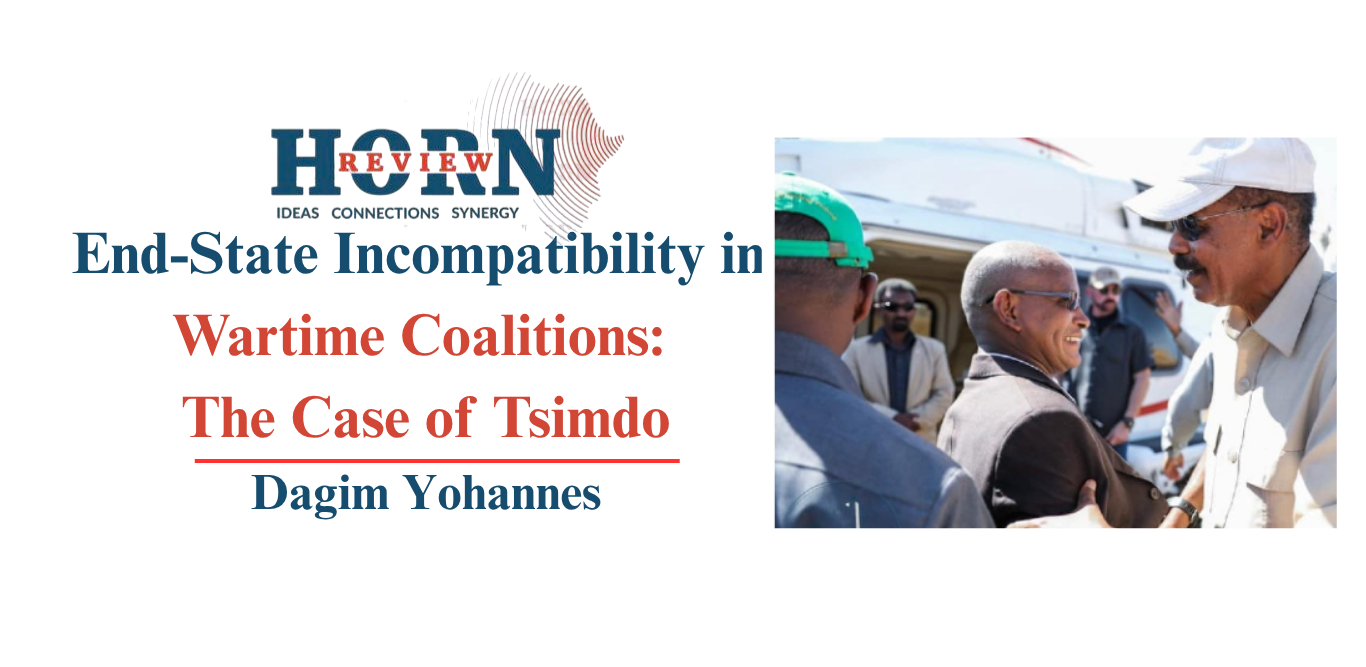
TPLF Deputy Chair Fetlework Gebregziabher recently described the Tsimdo arrangement as purely tactical, and that it could devolve into a “war of champions.” That admission cuts to the heart of the matter. The Deputy is not mistaken, Tsimdo is not an alliance in any meaningful sense, nor is it one that can endure beyond the very enemy it is premised upon. The Tigrinya term, literally “engagement,” has been attached since late 2025 to the loose convergence between the Eritrean government, the Tigray People’s Liberation Front, and factions of the Amhara Fano movement against Ethiopia’s federal government. Addis Ababa calls it a conspiracy for war; Eritrean-aligned media call it a people-to-people reconciliation. Both descriptions miss the more consequential fact: Tsimdo is a coalition assembled entirely around a shared adversary, with no agreement among its members about what the region should look like once that adversary is gone. That absence is the reason Tsimdo will not survive contact with the outcome it is organized to produce.
A strategic alliance requires convergence on two levels: a shared perception of threat, and a compatible vision of the end-state that follows removal of that threat. NATO’s durability rests on the second as much as the first. Tsimdo has only the former. Its three principal actors want the government in Addis weakened or removed, and nothing further unites them, because what each wants to happen afterward is mutually exclusive.
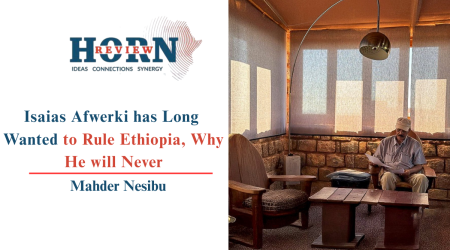
Eritrea’s interest in the alliance is the clearest and the least compatible with the other two. President Isaias Afwerki’s government has spent three decades treating a strong, centralized Ethiopian state as an existential threat regardless of who runs it; Isaias called for the “thorough elimination” of TPLF remnants as recently as 2018. His current tolerance of the TPLF is a wager that a fragmented Ethiopia serves Asmara better than a TPLF-free but strong one, not a reconciliation. Permanent Ethiopian fragmentation is Eritrea’s end-state. It is not the TPLF’s, and it is not Fano’s. This posture is consistent with Eritrea’s post-2018 regional strategy, particularly its security alignment with Addis Ababa following the peace agreement, and its continued emphasis on neutralizing TPLF as a military and political force.
The TPLF’s objective is close to the opposite: restoration of Tigray’s political and territorial standing within a revised federal order, not federalism’s dissolution. That already collides with Fano’s claims. Wolkait and Tselemt sit at the center of both Tigrayan and Amhara nationalist claims, and no version of Tsimdo has produced a formula for resolving that contest, its members have simply agreed not to fight over it while Addis Ababa remains the more urgent target. Deferral, not resolution. Following the 2022 Pretoria Agreement, TPLF formally recommitted to the federal constitutional order, including provisions affirming regional sovereignty positions fundamentally at odds with Eritrea’s centralized security outlook.
Fano’s presence in the coalition is the most fragile of the three, resting on the shortest and most contradictory history. Fano militias fought on the federal government’s side against the Tigrayan Forces in 2020–2022; the rupture with Addis Ababa came afterward, over disputes unrelated to Tigray or Eritrea. Its alignment with former battlefield enemies is opportunism following a falling-out with a third party, not a newly discovered common cause. Nor is Fano unified enough to bind to anything durable: efforts to centralize its command, including the formation of the Amhara Fano National Movement this year, have not produced an organization capable of committing the movement to a coalition position and making it stick.
None of this has been institutionalized, which is itself the tell. A genuine strategic alliance produces structure: joint command, formal agreements, durable diplomatic representation. Eleven months after Ethiopia’s foreign minister accused Eritrea and the TPLF of organizing Tsimdo in an October 2025 letter to the UN, what exists is summit diplomacy, secret contacts in Dubai, a public gathering in Port Sudan, and coordinated messaging. Neither government has publicly confirmed a formal alliance exists, which is not deniability so much as an accurate description of how thin the arrangement is.
The coalition is also unstable within its own strongest member. The TPLF retains relative control over Tigray largely through its military might, yet this control does not translate into political unity. Tsadkan Gebretensae’s forces, Getachew Reda’s Simret faction, and the breakaway Tigray Peace Force continue to contest TPLF authority inside the region, in some cases with Addis Ababa’s backing. A partner that cannot secure genuine internal cohesion and that rests primarily on force rather than broad consent cannot credibly trade concessions on behalf of the people it claims to represent.
There is a deeper contradiction at work. The TPLF once correctly accused the federal government of inviting a foreign army, Eritrea onto Ethiopian soil to fight against its own citizens. That charge carried moral and political weight. Yet the same leadership is now engaging with the same foreign actor in ways that compromise the very principle of sovereignty it once defended, trading long-term claims for short-term political leverage. The inconsistency is not lost on those watching from inside Tigray.
The “people-to-people” framing that Eritrean-aligned outlets have attached to Tsimdo, border reopenings, reunions at Zalambessa and Badme, invocations of shared Tigrinya kinship describes something real, but a different phenomenon than the elite pact riding on top of it. Grassroots reconciliation after 2020–2022 reflects exhaustion and cross-border ties predating any of this; it resolves neither accountability for Eritrean conduct in that war nor Wolkait, Tselemt, or the unimplemented Pretoria framework. Citing popular reconciliation as evidence of elite alignment inverts the causal relationship: the elites are borrowing legitimacy from the people, not building an alliance on their behalf.
The forecast this generates is specific enough to be tested. Coalitions built on a shared adversary do not fragment gradually; they fracture the moment that adversary is sufficiently weakened. Should the federal authority erode further through continued Fano and OLA pressure, or a harder TPLF push in the north Tsimdo’s contradictions will not resolve. They will explode into the open. Eritrea’s interest in permanent Ethiopian fragmentation will collide with the TPLF’s demand for a restored federal seat. Fano’s territorial claims will collide with Tigray’s. The coalition will not need an external enemy to destroy it. It already carries the terms of its own dissolution inside it.
Yet the temporary nature of this elite alignment does not make it harmless. Because it is driven by short-term calculations among leadership rather than by any shared vision for the populations they claim to represent, its most likely consequence is prolonged instability along the Ethiopia–Eritrea–Sudan borders. Communities already scarred by the 2020–2022 war risk renewed displacement, cross-border raids, disrupted livelihoods, and the further militarization of daily life. Even if the coalition collapses once Abiy is weakened, the damage it may inflict in the meantime on civilian populations, on fragile local economies, and on the region’s already thin trust networks, will outlast the political arrangement that caused it.
Tsimdo is a real near-term threat to Addis Ababa. It is not a durable realignment. Alliances of convenience buy their members time, not outcomes, and the outcome each of Tsimdo’s members actually wants is one the other two cannot accept. When the common enemy is gone, they will discover they were never allies. They were only temporarily useful to one another. The danger is that ordinary people along the borders may first be made to absorb the cost of that discovery.
By Dagim Yohannes, Researcher, Horn Review