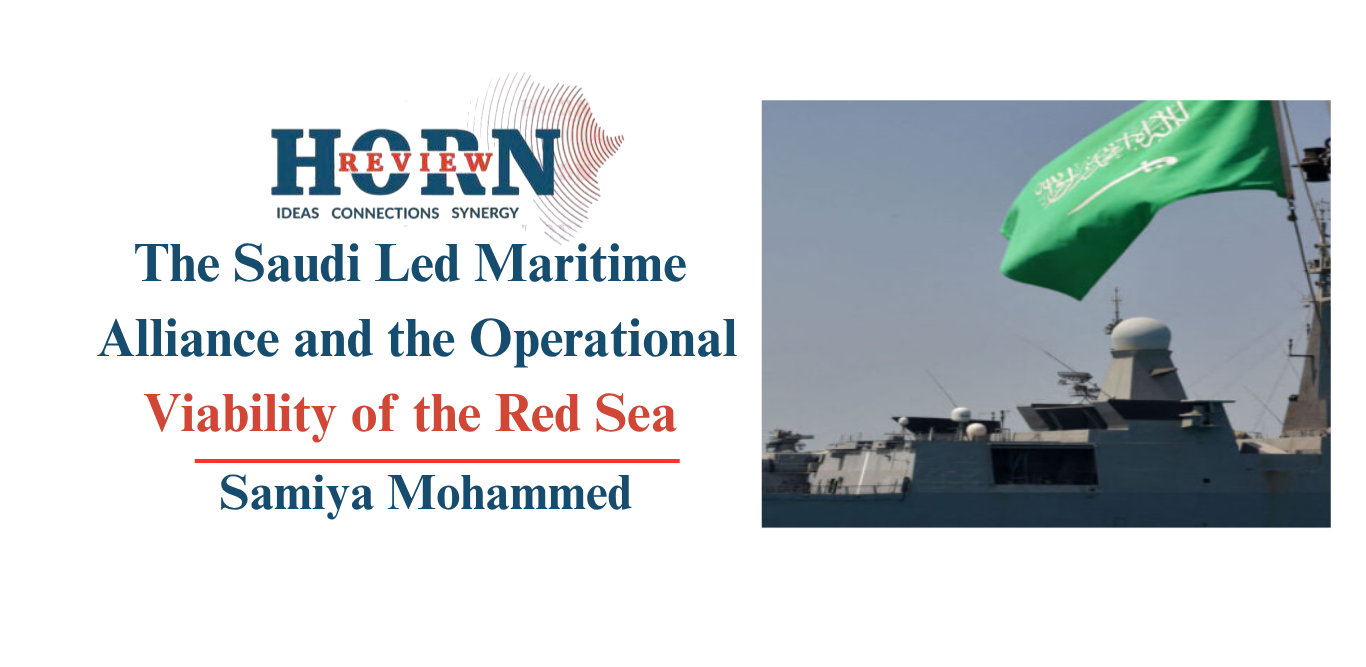
By Samiya Mohammed, The announcement of a Saudi led multinational maritime defence alliance drawing together fifty nations is a determined effort to shape the security arrangements governing the Red Sea. The founding and supporting members being Saudi Arabia, Egypt, Yemen’s internationally recognized government, Somalia, Djibouti, Sudan, Jordan, Bahrain, Kuwait, Qatar, Turkey, Pakistan, Bangladesh and Nigeria form a numerically substantial coalition. However a reading of power distributions, geography and the nature of the actual threats moving through these waters suggests the initiative will struggle to translate diplomatic ceremony into operational effect. The project risks becoming an exercise in political language that recedes within months into low level intelligence exchanges and periodic communiqués.
The central security challenge today is not a conventional naval confrontation however an asymmetric threat emanating from the Yemeni coast. Ansarallah which is the Houthi movement controls the decisive western stretches of Yemen’s Red Sea coastline including the port of Hodeidah and the maritime approaches to the Bab al Mandab strait. The group has already demonstrated an ability to strike vessels with anti ship missiles, explosive laden drone boats and aerial drones. Credible intelligence now indicates that the Houthis are preparing to formalize their leverage by imposing transit tolls on vessels passing through Bab al Mandab in which a model that explicitly mirrors Iran’s practice in the Strait of Hormuz and reportedly benefits from IRGC advisory support. Any security structure that cannot meaningfully address this reality is fundamentally ornamental.
The presence of the internationally recognized Yemeni government in the coalition provides diplomatic cover and the symbolic continuity of state sovereignty. Its actual contribution to maritime security however is extremely limited where it matters most. The recognized government does not control a single major Red Sea port that is relevant to the Houthi threat. Its effective territorial writ is concentrated in the south and along parts of the Gulf of Aden and it holds no authority over the critical Red Sea stretches, the port infrastructure opposite Bab al Mandab or the coastal launch sites from which Houthi missiles and drones operate. Expecting this to meaningfully deter, interdict or collect intelligence on Houthi attacks or fee collection mechanisms is a category error. The government’s inclusion serves a political function and preserves the fiction of a unified Yemeni state within a multilateral framework but it adds no decisive operational capability to the protection of Saudi flagged shipping or international freedom of navigation in the point itself.
Somalia’s participation must be assessed with equal clarity. Somalia is a signatory but its relevant coastline is oriented toward the Gulf of Aden and the Indian Ocean and not the core Red Sea. The distance from Mogadishu to the Bab al Mandab strait is roughly a thousand miles and the Somali maritime domain is separated from the critical threat zone by the entire expanse of the Gulf of Aden. While Somalia has legitimate interests in combating piracy, illegal fishing and general maritime crime, it is not a core Red Sea littoral power capable of projecting sustained naval force into the waters where Houthi drones and missiles travel. The Somali navy remains heavily dependent on external support and preoccupied with immediate coastal security tasks. Framing Somalia as a frontline actor in a Red Sea shield against Iranian backed precision strikes is a stretch that confuses geographic adjacency with operational reach.
The coalition’s composition also reveals a set of telling absences. Not participating is the African state that sits opposite the Bab al Mandab on the western shore. Likewise missing is the Gulf state that has accumulated the most extensive recent operational experience in Yemeni littoral and maritime security including direct involvement in securing ports, training local forces and running counter smuggling interdiction campaigns along the Yemeni and Horn of Africa coasts. That state’s expertise, intelligence networks and deployable assets would have been among the few elements that could give the framework practical bite against asymmetric actors. Without that experience and without the proximate African geography, the alliance is essentially trying to secure a strait from a distance using nations that lack direct access to the battle space.
The Egyptian turn is especially revealing of the political forces at work. Only weeks before the coalition was set, Egyptian and Eritrea were promoting a doctrine that Red Sea security and governance must remain the exclusive preserve of the littoral states explicitly rejecting the involvement of non littoral powers. Egypt has now abandoned that position to join a Saudi led framework that includes Turkey, Pakistan, Bangladesh, and Nigeria in which states with no coastline on the Red Sea. The reversal reflects competition for primacy. Egypt’s decision to enter the coalition while Eritrea is left out is less a genuine convergence with Saudi than a defensive move to prevent its own marginalization.
Past multilateral maritime efforts in these same waters provide little comfort. Combined Task Force 153, the Combined Maritime Forces’ Red Sea focused arm has existed since 2022. While it improved information sharing and naval diplomacy, it did not prevent Houthi attacks on commercial shipping from escalating in 2023 to 2024 nor did it stop the group from paralyzing a portion of transit traffic through the Bab al Mandab when it chose to do so. The Houthis understand that naval coalitions move slowly, operate under rules of engagement and are constrained by the political red lines of their member states. They have repeatedly demonstrated the ability to impose costs far disproportionate to the investment. A larger coalition with more distant members does not solve this asymmetry and it may only multiply the coordination challenges and creates a wider surface for political friction.
Ethiopia’s exclusion from the structure introduces a flaw that goes far immediate military capability. Ethiopia is the Horn of Africa’s largest economy and population and trade lifeline runs through these waters. Ethiopia has understood that its access to the sea is not just an economic question but a strategic one with existential dimensions. Recent actively pressing forward with plans to reclaim Red Sea island territories underline that Ethiopia now intends to assert as a direct stakeholder in the maritime order and is declaring that the table itself is illegitimately set unless it is present.
A security framework that excludes the region’s demographic and economic heavyweight while including distant nations that will never maintain an operational presence in the zone is structurally imbalanced. The point is that any durable order in the Red Sea must reflect the political and economic realities of the countries whose trade, stability and development depend on uninterrupted passage through Bab al Mandab. Excluding while including nations thousands of miles away undermines the legitimacy and local ownership that any sustainable security arrangement requires. Decisions that affect the Red Sea corridor will be contested by and that contestation alone will erode the coalition’s claim to represent a consensus regional order. The Saudi led alliance is therefore not one of sudden collapse but of gradual deflation. But the mismatch between ambition and capability combined will quickly reduce its operational relevance. Member states will contribute the minimum necessary to avoid diplomacy while avoiding any action that could expose their vessels to combat or their political leadership to blame.
The alliance will not protect Saudi shipping from Houthi missiles, Iranian drones or the risk of piracy in any manner fundamentally different from the existing patchwork of national escort missions and routing decisions. Ignoring the asymmetric control of the Yemeni coast, overrating the contributions of the recognized Yemeni government and Somalia, omitting the most experienced Gulf security actor and structurally excluding Ethiopia is a recipe for a still born plan. The coalition as currently constituted is an answer to a political question about Saudi leadership, not a solution to the security problem that is actually happening on the water.
By Samiya Mohammed, Researcher, Horn Review