Sawa’s Conveyor Belt: How Eritrea Swaps Classrooms for Barracks
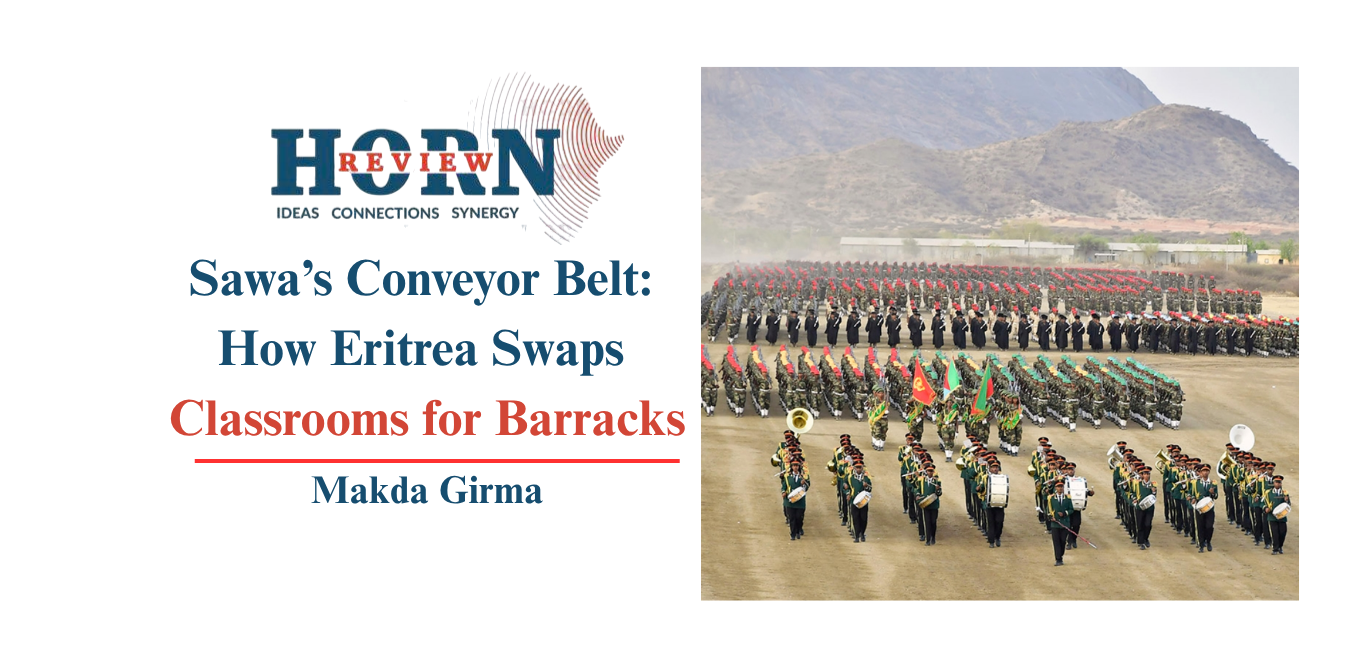
On July 11, 2026, Eritrea celebrated the graduation of the 38th Round of National Service at Sawa. President Isaias Afwerki, senior government officials, military commanders, members of the ruling People’s Front for Democracy and Justice and invited guests watched as graduates marched in formation. Music, speeches and a military parade presented the ceremony as a national achievement built around discipline, unity and sacrifice. President Isaias congratulated the students and encouraged them to continue their studies regardless of their examination results.
Behind the ceremony, however, lies a system that has steadily erased the distinction between education, military recruitment and compulsory state labor. Sawa is not simply a secondary school located beside a military training centre. It is a structural funnel through which Eritrea moves young people from the classroom into national service. By requiring students to complete Grade 12 inside a military camp, the government makes academic advancement dependent on submission to military authority.
The experience of the 38th Round demonstrates how closely the different stages are connected. Students began departing for Sawa in July 2025. They received Grade 12 instruction from August 2025 until March 2026, followed by military and political training from April until their graduation in July. The completion of secondary school and preparation for military service therefore occurred within the same institution and under the same chain of authority.
The examination results revealed how narrow the path into higher education remains. Of the 21,561 candidates who sat for the National School Leaving Examination in March 2026, only 4,831, or 22.4%, achieved scores qualifying them for degree or diploma programs. Nearly 78% did not reach that threshold. The national total included regular students, repeat candidates and students at Eritrean community schools in Saudi Arabia, so it should not be treated as the precise number of students graduating from Sawa. It nevertheless represents the academic gate through which the central body of the 38th Round was required to pass.
The official argument is that Sawa promotes equality, discipline and national cohesion by bringing students from every region into one institution. Yet the physical and political design of the system suggests a broader objective. The final year of secondary education is conducted in a guarded military camp and followed immediately by decisions determining whether a student enters a public college, vocational training, civilian national service or a military assignment. Education does not stand apart from conscription. It has become the principal administrative mechanism through which conscription is organized.
This transformation began in 2003, when the Eritrean government required students throughout the country to complete Grade 12 at the Warsai Yikealo Secondary School inside the Sawa military complex in western Eritrea. Since then, thousands of students have been transported from their communities to the camp each year, including some who reportedly arrived before turning 18.
The policy institutionalized a direct pipeline between school and national service. Students cannot complete ordinary secondary education without entering a military controlled environment. Their movement, accommodation, study schedules, discipline and access to rest are regulated by military authorities. Human Rights Watch has described Sawa as a fenced and guarded complex where students sleep in large hangars and remain under military command even during the academic phase.
Teachers are caught inside the same structure. Eritrea relies heavily on university graduates assigned through national service to staff secondary schools. Many have little control over where they are deployed, which subject they teach or how long they remain in the profession. Graduates trained in engineering, agriculture, business or other fields may be assigned to teach mathematics, science or English, sometimes without adequate teacher training. The result is a closed educational system in which conscripts teach the next generation of conscripts.
Government control over education also continues beyond Sawa. The closure of the University of Asmara in 2006 completed the second half of the institutional pipeline established three years earlier. The university had been Eritrea’s only university and its most important concentrated centre of academic life. Although it was not formally independent of the state, it brought students, lecturers and intellectuals together in a space where discussion and collective organization remained possible.
This had already become politically sensitive. In 2001, university students protested government efforts to compel them to participate in a state summer work program. A United Nations Commission of Inquiry later concluded that the university’s closure was connected to the government’s determination to prevent further student protest.
The university was replaced by geographically dispersed public colleges, including the Eritrea Institute of Technology at Mai Nefhi and other specialized institutions. Officially, this was presented as an expansion and decentralization of higher education. Structurally, however, it dispersed students across smaller institutions and removed the single national campus that had allowed a large academic community to form in Asmara.
No private universities operate in Eritrea. Students who qualify for higher education therefore have no independent domestic alternative to the public college system. They study within institutions controlled by the state, remain subject to national service obligations and are generally returned to government assigned employment after graduation.
The importance of this arrangement is not simply that the state owns the colleges. It is that higher education does not create a route out of military and administrative control. The government controls the entry point through Sawa, the destination through the public college system and the employment outcome through national service. Closing the University of Asmara ensured that students passing through Sawa would not enter an autonomous academic sphere on the other side.
This wider structure also shapes academic performance. The poor results recorded in 2026 should not be viewed merely as an accumulation of individual failures. Students prepare for a decisive national examination while separated from their families, living under military discipline and facing physical exhaustion. Former students have described inadequate food, limited medical care, compulsory work and military activities that consume time intended for rest and revision. Commanders can impose duties without regard for academic schedules.
The system then punishes students for academic outcomes produced within this environment. Those with the highest results may enter degree or diploma programs. Those with lower marks can be assigned to vocational training, civilian labor or military units. Examination performance therefore becomes a mechanism through which the state sorts young people into different forms of compulsory service.
Daily life at Sawa reinforces this transformation from student to conscript. Although the official calendar distinguishes the academic period from the later phase of military and political training, military authority governs the entire year. Former students have reported marching to class under supervision, restrictions on movement and speech, and punishment for lateness, oversleeping or minor infractions. Reported punishments include beatings, forced exercises, prolonged exposure to the sun and compulsory labor. Human Rights Watch found that military discipline frequently interfered with students’ study and rest time.
These conditions shape the psychological purpose of the institution. Sawa teaches students that personal ambition must remain subordinate to a state narrative centred on national survival, sacrifice and permanent military readiness. Education becomes less a route toward an independent professional future and more a process of conditioning young people to accept hierarchy, compulsory labor and restricted choice as normal features of adult life.
That conditioning is not incidental to Sawa’s design. The Eritrean Ministry of Information itself describes the academic, military and political education conducted there as a form of political socialization intended to connect young people to the liberation struggle, teach prescribed duties and align them with national goals. Human Rights Watch likewise reports that Grade 12 students complete compulsory political education alongside military training. In a state where the PFDJ is the only permitted political party, this is not ordinary civic education conducted within an open political system. It is a closed ideological process in which the ruling front defines patriotism, history, sacrifice and citizenship without exposure to competing political ideas.
The ideological message is reinforced by the structure surrounding it. Sawa teaches that the individual exists within a permanent national emergency and that personal plans acquire legitimacy only when they serve the state. The distinction between loyalty to Eritrea and loyalty to the PFDJ is consequently blurred. A student is not invited to debate the meaning of citizenship or choose among competing visions of the country’s future; the acceptable future has already been defined through discipline, self sacrifice, obedience and readiness for service. Indoctrination is therefore not limited to classroom lectures. It is embedded in the daily experience of command, punishment, uniformity and the absence of alternatives.
Sawa therefore performs two functions simultaneously. It identifies the minority of students who will be allowed to continue into higher education while conditioning the wider cohort to accept military authority. Whether a student is sent to a college, workshop, ministry, construction project or military unit, the state remains the institution deciding what follows.
The indefinite nature of national service makes this lack of choice especially significant. Eritrea’s National Service Proclamation, issued in 1995, established an 18 month period of compulsory service. This was intended to include military training followed by military or development work. The legal limit was effectively displaced after the border war with Ethiopia between 1998 and 2000. The government argued that the unresolved border dispute required permanent mobilization, turning a fixed obligation into service that could continue for years or decades.
The 2018 peace agreement between Eritrea and Ethiopia appeared to remove the main security justification for indefinite service. The border reopened briefly, separated families were reunited and many Eritreans hoped that demobilization would follow. It did not. Instead, the government found a new regional emergency through which continued mobilization could be justified.
When war began in Tigray in November 2020, Eritrean forces entered northern Ethiopia. National service conscripts formed part of the forces deployed in the conflict.
The Tigray War transformed the meaning of Sawa for another generation of Eritreans. Before the conflict, the government could still present national service as a mixture of defence, agriculture, infrastructure work, teaching and national development. The war demonstrated that a student passing through Sawa could later be sent into lethal combat beyond Eritrea’s borders.
The number of Eritrean soldiers killed or wounded remains unknown because the government has not published a comprehensive casualty list. A 2025 report by Belgium’s refugee authorities concluded that thousands of Eritrean conscripts were believed to have been killed or seriously wounded in Tigray, while also emphasizing the absence of official figures. Families could receive informal news of a death while being unable to mourn publicly until the state formally recognized the person as a martyr.
For the members of the 38th Round, the conflict is not distant history. They grew up while older siblings, relatives and neighbours were mobilized. The war shattered any remaining assumption that national service was primarily a civilian development program. It showed that the government could move conscripts from classrooms, colleges and government offices into an active regional conflict whenever political circumstances changed.
The war also strengthened the machinery of coercive recruitment. Mobilization intensified during the conflict and again during the major Eritrean and Ethiopian offensive in late 2022. Authorities recalled reservists, searched homes, established checkpoints and expanded the range of people targeted for military service, including older men. Although some Eritrean forces returned from Tigray in 2023, the national service system itself remained untouched.
The government had effectively shifted the goalposts. Before 2018, indefinite service was justified by the unresolved border with Ethiopia. After reconciliation, the Tigray War supplied a new emergency. Following that conflict, renewed tensions with Ethiopia and broader regional uncertainty continued to sustain the language of national vigilance. The security explanation changes, but demobilization never arrives.
For those who qualify for college, higher education still does not offer an escape from this cycle. Examination results may determine which institution and program a student enters, but graduates are generally assigned back into national service. They may become teachers, health workers, engineers, technicians or administrators, frequently with little control over their occupation or place of work.
This produces a closed loop economy. The state controls the movement from school to college, from college to employment and from employment to eventual release. A graduate cannot reliably choose an employer, negotiate a market wage, relocate freely or resign from an assigned position.
The economic consequences deepen this dependence. Current official pay scales are not published transparently and compensation varies according to assignment and qualification. Recent country reporting nevertheless continues to describe national service pay as minimal. Workers without educational or vocational qualifications may receive food or other rations instead of part of their wages, while educated civilian conscripts often need informal work or assistance from relatives to survive.
Education therefore does not necessarily produce economic mobility. A degree may change the form of compulsory assignment, but it does not guarantee professional autonomy or a salary reflecting the value of the person’s training. Teachers, doctors, engineers and administrators can remain tied to government positions under the same indefinite structure governing military personnel and manual workers.
This pressure is intensified by Eritrea’s restrictive financial system. The United States government reported in its 2025 investment assessment that individuals were limited to monthly bank withdrawals of 5,000 Nakfa and were generally unable to withdraw United States dollars. Private banks are prohibited, access to foreign currency is tightly controlled and the wider private sector remains severely restricted.
The result is a state enforced poverty trap. Young professionals struggle to save money, start businesses, secure housing or plan independent family lives. The problem is not simply that the government chooses their first job. The system also limits their capacity to accumulate enough income to build a life beyond state employment.
What is taken from conscripts is therefore not only income or freedom of occupation, but civil life itself. Indefinite service removes the stable horizon around which an adult future is normally built. A young person cannot know when service will end, where he or she will live, whether a chosen profession can be pursued, or whether earnings will support housing, marriage, children or the care of parents. Human Rights Watch has found that many Eritreans spend their entire working lives in military or civilian service and that Sawa graduates have little say over where they live, work or serve. Under those conditions, adulthood becomes a prolonged assignment rather than an independent life.
This is the lasting political effect of the system. By consuming the years in which people would normally establish careers, families, associations and independent economic networks, national service weakens the foundations from which civil society could emerge. The state is not merely directing labor; it is occupying the time, mobility and material security required for citizens to build institutions and futures beyond its command. The result is a population kept in permanent transition, old enough to carry national obligations but denied the predictability needed to form a lasting civilian future.
This economic structure transfers much of the cost of survival to Eritreans abroad. Diaspora remittances function as a social safety net for many households. Families inside the country remain heavily dependent on relatives abroad for food, medical expenses and everyday consumption. The state extracts labor from citizens at home while relying on the earnings of citizens who have left to compensate for the poverty created by the same system.
National service therefore performs an economic as well as political function. By keeping compensation low, restricting private enterprise and controlling financial transactions, the state prevents the emergence of an economically independent professional class. A doctor, teacher or engineer who depends on a government assignment and assistance from abroad has little room to challenge the system controlling both employment and survival.
Because Sawa stands at the entrance to this indefinite cycle, some students resist by undermining their own education. Human Rights Watch has documented cases of students intentionally failing classes to remain below Grade 12, leaving school before being sent to Sawa or asking teachers to lower their marks. Some girls and young women enter early marriages or become mothers because marriage and motherhood may reduce the likelihood of conscription, although exemptions remain inconsistent.
These actions expose the deepest contradiction in Eritrea’s education system. Students sabotage their academic futures because academic advancement brings them closer to military control. Remaining behind in school may temporarily delay Sawa, even though it reduces later opportunities.
Leaving school, however, does not guarantee safety. Security forces conduct military roundups, commonly known as giffas, to locate people believed to be avoiding national service. Young people found without documentation proving that they are students, conscripts or legally exempt may be detained and sent directly to military training. Checkpoints, identity inspections and searches of homes turn evasion into a continuous life of hiding.
The danger also extends to the families of those who evade service. Eritrea has repeatedly used collective punishment against relatives of draft evaders and deserters. Earlier country reporting documented fines of up to 50,000 Nakfa, as well as detention of family members who could not pay. More recent mobilization campaigns have involved arbitrary detention, eviction, property confiscation, business closures, seizure of livestock and denial of food ration coupons.
During the mobilization connected to the Tigray War, authorities went from house to house searching for missing recruits. Parents, elderly relatives and women with young children were detained or expelled from their homes when family members failed to report. Shops were closed, livestock was confiscated and crops were reportedly left unharvested as pressure was placed on households to surrender sons, daughters and other relatives. Neighbours could also be threatened for sheltering families that had been evicted.
Evasion is therefore not an individual decision. A young person considering escape must also consider the possible imprisonment of a parent, the closure of a family business, the loss of a home or the withdrawal of food support. The state turns family relationships into instruments of enforcement, making every household partly responsible for policing the national service status of its members.
This system helps explain why so many Eritreans ultimately choose to leave the country rather than remain in hiding. Yet departure carries its own dangers. Most young Eritreans cannot obtain passports and exit visas legally, forcing them to cross clandestinely into Ethiopia or Sudan. From there, many face trafficking, detention, violence and dangerous journeys through Libya and across the Mediterranean.
By 2025, approximately 679,346 Eritreans were recorded as refugees or asylum seekers outside the country, equivalent to roughly 11 percent of the estimated national population. Indefinite national service is not the only cause of this exodus, but it remains one of its most important structural drivers. The loss is not limited to population numbers. Those leaving include students, teachers, health workers, technicians and university graduates. Eritrea invests scarce resources in their education and then places them in a system offering limited autonomy, uncertain release and inadequate compensation. Many eventually transfer their knowledge and labor to the countries in which they seek refuge.
Against this wider reality, the graduation of the 38th Round appears less like the completion of an educational journey and more like the continuation of a state managed cycle. Sawa processes each generation through the same sequence: removal from local schools, residence under military authority, a decisive national examination, ideological and military training, and eventual assignment into college, vocational training, civilian labor or military service.
This continuity should not be confused with progress. A state capable of mobilizing its youth is not necessarily capable of developing them. Eritrea’s system uses education primarily to distribute labor, reproduce military discipline, transmit PFDJ political ideology and prevent the emergence of independent social and economic power. Its deepest achievement is not merely the recruitment of soldiers and workers, but the removal of the civilian future in which young people might become autonomous professionals, parents, organizers and citizens.
The closure of the University of Asmara removed the country’s principal concentrated academic space. The absence of private universities ensures that successful students have no alternative domestic route. Minimal national service compensation and financial controls prevent graduates from translating education into economic independence. Giffas and collective punishment make evasion dangerous not only for individuals but for their entire families. The Tigray War demonstrated that the final destination of the pipeline can include combat and death outside Eritrea.
President Isaias’s appeal for the latest graduates to continue their studies regardless of their examination results therefore exposed the central irony of the ceremony. The statement appeared to recognize that one examination should not determine the future of a young person. Yet the state’s own architecture gives that examination extraordinary power while denying students meaningful control over what comes next.
For the 4,831 candidates who qualified for degree or diploma programs, education may continue, but only inside a state controlled system and under the shadow of later national service assignments. For the majority who did not qualify, the promise of further study competes with the immediate demands of military training, vocational placement and compulsory labor.
The 38th Round is therefore not simply another graduating class. It is another generation entering a system in which the classroom leads to the barracks, the college leads back to national service and regional conflict can transform a compulsory assignment into a battlefield deployment. Until Eritrea separates education from recruitment, restores the legal limit on national service and permits genuine academic, political and economic independence, Sawa will remain less a school than a conveyor belt carrying the country’s youth away from civilian adulthood and into a stagnant future defined by permanent service.
By Makda Girma, Researcher, Horn Review

RELATED
Posts
7
Sep
Abiy Ahmed and the Remaking of the Ethiopian State
Blen Mamo
The political trajectory of Abiy Ahmed cannot be adequately...
3
Sep
Is Ethiopia Ready for a Presidential System?
By Blen Mamo
Ethiopia has spent much of its modern political...
28
Aug
Ethiopia-U.S. Strategic Defense Partnership
The recalibration of United States–Ethiopia relations recently reflects a deeper...
20
Aug
Eritrea’s Buffer Zone Politics from Eastern Sudan to Ethiopia's Tigray
The most consequential development in the Horn of Africa may...
14
Aug
Ethiopia’s Withdrawal from Burhakaba and What Comes Next for Al-Shabaab?
The recent handover of the Burhakaba forward operating base...
13
Aug
What Another War Against Ethiopia Could Mean for Eritrea’s Future
Another Ethiopia–Eritrea war would not be a replay of 1998....