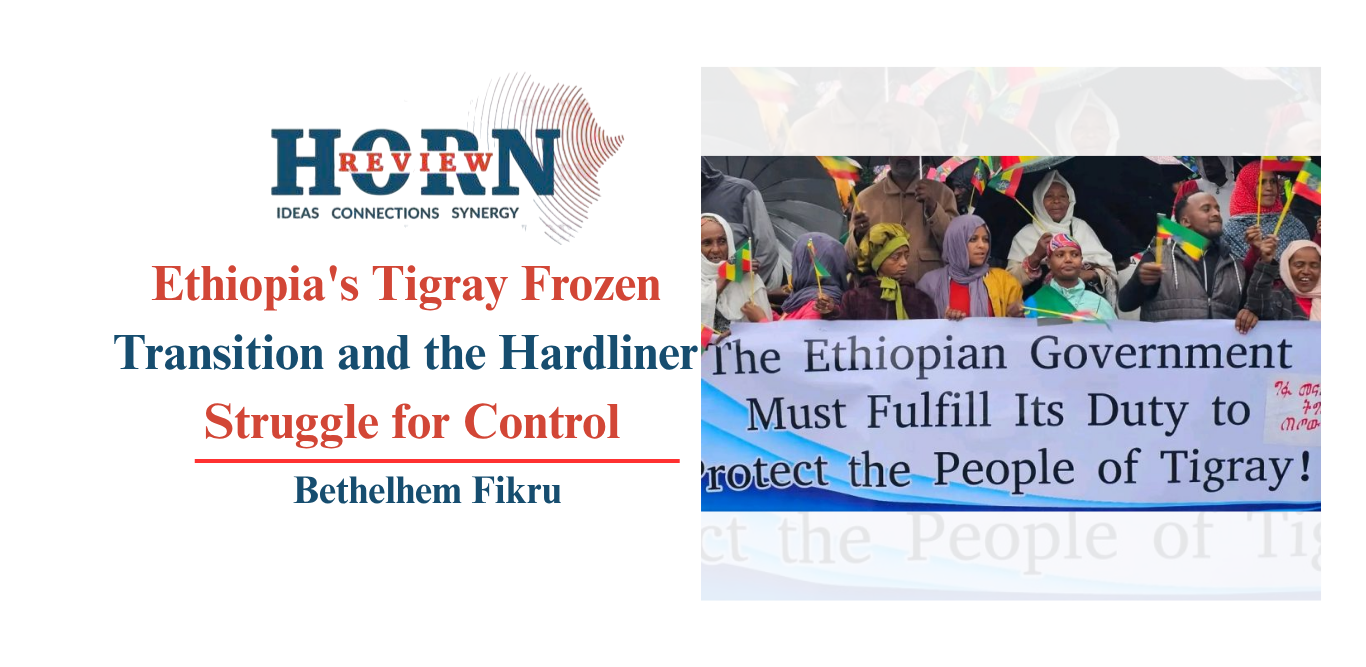
In mid-July 2026, thousands of Tigrayan demonstrators gathered at Meskel Square in Addis Ababa to express grave concerns over alleged forced conscription , political restrictions, and heightened militarization attributed to dominant factions of the Tigray People’s Liberation Front (TPLF) within the region. Organized by the Tigray Peace and Change Council, the rally was more than a protest against immediate grievances , it represented a breaking of the monopoly on the Tigrayan narrative by diaspora and displaced voices demanding an end to cycles of suffering. Far from isolated defiance, the underlying dynamics reveal hardline TPLF factions deliberately constructing a parallel sovereignty in Tigray that actively undermines the Ethiopian federal project and risks turning the region into a de facto failed transitional zone.
This strategy carries a striking historical irony. The TPLF, which once battled Eritrean forces, now appears to be internalizing the Shabia (EPLF/PFDJ) model of governance. After independence, Eritrea institutionalized the Warsai Yikaalo National Service, transforming society into a permanently militarized garrison under the pretext of existential threats. The result was total societal securitization and the fusion of party, state, and military into a single ruling apparatus. Echoes of this approach , including alleged recruitment pipelines feeding fighters into Sudan’s conflict zones and the suppression of moderate voices reveal the TPLF hardliners’ intent to prioritize factional survival over civilian welfare. In the Horn of Africa, wartime parties that refuse to demilitarize politically, whether Somali regional strongmen or Eritrean stalwarts, consistently produce the same outcome, perpetual instability dressed as resistance.
The human cost underscores a troubling dynamic of hostage politics, in which Tigrayan civilians, particularly the youth ,are increasingly treated as instruments in factional power struggles. Reports of forced recruitment, the alleged movement of young people toward active conflict zones in Sudan, obstructions to development initiatives, and restrictions on figures such as Gen. Tadesse Worede suggests that segments of the population are being leveraged to sustain political and military objectives rather than being supported as citizens entitled to protection and opportunity. This pattern reflects what can be described as an elite capture of victimhood, whereby the suffering endured during the war is invoked to legitimize ongoing control, often at the expense of broader post-conflict recovery efforts and dissenting voices within the community. In this context, the Meskel Square demonstrators represent an important counter-narrative, challenging these practices and calling for greater accountability and genuine civilian-centered governance.
At a broader level, the crisis illustrates the vulnerabilities of a stalled political transition. Rather than functioning as a comprehensive framework for sustainable peace, the Pretoria Agreement primarily established a cessation of hostilities. Its lingering structural ambiguities ultimately compromised the operational effectiveness of the Interim Regional Administration from its inception. Responsibilities must be attributed both to centralizing pressures from the federal government and to unyielding political postures within the regional leadership.This “frozen transition trap,” familiar from South Sudan’s endless elite pacts and Somalia’s fragmented fiefdoms, turns interim institutions into arenas of contestation rather than foundations for stability. Furthermore, persistent friction surrounding international diplomatic engagements, including logistical and security impediments during the U.S. Ambassador’s visit, signals a severe erosion of transitional legitimacy. Without decisive diplomatic re-engagement and structural reform, the risk of renewed large-scale conflict remains heightened.
Underneath the immediate political crisis lies a profound ideological fracturing. A movement that once built its reputation on strict organizational coherence and strategic clarity is now succumbing to classic post-conflict decay. By sidelining pragmatic voices from within its ranks, silencing internal opposition, and relying on heavy-handed mobilization, the old guard is revealing its institutional obsolescence. The organization may have navigated the complexities of armed conflict, but it is proving ill-equipped to manage the demands of peacemaking and civilian governance. Ultimately, the primary vulnerability facing the region today is not an outside adversary, but an entrenched leadership holding Tigray’s future hostage to its own history.
The implications for the Horn are grave. Tigray’s implosion threatens direct Ethiopia-Eritrea escalation, with both TDF remnants and other forces reportedly active in Sudan’s war, further destabilizing the Red Sea corridor and IGAD’s fragile security architecture.
A bold way forward is essential. The African Union should lead binding arbitration to enforce clear timelines for demobilization, inclusive governance, and transitional justice. An inclusive Tigrayan national conference must be convened. International aid and engagement should be made conditional on verifiable progress toward demobilization, free movement, and an end to hostage politics.
Fundamentally, the TPLF in its current posture remains a structural obstacle to regional recovery. By clinging to an outdated vanguard model defined by party-state dominance and perpetual mobilization, it risks steering Tigray toward the very isolation and stagnation it historically opposed. To play a constructive role in a stable future, the party must undergo deep ideological and structural reform, formally decoupling from military apparatuses, abandoning unilateral control, and embracing genuine democratic power-sharing. Ethiopia and its regional partners must not let an organization’s survival instincts compromise the peace of an entire region. The calls for change at Meskel Square are clear, sustainable stability requires a reformed leadership capable of transitioning from wartime governance to democratic accountability.
By Bethelhem Fikru, Researcher, Horn Review