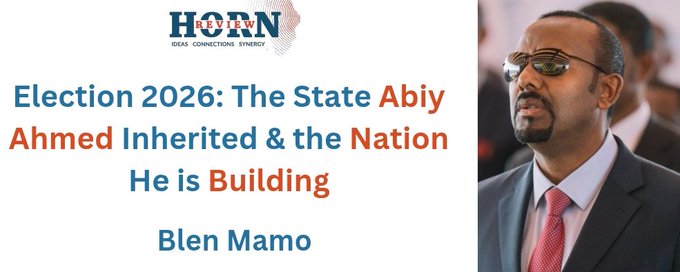
Election 2026: The State Abiy Ahmed Inherited and the Nation He Is Building
By Blen Mamo
When Abiy Ahmed assumed office in 2018, Ethiopia was already approaching the limits of the political settlement that had defined its trajectory since the early 1990s. The Ethiopian People’s Revolutionary Democratic Front (EPRDF) had overseen a period of rapid state expansion, infrastructure growth, and sustained macroeconomic gains, yet beneath these indicators lay a progressively weakening governing architecture. The legitimacy+} crisis that emerged through sustained protests in Oromia and Amhara between 2015 and 2018 reflected not episodic dissent but structural exhaustion of the ethno-federal order, particularly its reliance on TPLF’s coalition dominance, tightly managed political participation, and an over-securitized model of governance. In essence, Ethiopia entered 2018 with a state that retained administrative scale but had weakened internal coherence.
The state inherited in 2018 was therefore not merely in transition but under structural stress across fiscal, institutional, and coercive dimensions. Fiscal pressures were intensifying, foreign exchange shortages were chronic, and recurrent expenditure was increasingly difficult to sustain within a constrained revenue base and high import dependence. Debt exposure and currency misalignment compounded these pressures, producing an environment in which short-term liquidity constraints periodically affected core state functions, including wage obligations and procurement stability. At the same time, policy execution capacity was uneven across federal and regional layers, reflecting accumulated administrative fragmentation within the federal system. Institutionally, the security and intelligence architecture represented one of the most sensitive fault lines of the transition. The coercive institutions of the state had evolved within the EPRDF framework as vertically integrated but internally segmented structures, with significant influence concentrated within specific coalition components, particularly the TPLF-dominated security establishment. The 2018 transition therefore entailed not only leadership change but a renegotiation of coercive authority across federal and regional lines, producing early discontinuities in command cohesion and contributing to realignments within segments of the security apparatus as institutional loyalty was tested against rapidly shifting political authority.
The core thesis of Abiy Ahmed’s tenure is that Ethiopia’s post-2018 trajectory represents an attempt at simultaneous state reconstitution and political liberalization under conditions of elite rupture, institutional fragmentation, and heightened geopolitical exposure. This dual-track transformation – opening the political arena while restructuring the state – generated both reform momentum and systemic instability. The early governance agenda combined rapid political liberalization with structural redesign. The release of political prisoners, legalization of opposition movements, restoration of exiled actors, and expansion of media space marked a sharp departure from prior governance constraints. In parallel, the normalization of relations with Eritrea represented a major regional recalibration, shifting Ethiopia from a long-standing posture of frozen hostility to diplomatic engagement and strategic repositioning in the Horn of Africa. However, liberalization occurred alongside elite restructuring that disrupted the prior federal equilibrium. The dissolution of the EPRDF and formation of the Prosperity Party was intended to move beyond ethnically segmented coalition governance toward a civic nationality oriented national political framework. In practice, this reconfiguration triggered resistance from entrenched regional power centers and aligned bureaucratic networks in Tigray and parts of Amhara and Oromia, embedded in the previous order – reflecting not only ideological disagreement but displacement of administrative authority, security influence, and patronage structures accumulated over decades. The outbreak of the Tigray conflict in 2020 must be understood within this broader breakdown of inter-elite consensus, contested constitutional interpretations, and collapsing trust between federal and regional authorities. The conflict evolved into a multi-layered war involving regional forces, federal institutions, and external dynamics, producing one of the most complex and contested conflicts in contemporary African politics. Its aftermath continues to shape governance, intergovernmental relations, and Ethiopia’s external perception.
Economically, the post-2018 period has been defined by attempted restructuring under severe constraint. Structural foreign exchange shortages, inflationary pressure, and external shocks – including pandemic disruptions, global commodity inflation, and conflict-related fiscal strain – have required gradual macroeconomic recalibration. Home grown economic reform efforts have focused on stabilizing macroeconomic fundamentals, cautiously expanding private sector participation, and adjusting long-standing state-led development structures toward a more mixed and externally integrated model. However, this reform path contains an inherent tension: the simultaneous pursuit of liberalization, developmental state continuity, and wartime fiscal pressure has produced a structurally constrained policy environment in which trade-offs are persistent rather than temporary. As stated above, this period was further destabilized by overlapping global shocks that amplified domestic vulnerabilities. The COVID-19 pandemic disrupted supply chains, reduced service-sector activity, constrained fiscal space, and placed additional pressure on an already strained public health system. At the same time, the Russia-Ukraine war triggered global inflationary pressures, particularly through fuel, fertilizer, and wheat price shocks, which had direct transmission effects on Ethiopian urban cost-of-living conditions and import-dependent macroeconomic stability. These external shocks interacted with domestic conflict dynamics, producing a compounded stress environment for households and state finances alike. Parallel disruptions in global energy markets and shipping insurance costs further tightened external conditions for a structurally import-reliant economy. And most recently, Ethiopia also faced indirect geopolitical spillovers from wider Middle Eastern tensions, including Iran-Israel-US war, closure of the Strait of Hormuz, and Red Sea security uncertainties. These dynamics affected maritime logistics, trade routing costs, and regional risk pricing, embedding Ethiopia more deeply into a global system of interconnected security-economic feedback loops.
Institutionally and socially, governance priorities gradually expanded toward longer-term state capacity building and generational investment. This included early childhood development initiatives, expansion of basic public services, and efforts to normalize community infrastructure in rapidly urbanizing areas. Education and health reforms – including but not limited to rural and urban school projects for both the able and the disable, free school uniform and school meal across the country, state subsidised national health insurance, modernisation of state funded hospitals and so forth – sought to address longstanding disparities in access and quality, though implementation has been uneven across regions due to administrative capacity gaps and localized insecurity. Parallel efforts to strengthen domestic industrial capacity and strategic production reflect a broader shift toward economic sovereignty and resilience. A further emerging dimension of governance in this regard has been the increasing emphasis on digital transformation and technological modernization. Post 2018, Ethiopia has expanded efforts toward digitisation of public services, financial inclusion systems, and administrative processes, including the scaling of national digital ID frameworks, mobile banking integration, and e-government service delivery platforms. These initiatives aim to reduce bureaucratic inefficiencies while increasing state reach and transparency in service provision. More recently, growing attention has been placed on artificial intelligence as part of a broader development strategy, with policy discourse increasingly linking AI capacity-building to education reform, governance efficiency, crime control and andlaw enforcement and economic competitiveness. This orientation has received recognition from continental institutions, including acknowledgement of the Prime Minister – by the African Union – for his leadership in Ethiopia’s increasing engagement with digital transformation and emerging technologies as part of its broader modernization agenda.
Politically, as already stated above, the post 2018 transition process has involved an attempt to reconfigure civic identity and national cohesion. Efforts to move political discourse away from zero-sum ethno-nationalist framing toward a more centralized civic conception of statehood have encountered both resistance and partial uptake, reflecting the depth of historical identity embedded within Ethiopia’s political structure. The outcome has been a contested ideological landscape in which competing visions of the state remain active, shaped by intensified and overpersonalised elite competition and resistance mechanisms. Regional political actors, segments of the bureaucracy, and diaspora-aligned networks have each played roles in shaping competing narratives and influencing political contestation. These dynamics have reinforced already existing polarization, particularly where identity-based mobilization intersects with institutional competition, resulting in a political environment in which political reform is continuously negotiated rather than linearly implemented – and the National Dialogue Initiative is one of the major platforms where negotiations over the reform trajectories and the future of the state is happening.
Parallel to these developments, Ethiopia’s foreign policy underwent significant transformation. Historically characterized by cautious alignment and reactive diplomacy, the post-2018 approach increasingly reflected strategic autonomy and recalibrated engagement. This shift included greater emphasis on sovereign decision-making in regional security matters, pragmatic bilateral engagement with neighboring states, and adaptive positioning within a shifting global order and a competitive Horn of Africa environment shaped by Gulf rivalries, Nile basin tensions, and evolving global power competition. This posture can be understood as strategic hedging: maintaining diversified external relationships while reducing official or declared dependency on any single geopolitical alignments. A key dimension of this period has also been the persistent gap between external perception and internal state logic. West oriented international narratives have often framed Ethiopia’s global image primarily through conflict and humanitarian crisis lenses, while Ethiopia’s foreign policy reasoning places greater emphasis on sovereignty preservation, institutional survival, and territorial integrity under fragmentation regional pressure. These are not mutually exclusive perspectives, but they reflect different epistemic entry points into the same set of events, often producing divergent interpretations of causality and responsibility. It shall also be noted that Abiy Ahmed’s push for Ethiopia’s strategic autonomy has not only reduced external policy dependency but has also increased diplomatic friction with actors accustomed to greater influence in earlier periods. Within this context, the evolving tension with Eritrea and Isayas Afeworki’s proxy provocations through the TPLF splinter group in Mekelle and certain factions of the Fano militia, alongside the war in Sudan, the constitutional crisis in Somalia, Al-Shabaab-Houthi alliance, the blurring of the fault lines between the Gulf and the Horn, the spill over effects of the security crisis in the Sahel, and Egypt’s desperate encirclement of Ethiopia further complicated Ethiopia’s regional balance.
With that note, Ethiopia’s post-2018 restructuring, under Abiy Ahmed’s premiership, can be understood as both domestically driven and externally embedded, where internal reform, conflict, and institutional redesign have unfolded in parallel with global shocks and regional systemic volatility. The interaction between these layers has produced a state that is simultaneously more assertive in its sovereignty claims yet more exposed to external systemic pressures. The eight years story of Abiy Ahmed as a leader is thus neither a linear success story nor a simple narrative of decline, but a complex reconstitution process in which political authority, institutional structure, and regional positioning have been renegotiated in real time under sustained pressure.
What remains analytically robust is that Ethiopia has undergone a structural transformation in state form since 2018 – one whose outcomes are still unfolding, but whose direction has already moved decisively away from the pre-2018 equilibrium of elite-managed stability and constrained nation-building. In this sense, Abiy’s premiership represents not continuity but a strategically managed rupture: an attempt, however turbulent, to reset the foundations of the Ethiopian state and expand its political and developmental horizon beyond the limits of the previous orders. It is defined by the scale of the state he inherited, not just from EPRDF but also from regimes preceding that, and the depth of the transformation he has undertaken – where the state is being reassembled through an ongoing process of institutional redesign, political recalibration, and nation-building under conditions shaped simultaneously by internal political pressures and a rapidly evolving regional and international environment, where shifting alignments in the Horn of Africa, Red Sea geopolitics, and broader global power competition increasingly interact with Ethiopia’s own domestic transformation.
The long-term judgment of his era will, therefore, depend on whether the institutions being built under his leadership achieve durable stability, whether ongoing economic restructuring produces sustained resilience, and whether Ethiopia’s political order can eventually accommodate internal plurality without reverting to cycles of fragmentation, violence and elite capture. Regardless, the post-2018 period is a foundational transformation rather than a failed interlude – an era in which the logic of the Ethiopian state was constructively reconfigured and set on a new, irreversible trajectory. As Ethiopia approaches the n2026 election, its significance lies in the continued institutionalization of the post-2018 political order through competitive constitutional processes. Unlike earlier electoral cycles conducted within a more stable dominant-party framework, this election takes place in a system still undergoing restructuring, where political competition, state reform, and security consolidation are simultaneously in motion. In this context, the election derives its legitimacy from its function as an institutional mechanism through which a reconfigured state continues to translate political contestation into constitutional form, and not from predictability of outcome. It therefore represents a continuation of Ethiopia’s post-2018 transformation – an effort to stabilize and normalize a new political order through established electoral processes, even under conditions that remain complex and fluid.
Authors Bio
Blen Mamo is Executive Director of Horn Review and a researcher specializing in law, international security, and geopolitics in the Horn of Africa. She holds an LL.B and an M.Sc. in International Security and Global Governance.

RELATED
Posts
7
Sep
Abiy Ahmed and the Remaking of the Ethiopian State
Blen Mamo
The political trajectory of Abiy Ahmed cannot be adequately...
3
Sep
Is Ethiopia Ready for a Presidential System?
By Blen Mamo
Ethiopia has spent much of its modern political...
28
Aug
Ethiopia-U.S. Strategic Defense Partnership
The recalibration of United States–Ethiopia relations recently reflects a deeper...
20
Aug
Eritrea’s Buffer Zone Politics from Eastern Sudan to Ethiopia's Tigray
The most consequential development in the Horn of Africa may...
14
Aug
Ethiopia’s Withdrawal from Burhakaba and What Comes Next for Al-Shabaab?
The recent handover of the Burhakaba forward operating base...
13
Aug
What Another War Against Ethiopia Could Mean for Eritrea’s Future
Another Ethiopia–Eritrea war would not be a replay of 1998....