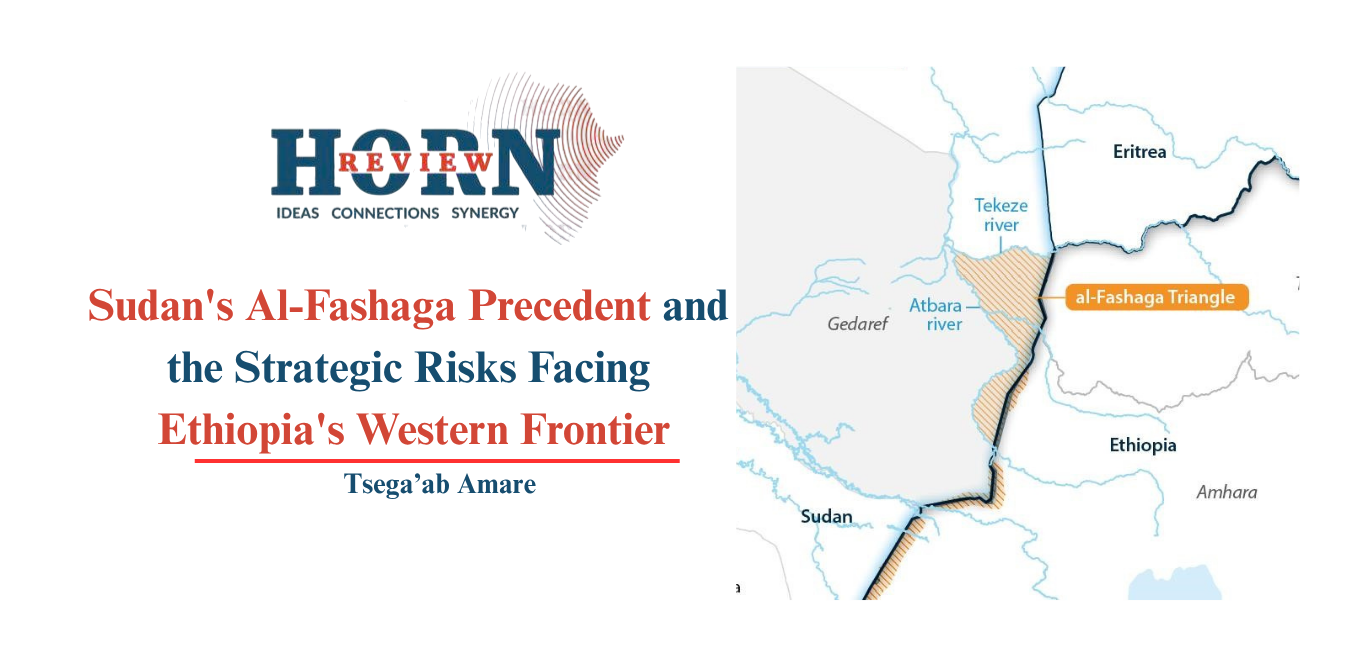
Sudan’s seizure of Al-Fashaga in December 2020 is usually treated as another episode in a century-old border dispute over an unresolved colonial-era delimitation. International relations scholarship distinguishes between revisionist states that pursue continuous territorial expansion and those that enforce long-dormant territorial claims only when temporary shifts in the local balance of power make enforcement feasible. Sudan’s conduct at Al-Fashaga fits the second pattern more comfortably than the first.
Sudan’s claim to Al-Fashaga rests on the 1902 Anglo-Ethiopian Treaty and the Gwynn Line, which placed the roughly 250 square kilometers of fertile borderland inside Sudanese territory, a delimitation Ethiopia has never accepted and views the 1903 Gwynn Line as an illegal, unilateral British creation that stripped them of ancestral lands without Imperial consent. Ethiopian farmers and security forces gradually established a sustained presence in the area while formal demarcation remained unresolved. A 2007 understanding between Omar al-Bashir and Meles Zenawi papered over the unresolved claim rather than settling it, permitting farmers from both countries to work the land while formal demarcation was deferred indefinitely. That arrangement lasted for roughly thirteen years.
It broke within weeks of the Tigray War’s outbreak in November 2020. As Amhara militias withdrew from the borderland to join the federal war effort against the Tigray People’s Liberation Front, Sudanese forces moved in, reportedly under an agreement reached with Addis Ababa mere days earlier. What followed was a rapid, systematic occupation: Ethiopian outposts dismantled, permanent supply roads built, and thousands of Amhara farmers evicted from land some had cultivated for decades. By mid-December 2020 Sudan controlled the disputed territory outright, and by the end of 2021 it held up to 95 percent of it, reinforced with new bridges and fixed military infrastructure. The fighting was lethal on both sides. Six Sudanese soldiers were killed in a November 2021 Ethiopian raid on an army post, and al-Burhan cited a total of 96 Sudanese dead in the operation by that point, though Ethiopia never released comparable figures.
The speed of that campaign supports the opportunistic revisionism interpretation rather than a simpler account of pure improvisation. Converting a decade-old soft-border arrangement into full territorial control and permanent infrastructure within roughly a year suggests a military that had already considered how such an operation could be executed. It reflects a state maintaining a dormant claim while moving with practiced efficiency once the obstacle to enforcing that claim disappeared.
The Al-Fashaga episode raises a broader strategic question. If another major internal conflict were to weaken Ethiopia’s western frontier, would Sudan possess the military capacity to exploit the resulting vacuum as it did in 2020? Answering that question depends less on inferring Khartoum’s intentions than on assessing what it can actually project across the frontier today, after three years of civil war and growing dependence on external partners.
Sudan now bears little resemblance to the state that moved into the disputed territory in 2020. Since then, the SAF has been consumed by a nationwide civil war, spending much of 2025 fighting to retain Khartoum and losing their last major position in Darfur when the RSF captured El Fasher after an eighteen-month siege in late October. The SAF has since consolidated control over central and northern Sudan and reclaimed Khartoum, but the country remains functionally partitioned, with the RSF dominant in Darfur and a new front opened in Blue Nile State in February 2026 through an RSF coalition with a faction of the SPLM-N led by Abdelaziz al-Hilu.
The Blue Nile front is directly relevant to any assessment of Sudan’s western-frontier capability because it occupies the same strategic corridor linking Sudan and Ethiopia. The RSF-SPLM-N coalition seized the border town of Kurmuk in March 2026, gaining a foothold that Sudan’s government has accused Ethiopia of enabling by permitting drones to launch from Bahir Dar airport, an allegation Addis Ababa rejects.
What followed was a months-long SAF counteroffensive that gradually reversed RSF gains along the Blue Nile frontier and culminated in the recapture of Kurmuk on July 8, 2026. The campaign demonstrated that the SAF retains meaningful offensive capability along Sudan’s frontier with Ethiopia. Even so, that demonstration is narrower than it first appears, and the capability it reveals is not fully autonomous. Since mid-2025, Egypt has provided the SAF with drone support and a joint security operation, including rooms in North Kordofan and El Obeid. RSF drone strikes on Kosti in March 2026 reportedly killed an Egyptian brigadier general and several other personnel embedded with the Sudanese army, and a larger Egyptian unit was reportedly encircled by TASIS-aligned forces in the Sali area of Blue Nile, in a zone with direct proximity to the Ethiopian border and the GERD.
Read together, this suggests that the tempo the SAF has shown in Blue Nile depends substantially on Egyptian air power, intelligence coordination, and materiel, alongside Gulf financing from Saudi Arabia and Qatar. Any extension of that campaign into a deliberate confrontation with Ethiopia’s forces would require a scale of Egyptian commitment well beyond what Cairo has shown so far, and Egypt’s own strategic priorities of preserving its Nile leverage and securing the smuggling and trade corridors it has come to rely on, do not automatically extend that far.
Conventional capability is not the only channel linking Sudan’s war to Ethiopia’s stability, and arguably not the most consequential. A more immediate link between Sudan’s war and Ethiopia’s internal instability runs through a Tigrayan force known as “Army 70”, TPLF-aligned fighters who were stranded in eastern Sudan after the 2020–2022 Tigray war and who have been fighting alongside the SAF against the RSF. Addis Ababa frames this as one strand of a broader arrangement called “Tsimdo,” evident in a mid-May 2026 gathering that took place in Port Sudan, bringing together opposition figures, including Abdirahman Mahdi of ONLF and Andargachew Tsige.
Ethiopia’s foreign minister raised the accusation formally with the UN Secretary-General in October 2025, and by May 2026 the ENDF was briefing foreign diplomats on the “Tsimdo” threat, warning that Eritrea and TPLF hardliners were coordinating with Fano militias in Amhara as well. The TPLF denies any formal relationship with Army 70, and some regional analysts describe Tsimdo as an inflated label rather than a coherent command structure. The picture is also not one-directional: in March 2026, more than 500 Army 70 fighters entered a government-run disarmament and reintegration program inside Ethiopia, suggesting the group’s cohesion and also Khartoum’s or Asmara’s control over it may be looser than the Tsimdo framing implies.
Washington has also begun treating the regionalization of Sudan’s war as a policy problem in its own right. The bipartisan PEACE in Sudan Act, introduced in the U.S. Senate in June 2026, mandates reporting on foreign involvement and non-state armed groups linked to the conflict, including Army 70 and the Tigray Defense Forces. Their inclusion reflects growing concern in Washington over the expanding network of cross-border armed actors shaping Sudan’s war.
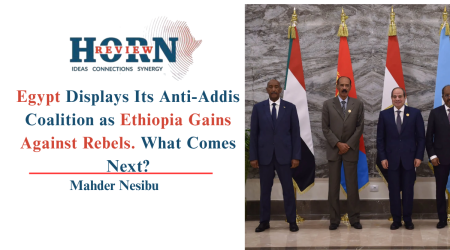
Burhan’s alignment with Egypt and Eritrea does not operate in isolation, though the three states’ interests overlap more than they align into a single command. Egypt provides much of the financial, diplomatic, and technological support underpinning Sudan’s western operations. Eritrea’s contribution is different. Asmara contributes through training, logistical facilitation, and longstanding relationships with Ethiopian opposition networks, reflecting its own strategic interest in constraining Ethiopia’s regional ambitions.
None of this argues for complacency in Addis Ababa. A conventional SAF thrust across the border is unlikely, precisely because Burhan’s army is stretched thin, but that constraint has historically shaped the form of Sudanese pressure on Ethiopia, not removed it. Army 70 remains intact, Eritrea’s training and logistical networks along the frontier are already active, and Fano-TPLF-Tsimdo linkages, however inflated the label, describe real relationships rather than invented ones. Should internal fractures in Ethiopia deepen whether a renewed Tigray rupture or a harder break with Eritrea, the calculus in Khartoum could shift quickly. A government fighting for its own survival in Darfur and Kordofan may still judge a low-cost, deniable proxy option worth the risk even when direct confrontation is not, particularly if it believes Ethiopia’s response capacity is degraded. Ethiopia would be wrong to read Sudan’s battlefield weakness as proof the threat has receded. It may simply mean that threat now travels through proxies rather than tanks.
By Tsega’ab Amare, Researcher, Horn Review