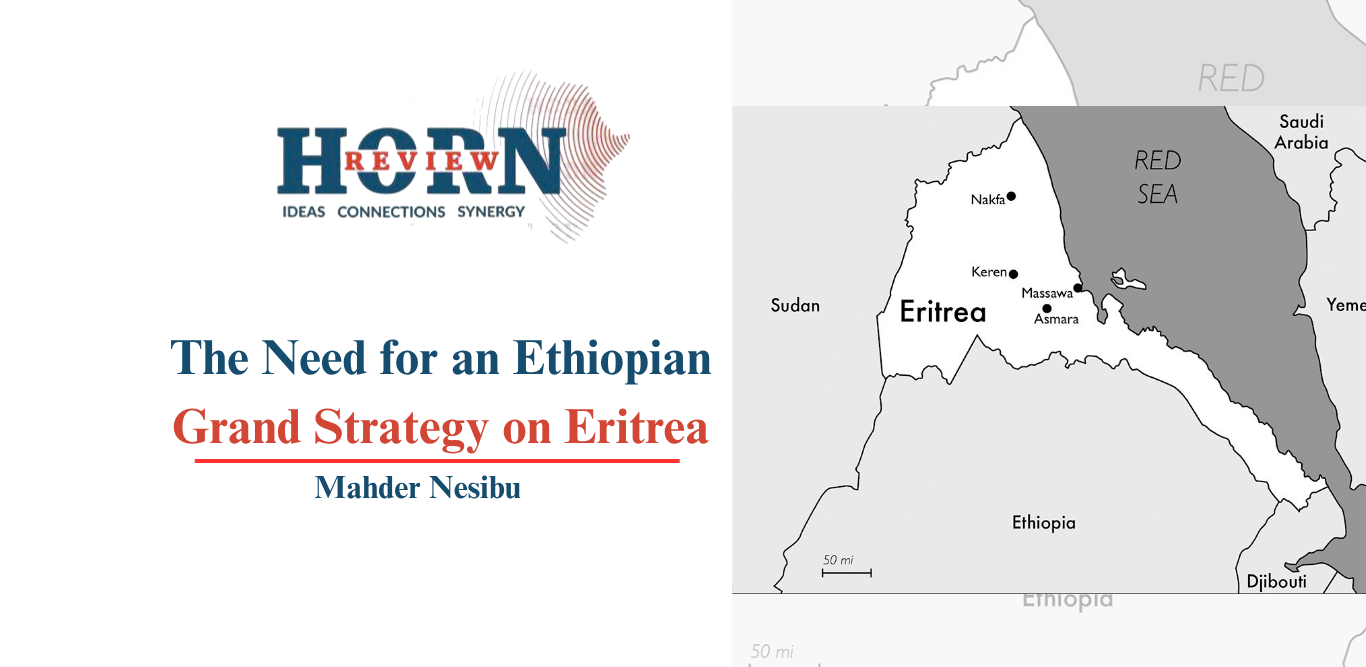
In May 1998, war broke out in the Horn of Africa. Ethiopia and its neighbour, which had seceded from it only a few years prior, engaged in fighting over territory along their undemarcated and newly realized border. Eritrean forces moved into disputed territories in the north, attacking Ethiopian military positions, and the fighting that ensued would last two years, claiming tens of thousands of lives.
The two countries had, just years before, appeared to have much going for them. Liberal internationalism promised the world new prospects for stability and prosperity, and the end of the thirty-year Eritrean People’s Liberation Front war against the Ethiopian state seemed to inaugurate a new era. Ethiopia also held genuine prospects under the Ethiopian People’s Revolutionary Democratic Front (EPRDF) coalition that had ousted the Derg. Both Eritrea, newly born, and Ethiopia, newly governed, professed a commitment to a shared future.
The problematic nature of Eritrea’s secession appeared inconsequential. Despite it being carried out through a UN-monitored referendum conducted under EPLF control and without Ethiopian participation. That it proceeded as smoothly as it did owed much to the EPRDF’s consent, and its disinterest to contest the circumstances under which it took place. On the question of Ethiopia becoming effectively landlocked, the EPRDF, and particularly the TPLF, saw its relationship with the EPLF, as standing on solid ground. Isaias Afwerki’s declaration of Assab and Massawa as “free ports” was treated as sufficient insurance for sea access, and until 1998, the practical consequences of landlocked status were barely felt, as Ethiopian imports and exports continued along familiar routes.
For Isaias and the PFDJ, the intimacy and economic interdependence with Ethiopia, the larger and more powerful neighbour, appeared to be not a source of concern. The relationship was highly personalized at the top, as correspondence between Isaias and Prime Minister Meles Zenawi in the period preceding the war would later lay bare, and the institutional mechanisms established to formalize the interdependence between the two states had produced little of substance.
Exploring the descent into war, Tekeste Negash and Kjetil Tronvoll, in their foundational work “Brothers at War”, observed the peculiarity of a conflict whose causes resisted simple explanation. The flashpoint of the war, the disputed territory of Badme, could not in itself justify the catastrophe that followed. Border delimitation negotiations were ongoing, and for two states apparently on good terms, and both still fresh from the costs of a long war, the resort to arms seemed inexplicable. Negash and Tronvoll explored deeper causes, including the deeply buried tensions between the TPLF and the EPLF.
In the end, the fighting produced decades of enmity, defined by proxy politics and the grim logic of “no war, no peace.”
The prospect of renewed good relations would emerge again in 2018. Following the 1998 war, the two countries had remained locked in perpetual hostility, with Eritrea, isolated and ostracized for its destabilizing regional conduct, pursuing an indirect proxy strategy against its larger neighbour. The change in Ethiopia promised to clear these accumulated obstacles. The Jeddah Agreement, signed by newly inaugurated Prime Minister Abiy Ahmed and Isaias Afwerki, declared that “a new era of peace, friendship and comprehensive cooperation has started,” and included broad declarations of “joint investment projects” and what appeared to be a trajectory toward integration.
Yet the same structural failings would reassert themselves. Critics noted that the rapprochement was as personalized as the original 1990s relationship had been, with the Eritrean state remaining largely opaque and the consensus residing between the two leaders rather than embedded in any institutional framework. When the Tigray conflict drew in both Ethiopian forces and the Eritrean Defence Forces, the arrangement did not survive the strain.
With war once again having come between the two states, a period of simmering tensions followed, and relations have since deteriorated to their current adversarial state. Tronvoll, whose earlier work excavated the mystery of the 1998 war, has described a renewed conflict as inevitable, and has raised the spectre of a conflagration that could draw in the broader region.
How do we make structural sense of this pattern? Ethiopia’s Foreign Minister, Gedion Timothewos, has framed the problem in terms of fundamental “underlying causes,” attributing much of it to the nature of the Eritrean state itself, characterizing the governing ideology through two concepts: the “Isaias doctrine” and the “Nakfa syndrome.”
The Isaias doctrine refers to the president’s conviction, rooted in his experience as a founder and longtime commander of the EPLF and sustained through his unchallenged rule under the PFDJ, that Eritrea’s security is contingent upon Ethiopian insecurity. In this framework, a strong, stably governed Ethiopia represents a permanent threat, a scenario to be forestalled rather than welcomed.
The Nakfa syndrome, named after the mountain stronghold from which the EPLF launched the counteroffensive that ultimately defeated Ethiopian forces and secured Eritrean statehood, describes a broader pathology of the tegadelai generation; the inability of the Eritrean leadership to move beyond the psychological and political horizons of the liberation struggle. Regime security and continuity remain the governing imperatives. The syndrome explains the aborted democratic opening of the early 1990s, the country’s prolonged underdevelopment, the apparent non-existence of any coherent macroeconomic trajectory, and above all, the deep incapacity for genuine good neighbourliness, with Ethiopia and beyond.
Hypermilitarization and pervasive securitization have made destabilization and the threat of force the primary instruments of Eritrean statecraft, at the cost of the country’s long-term viability.
So, confronted with these structural realities, how does Addis Ababa avoid either descent into open hostilities or the indefinite continuation of managed instability?
A systematic and layered approach to the Eritrea file may be the most important task facing Ethiopian foreign policy today. This is not to suggest that Ethiopia’s broader grand strategy should be organized around Eritrea. Rather, the argument is that the most consequential questions of national security in the immediate neighbourhood require that Eritrea be placed at the centre of strategic thinking. From that position, Ethiopia must bring to bear a sophisticated, long-term, and constructive outlook, one that is clear-eyed about Ethiopian power in the Horn of Africa and equally clear-eyed about Eritrea as both an Achilles heel and a geopolitical node, a space that has historically served either as a gateway to Ethiopian strength or as a corridor for its adversaries.
Such a grand strategy should be organized around several interlocking considerations.
Economic integration, on the long run, offers the most concrete path toward meaningful interdependence. The experience of 1998 demonstrated what the absence of institutionalized co-dependency produces; a genuine strategy should seek to build the kind of economic ties that make destabilization costly for Eritrea itself.
Ethiopia’s structural advantages must also be fully accounted for and deployed deliberately. These include economic weight, geographic centrality, international standing, and military capacity. They also include Eritrea’s unique value to Ethiopia as a geopolitical space, as well as historical Ethiopian claims to sea access through Assab and Massawa. Less often considered but equally significant is the decades-long flow of Eritrean refugees into Ethiopia. Ethiopia has served as both refuge and transit route for Eritreans, who in the diaspora now outnumber the population remaining inside the country. The goodwill generated by this record will have strategic value in the future.
Perhaps the most consequential dimension of any grand strategy is the need to plan seriously for Eritrea after Isaias and after the EPLF. The tegadelai generation is aging. The president is eighty years old. No succession mechanism exists, and the PFDJ has no institutional depth independent of its founding figures. A strategy that imagines only the Eritrea that currently exists is a strategy with a short shelf life. Ethiopia must engage with the full landscape of Eritrean political futures, including the diverse and largely nationalist diaspora, the various opposition movements that operate with more constructive policies toward Ethiopia, and the less known forces inside Eritrea that will shape whatever comes next.
The strategy would be perhaps ill conceived if separated from a rapidly shifting regional and international environment. Foreign Minister Gedion recently wrote for the IMF that “geopolitics is replacing globalization as the world’s governing philosophy.” It is an acknowledgment of the terrain on which Ethiopia and its neighbours are now operating; intensified great-power rivalries, a declining rules-based order, and a Horn of Africa that has become an arena for competing external interests. These forces are already shaping how Ethiopia and Eritrea interact and will continue to do so. Any Ethiopian vision for Eritrea that fails to situate the bilateral relationship within this broader environment risks being overtaken by it.
This thinking necessarily departs from the immediate geopolitical pressures currently animating the relationship. The two states operate within a layered and volatile regional environment, and their tensions are compounded by an array of external actors pursuing their own interests and strategies. A grand strategy will not resolve these short-term dynamics. But it would give Ethiopia a framework within which to navigate them, whatever form the next rupture or the next rapprochement takes. The deeper question is one of shared futures: two states, whatever the state of their relations at any given moment, bound together by geography, history, and a regional order they will both have to live in, in a world that is increasingly demanding of strategic clarity.
By Mahder Nesibu, Researcher, Horn Review