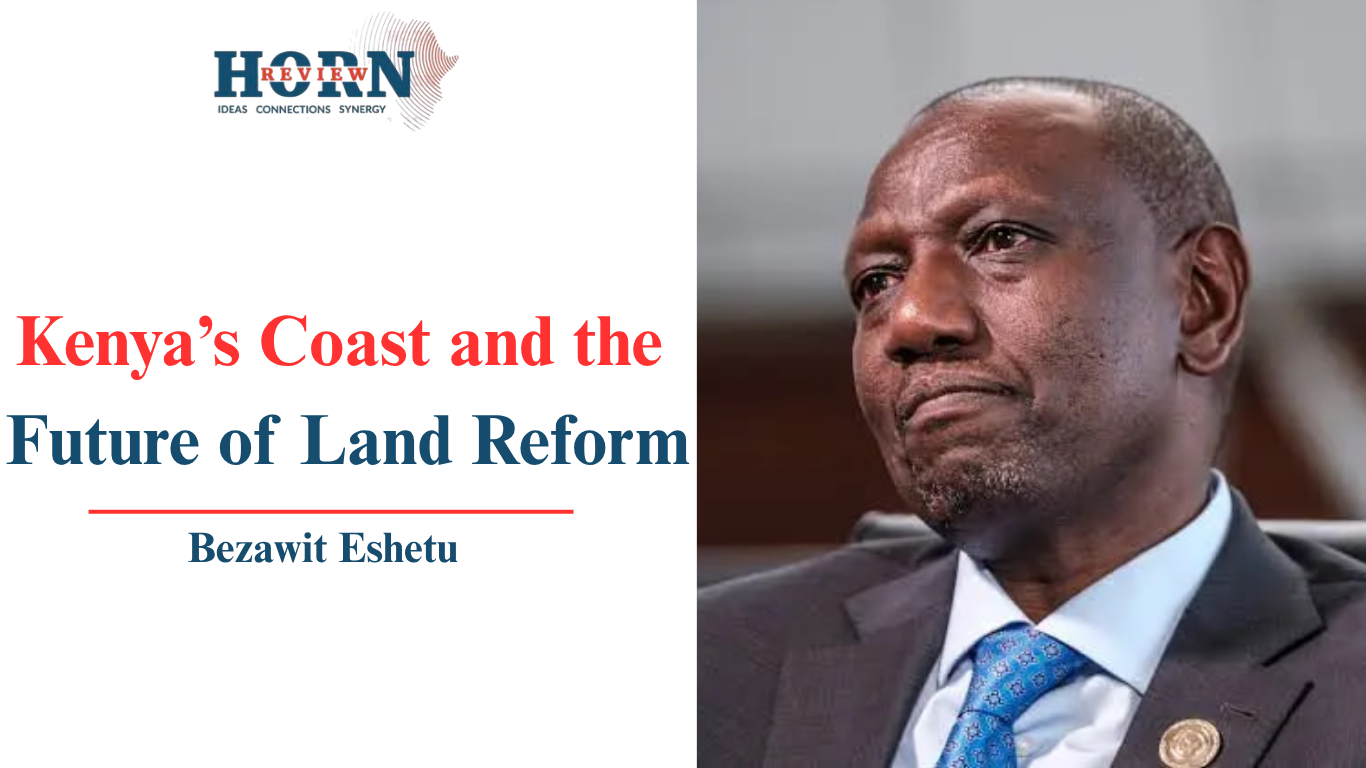
President William Ruto’s plan to formalize unused coastal land is not a routine administrative exercise. It reaches into one of Kenya’s most persistent political and moral disputes, where colonial dispossession, post-independence favoritism, and the gap between legal title and lived occupation have long collided. Recent reporting suggests the administration wants to issue titles to landless occupants during coastal tours in the second half of 2026, tying the policy to a broader political moment as the 2027 campaign season begins to take shape. That is why the initiative matters. It is not only about deeds and surveys. It is about whether the Kenyan state can finally treat land as a basis for inclusion rather than a reward for power.
The historical burden on the coast is deep. The ten-mile coastal strip was once tied to the sovereignty of the Sultan of Zanzibar and administered by the colonial government, while the abolition of slavery still left Arab and Swahili landowners in a position to allow Mijikenda squatters on land they did not control. Over time, this produced a coastal order in which ownership, residence, and belonging drifted apart. The result was not just land insecurity but a politics of exclusion, especially for communities whose claims were rooted in occupation, labor, and memory rather than formal documentation.
Independence did not repair that fracture. Instead, the new state preserved many colonial-era title arrangements in the name of national cohesion, while post-independence settlement schemes distributed large parcels to politically connected beneficiaries. That pattern converted land into a tool of loyalty and reward, and it left many coastal residents farming, settling, and raising families on land they could not secure in law. Later governments did little to resolve the contradiction in a durable way. The coast therefore remained a zone where frustration could be mobilized into demands for autonomy, a dynamic that sharpened after the 2007 election violence and later fed secessionist currents such as the Mombasa Republican Council.
The legal setting has now changed in ways that make the policy more consequential. The Land (Amendment) Act, 2025 commenced on 4 November 2025, and the National Land Commission Act was amended on the same date to expand the Commission’s authority over historical claims and review powers. Under the amended Act, the Commission must, within five years of the provision coming into force, review grants or dispositions of public land issued before 27 August 2010, hear affected parties, and determine whether titles were unlawfully or irregularly acquired. The Act also provides for revocation of unlawfully acquired titles and corrective action where irregularities are found. In other words, the state has now given itself the machinery to revisit old allocations through a constitutional and administrative framework, not simply through political rhetoric.
That machinery has also been staffed. On 23 March 2026, seven new National Land Commission commissioners were sworn in, including Chairperson Dr. Abdillahi Saggaf Alawy. That matters because land reform in Kenya has never been blocked by the absence of grievances. It has been blocked by the absence of institutional will. A newly reconstituted Commission gives the government a chance to move from announcement to execution, but it also raises expectations that the process will finally be visible, disciplined, and legally defensible. If the Commission acts boldly, it can restore confidence in the state’s capacity to confront historical injustice. If it hesitates, the policy will quickly look like another political performance.
The conflict with large landholders is therefore unavoidable. Absentee owners, politically connected families, and corporate interests are unlikely to surrender influence quietly, especially where compensation, compliance, or revocation threatens assets that have been secure for decades. Any compensation formula that falls below actual market expectations in prime coastal areas will immediately generate resistance, not only in politics but in the courts. That is not a side issue. It goes to the heart of the reform’s credibility. A policy that promises fairness but produces opaque valuation, selective enforcement, or preferential treatment for insiders will reproduce the very grievance it claims to solve.
Kenya’s Supreme Court has already clarified that formal title is not always enough. In Dina Management Ltd v County Government of Mombasa, the Court held that ownership of land whose title was not acquired regularly is not protected under Article 40 of the Constitution, and that unlawfully acquired property does not enjoy constitutional shelter. That ruling gives reformers a powerful legal foundation, but it also raises the stakes. It means historical grants can be challenged on public-interest grounds, while later buyers cannot always rely on the mere existence of a title if the root of ownership was defective. The policy, then, is not simply about redistribution. It is about testing whether constitutional property rights and historical justice can be reconciled in a legally coherent way.
Politically, the coastal plan is a sophisticated gamble. The coast has often leaned oppositional, and land distribution can translate directly into electoral goodwill if residents see the state finally correcting a long-standing injury. But the same policy can just as easily be read as an attempt to convert administrative reform into a new political coalition. Coastal voters, younger citizens, and members of the diaspora are more skeptical than before. They are likely to judge not only how many titles are issued, but how transparent the process is, how fast it moves, and whether it avoids creating a new class of beneficiaries. The reform will therefore be measured less by ceremony than by trust.
The security risks are real because land disputes on the coast have always been more than land disputes. They have fused class resentment, ethnic grievance, and autonomy claims for generations, and Kenya’s broader history shows how quickly land tension can become electoral violence. The 2007 crisis demonstrated that unresolved land conflicts can be weaponized on a national scale, while more recent coastal autonomy movements show that exclusion still carries political force. If implementation is selective or politically timed, it could produce lawsuits, protests, or localized disorder. If it is fair, visible, and consistent, it could instead reduce the appeal of radical narratives that portray the state as an absentee landlord.
The biggest danger may be administrative rather than dramatic. A five-year review of pre-2010 public land grants will inevitably generate heavy litigation, and ground-level demarcation in sensitive coastal zones will test already strained institutions. That is why the policy needs more than legal authority. It needs transparent eligibility criteria, independent conflict-prevention mechanisms, and constant communication with affected communities. Development literature on Kenya has long warned that projects carried out without conflict sensitivity can deepen the very tensions they are meant to ease. The coastal land project should be no exception.
In the end, this is a test of Kenyan governance itself. Land has remained the country’s most durable currency of favor because successive regimes treated it that way. Ruto’s coastal initiative offers a rare chance to break with that tradition by using constitutional tools to address historical injustice without descending into arbitrary seizure. If it succeeds, it will show that constitutionalism can outperform elite capture and produce both justice and development. If it fails, it will confirm the darkest suspicion in Kenyan politics: that reform was only patronage in new clothing. The real question is not whether titles are issued. It is whether the state can finally stop using land to reproduce inequality and start using it to build legitimacy.
By Bezawit Eshetu, Researcher, Horn Review