Revisiting Meles Zenawi’s Case for Semi-Recognition
On March 17, 2026 South West State formally suspended all cooperation and relations with Somalia’s federal government in Mogadishu. The administration of President Abdiaziz Laftagareen adduced what it described as the federal government’s arming of militias to destabilize the region, interference in internal governance and the pursuit of unconstitutional amendments designed to centralize power at the expense of the federal system. The airport in Baidoa was closed to federal traffic. Federal ministers and legislators originating from the region tendered their resignations. Within hours, the Somali Future Council an alignment that includes Puntland, Jubaland, and the Salvation Forum issued a statement endorsing Laftagareen’s decision. With this development South West State became the third federal member state following Puntland and Jubaland to sever ties with Mogadishu. This could be pervaded by the sequence as a deepening domino effect with Somalia’s federal system facing its most serious splitting since the establishment of the current political framework in 2012. The timing months before scheduled national elections and against an undergoing constitutional crisis has raised concerns about the viability of the federal project itself.
What makes this moment particularly distinct is its relationship to a decades old policy debate. The disruption now unfurling within Somalia mirrors precisely the scenario that the African Union sought to avoid when it repeatedly declined to engage with Somaliland’s quest for recognition. The AU’s consistent position ingrained in the principle of territorial integrity enshrined in the 1964 OAU resolution on colonial borders and reinforced in the Constitutive Act held that recognizing Somaliland would open a Pandora’s Box of secessionist claims across the continent. However the crisis now emerging is not a product of Somaliland’s secession but of internal dynamics within Somalia’s federal system which are dynamics that a different approach proposed two decades ago by Ethiopian Prime Minister Meles Zenawi might have helped mitigate.
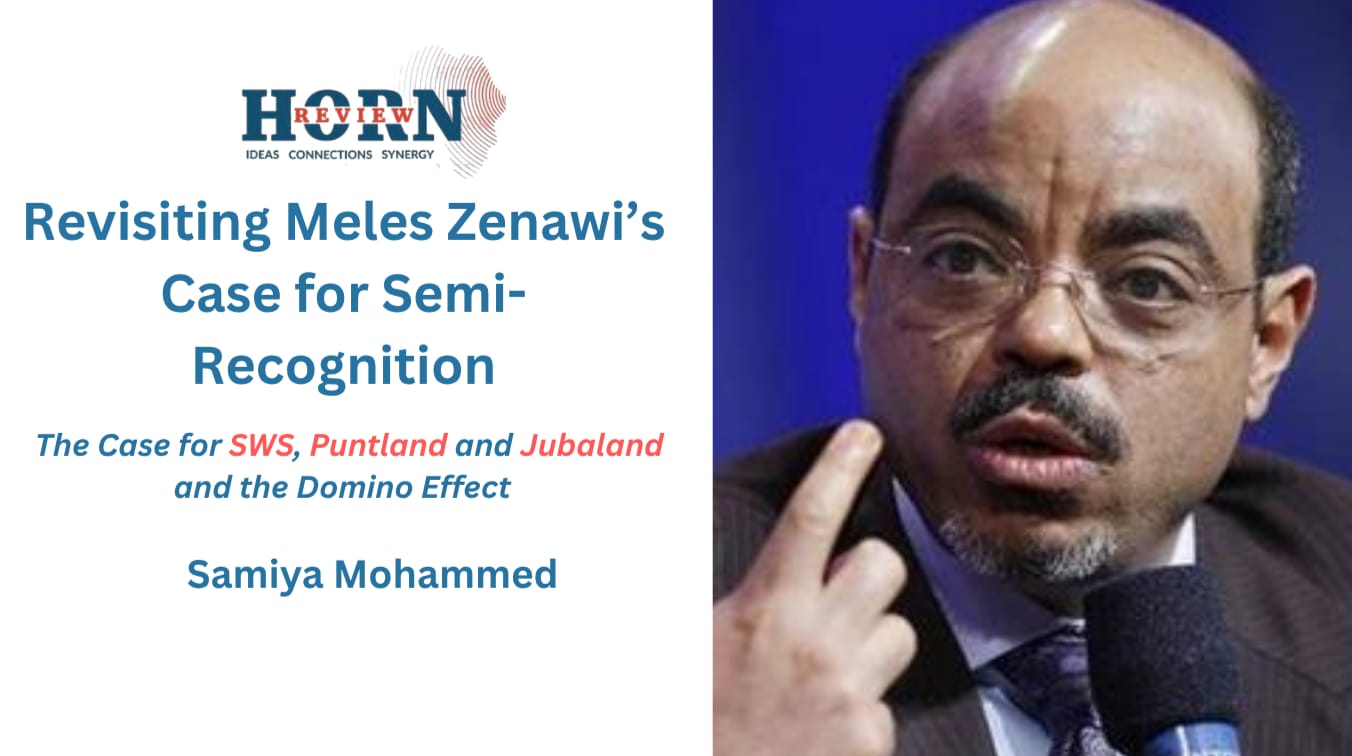
Between 2004 and 2007, during a series of discussions with American diplomats documented Meles Zenawi articulated a position on Somaliland that departed from the binary framework dominating international discourse. He did not advocate for full recognition of Somaliland nor did he endorse the status quo of complete non-engagement. Instead he repeatedly advanced what he termed a middle-ground solution with semi-recognition, interim status or partial recognition. Meles’ reasoning was grounded in an assessment of both Somaliland’s achievements and the constraints of the international system. He acknowledged that full recognition would indeed risk setting precedents that the African Union and its member states were unwilling to accept. The examples of Biafra in Nigeria, Ambazonia in Cameroon, Casamance in Senegal and Cabinda in Angola were frequently invoked in AU discussions as cautionary tales of what continental stability might suffer if secessionist claims were validated. Meles did not dismiss these concerns.
However, he also argued that the status quo was untenable. Somaliland had since reclaiming its sovereignty in 1991 following the collapse of the union with Somalia, established functioning state institutions, held multiple elections, transferred power peacefully and maintained internal security achievements that contrasted sharply with the instability that characterized much of the rest of Somalia. The international community, Meles contended, required a mechanism to support these accomplishments without triggering the continental precedents that full recognition would inevitably unleash. His proposal drew partly on the model of the Palestinian Authority in which a form of international engagement that granted practical support and a degree of diplomatic interaction while stopping short of full sovereignty. This approach he argued, would allow the international community to provide Somaliland with the security cooperation, development assistance and diplomatic engagement necessary to consolidate its democratic gains. It would also create a structured pathway that could be presented as a unique arrangement tailored to Somaliland’s specific historical circumstances, thereby minimizing the risk of setting broader precedents.
Meles’ famous caveat to his American interlocutors revealed the strategic logic underlying his position. Ethiopia, he stated “will not be the first to recognize Somaliland, but it will not be the third either.” This formulation signalled both sympathy for Somaliland’s aspirations and a clear understanding of regional politics. Ethiopia would follow others, not lead, precisely to avoid being cast as the catalyst for a precedent setting cascade. But the promise to recognize Somaliland once others had done so indicated that, in Meles’ view, the question was not whether Somaliland would eventually gain recognition, but when and under what conditions.
The disintegration now happening inside Somalia did not occur out of nowhere. Puntland which has maintained autonomous institutions since 1998 has repeatedly suspended cooperation with the federal government over constitutional disputes, power-sharing arrangements and resource allocation. Jubaland under President Ahmed Madobe has similarly clashed with Mogadishu over electoral processes, the distribution of federal revenues and the role of external actors. These disputes have been chronic, erupting periodically and threatening to undermine the federal framework. The South West State break of March 2026 presents an escalation of this pattern.
According to reports, the immediate trigger was the federal government’s decision to appoint its own police commanders in the Bay region in parallel with Laftagareen’s appointments an action that South West State interpreted as an attempt to undermine its authority. The subsequent federal response blocking flights to Baidoa, preventing South West State-aligned members of parliament from international travel, and declaring Laftagareen’s mandate expired has only deepened the confrontation. What distinguishes this moment from previous disputes is the alignment of regional actors against the federal government. The Somali Future Council’s endorsement of Laftagareen’s move transforms what might have been an isolated dispute into a coordinated challenge. With Puntland, Jubaland, and South West State now united in their suspension of cooperation with Mogadishu, and with Galmudug and Hirshabelle under pressure to take sides, the federal system faces a structural crisis.
The irony of the current situation lies in its relationship to the AU’s original concerns. The organization’s refusal to engage with Somaliland’s case was predicated on the fear that recognition would encourage fragmentation. However fragmentation has occurred regardless not through Somaliland’s secession which remains frozen in a state of de facto independence without de jure recognition but through the internal collapse of the federal system the AU sought to protect. Meles Zenawi’s proposal for semi-recognition was designed to address precisely this scenario. His insight was that the all-or-nothing approach full recognition versus no recognition created perverse incentives for all parties. Without a structured middle path, Somaliland’s de facto statehood would continue in legal, denied the support it needed to consolidate its achievements. Simultaneously, Somalia’s federal government would face no incentive to accommodate regional autonomy within a functional federal framework, since the international community’s commitment to Somali unity remained unconditional regardless of the federal government’s behavior toward its constituent states.
Semi-recognition, as Meles conceived it, would have offered a different road. For Somaliland it would have provided practical support in security cooperation, development assistance and diplomatic engagement that has long been denied. For Somalia’s federal member states, it would have created a model of managed autonomy that demonstrated how regions could receive structured international engagement without full secession. For the African Union, it would have provided a special method for dealing with Somaliland’s case that respected both the continent’s interest in stability and the realities of three decades of de facto statehood.
The events of March 2026 do not, in themselves, constitute an argument for Somaliland’s full recognition. The collapse of federal cooperation among Somalia’s member states is a crisis that requires a political solution within Somali sovereignty. However, the current situation does expose the limitations of the approach that has prevailed for two decades which is an approach that refused to countenance any structured engagement with Somaliland in the name of preserving Somali unity, even as the federal system fragmented from within.
Meles Zenawi’s overlooked proposal offers a different framework. Semi-recognition or interim status would not have solved all of Somalia’s problems, nor would it have prevented all forms of political contestation within the federal system. But it would have established a precedent for managed autonomy with a demonstration that regions could receive structured international support without seceding, and that the international community could engage with de facto realities without abandoning the principle of territorial integrity. Two decades after Meles first articulated this vision to American diplomats, With South West State joining Puntland and Jubaland in suspending cooperation with Mogadishu, the federal system is in a state of deepening fragmentation. A middle path one that provides practical support to Somaliland while creating a model for regional autonomy within Somalia may offer the most viable off-ramp from a crisis that as Meles anticipated was always more likely to emerge from within Somalia than from its unrecognized northern region.
By Samiya Mohammed, Researcher, Horn Review
Disclaimer:
All factual assertions, analytical perspectives, and opinions in this article is attributed exclusively to the researcher and are presented for scholarly discussion and informational purposes only. It does not necessarily reflect the positions of Horn Review orny affiliated institutions.