In early October 2026, Afar regional officials alleged that Eritrean forces had infiltrated parts of Afar and sought to disrupt a railway link between Ethiopia and Djibouti. This railway built and partly financed by China forms part of its Belt and Road Initiative (BRI), alongside its first overseas military base in Djibouti, illustrate Beijing’s growing stakes in the region’s economic development and, increasingly, its security affairs. For Ethiopia, the railway is a critical economic lifeline, connecting its landlocked economy to the Port of Djibouti and facilitating the movement of almost the entire of its imports and exports. Beyond this strategic corridor, China has deepened its economic engagement across the Horn of Africa through infrastructure financing, industrial investments, trade partnerships, and energy projects.
The growing presence of extra-regional in the region’s seaports, alongside the establishment of naval and military bases along its coastline, reflects the Horn of Africa’s strategic value to external powers. The United States, European countries, China, India, Türkiye and Gulf states have all sought to expand their presence in the region. As competition among global powers intensifies, the Horn has increasingly become an arena for geopolitical rivalry, with port investments, military facilities and security partnerships serving as instruments of strategic influence. Understanding this, China has been able to establish its first military base in Djibouti, work on various issues in the region, and at the same time grow its economic relations with the countries of the region.
In recent years, in addition to economic and trade investments, China has begun to form strategic diplomatic and security partnerships in the region. With its Horn of Africa initiative, China has entered the crowded region with various domestic and external actors with stakes in peace and security in site already. While its rival the United States, which previously maintained a dedicated special envoy for the region, now appears to be integrating Horn of Africa affairs into a broader African and Middle Eastern policy portfolio, assigning Massad Boulos responsibility for the region.
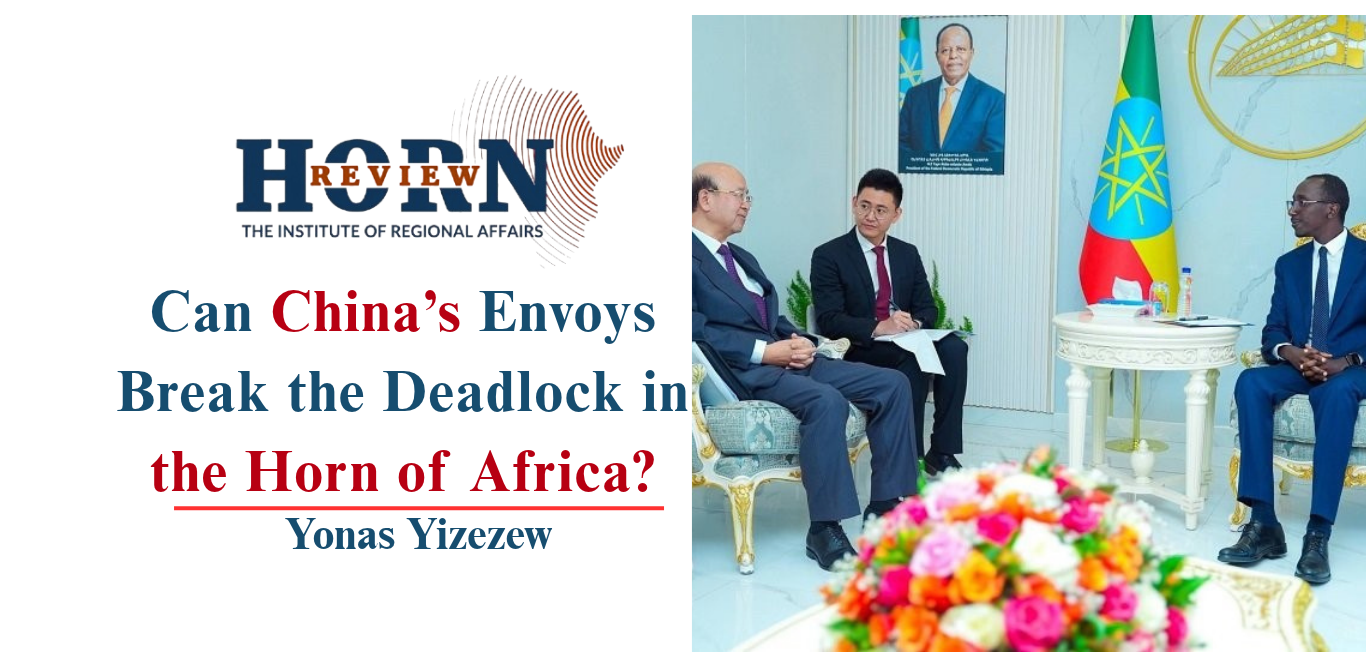
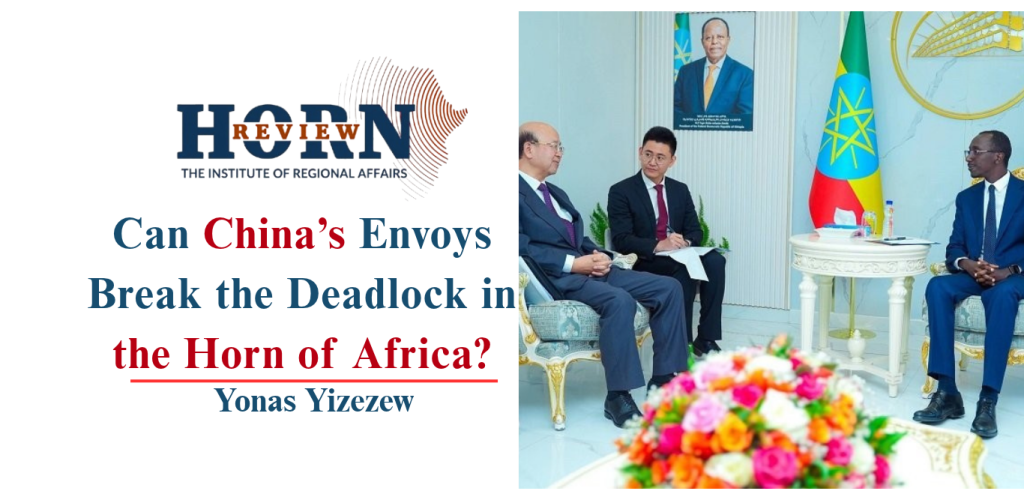
For the first time in 2022, China has appointed a special envoy to the Horn of Africa, during the height the northern Ethiopia conflict. Three years after the end of the conflict, regional dynamics have shifted considerably, established alignments have been reshaped, and Ethiopia and Eritrea have found themselves on the brink of renewed confrontation. To ease these tensions, China has stepped up its diplomatic engagement with both Ethiopia and Eritrea, dispatching envoys to engage the two countries in 2026. With a few days difference, the special envoy held talks with Eritrea’s president Isaias Afeworki and Ethiopia’s foreign affairs State Minister Birhanu Tsegaye.
Given its longstanding relationship with Eritrean regime, China has diplomatic access that may be difficult for other external powers to engage. Just as predecessor Xue Bing launched his first two regional tours in Eritrea to meet Isaias Afeworki and senior officials—highlighting close bilateral ties—current special envoy Hu Changchun has reinforced that partnership through high-level visits to Asmara in April and November 2026.
China is therefore seeking to translate its diplomatic access to Eritrea and other regional countries into tangible gains from its shuttle diplomacy across the region. A deterioration of relations between Asmara and Addis Ababa would carry costs for Chinese interests across the region. Since this confrontation would engulf the whole region, China has not limited its diplomacy to both countries, rather is engaging other regional countries including Egypt and Djibouti. China has also extended the scope of its diplomatic engagement into the wider Middle East by assigning its special envoy, Zhai Jun, to the region. In early to mid-November 2026, he visited Iran, Oman and Saudi Arabia for discussions on regional de-escalation, developments in Iran and Yemen, and security risks in the Red Sea. His visit coincided with parallel diplomatic missions by Chinese envoys to Ethiopia, Eritrea, Egypt and Djibouti. The effects of the Iran war on the Bab el-Mandeb Strait and the Red Sea have brought renewed attention to the interconnectedness of these waterways and the speed with which conflict in one part of the region can spill over into others, with wider security and economic consequences. Thus, the corridor’s centrality to China’s economic and energy supply routes, make its stability a significant economic and security concern for Beijing.
Henceforth, China’s shuttle diplomacy is a way to maintain balance in its regional relationships while aiming to project Beijing as a credible intermediary committed to regional stability. Consequently, the mandates assigned to China’s special envoys to advance initiatives proposed by Xi Jinping, including the Outlook on Peace and Development in the Horn of Africa reflect Beijing’s interest in contributing to conflict resolution while maintaining influence over the diplomatic process and its eventual outcomes. The envoys’ parallel diplomatic engagements span a strategically connected space linking the Persian Gulf, the Red Sea and the Horn of Africa. Its Middle East diplomacy has centered on the Four-Point Proposal on Promoting Peace and Stability in the Middle East, which was introduced by Beijing in 2026 amid escalating regional tensions. As the United States remains deeply preoccupied with Iran and wider Middle Eastern affairs, China is stepping up its diplomatic engagement on both sides of the waterway. In its approach to mediation, China differs from the US and EU in its dis-inclination to employ external incentives or sanctions, a position that allows Beijing to present itself as a more accommodating interlocutor and strengthen its diplomatic relationships with the conflict parties. According to China’s Horn of Africa initiative’s security pillar, facilitating negotiations between regional stakeholders is at the heart of the security-development nexus. Consequently, it appears to use its economic leverage and diplomatic influence to encourage regional parties to engage in dialogue and create conditions for negotiations.
The diplomatic contacts extended to both sides of the Ethiopia–Eritrea divide, with China’s Special Envoy for Africa, Liu Xianfa, meeting Ethiopia’s foreign minister, while its Special Envoy for the Horn of Africa, Hu Changchun, held talks with Eritrean President Isaias Afwerki. The parallel engagements suggest that Beijing is seeking to maintain channels of communication with both governments as tensions between them rise. Liu Xianfa’s subsequent visit to Djibouti, just days later, further extended Beijing’s diplomatic outreach. The visit indicated that China views Djibouti as a key Red Sea and Horn of Africa partner in its broader stabilization effort. Djibouti’s strategic maritime position and close ties with China make it central to Beijing’s effort to contain the regional spillover of the Ethiopia–Eritrea tensions. Liu’s subsequent engagement with Egypt reflected China’s awareness that the crisis has wider regional dimensions.
The engagement with Egypt is particularly significant since these tensions extend well beyond the Ethiopia–Eritrea confrontation. The regional security environment has already been weakened by Sudan’s civil war, with the Sudanese Armed Forces (SAF), one of the principal belligerents, maintaining an increasingly antagonistic posture towards Ethiopia. Egypt, a key backer of the SAF and a longstanding rival of Ethiopia, has also expanded its involvement in the affairs of Ethiopia’s immediate neighbors aiming to shape the strategic environment surrounding Ethiopia and constrain Addis Ababa’s regional options.
These overlapping rivalries and external alignments mean that any diplomatic effort to address tensions between Addis Ababa and Asmara must account for the wider network of regional actors, their interests, and the conflicts in which they are involved. Even though Chinese officials have well-established lines of communication with host governments in the region, it would face a difficult environment in translating this diplomatic access into a coordinated regional effort particularly given the competing interests of countries such as Egypt. In this regard, the extent to which Egypt’s influence shapes Beijing’s diplomatic calculations, as it does those of Massad Boulos, will also be an important consideration. China’s ability to balance its relationship with Egypt against its substantial interests in Ethiopia and its ties with Eritrea will consequently be an important determinant of the scope and effectiveness of its regional diplomacy. What it would undoubtedly face is an increasingly contested regional environment, with actors becoming more entrenched in competing positions and increasingly focused on defending their respective positions against one another.
Beyond these regional complications, the presence of several other special envoys in the region, including those representing the UN, Germany, France, Norway and the European Union, the extent to which their respective efforts will converge around a coordinated regional diplomatic approach remains an open question. The US absence from this diplomatic picture also raises questions about the coherence of Washington’s regional engagement and its ability to sustain a consistent diplomatic role amid the Horn of Africa’s increasingly interconnected conflicts. Such gaps in diplomatic engagement are compounded by the broader difficulty of reconciling the different approaches and political calculations of external actors.
The challenge extends beyond coordination, as external actors often differ in their understanding of the region’s conflicts, the interests driving them and the approaches required to resolve them. These differences can complicate diplomatic engagement, particularly when competing mediation efforts reflect different priorities and political calculations. The effectiveness of China’s special envoys, like that of their international counterparts, will consequently depend not only on diplomatic access but also on a deeper understanding of the Horn’s complex political dynamics, overlapping conflicts and interconnected security challenges.
Despite these constraints, Beijing has the diplomatic access, economic presence and regional partnerships to contribute to de-escalation. What remains uncertain is whether these advantages can generate sufficient political influence to bring the competing parties into a meaningful negotiating process. Its stated preference for dialogue, non-interference and development-oriented approach may help preserve its credibility with regional governments, but these principles also limit the instruments available when parties are unwilling to compromise. China may be well positioned to keep diplomatic channels open and prevent further deterioration, but converting that access into a durable political settlement is a considerably more demanding task.
By Yonas Yizezew, Researcher, Horn Review