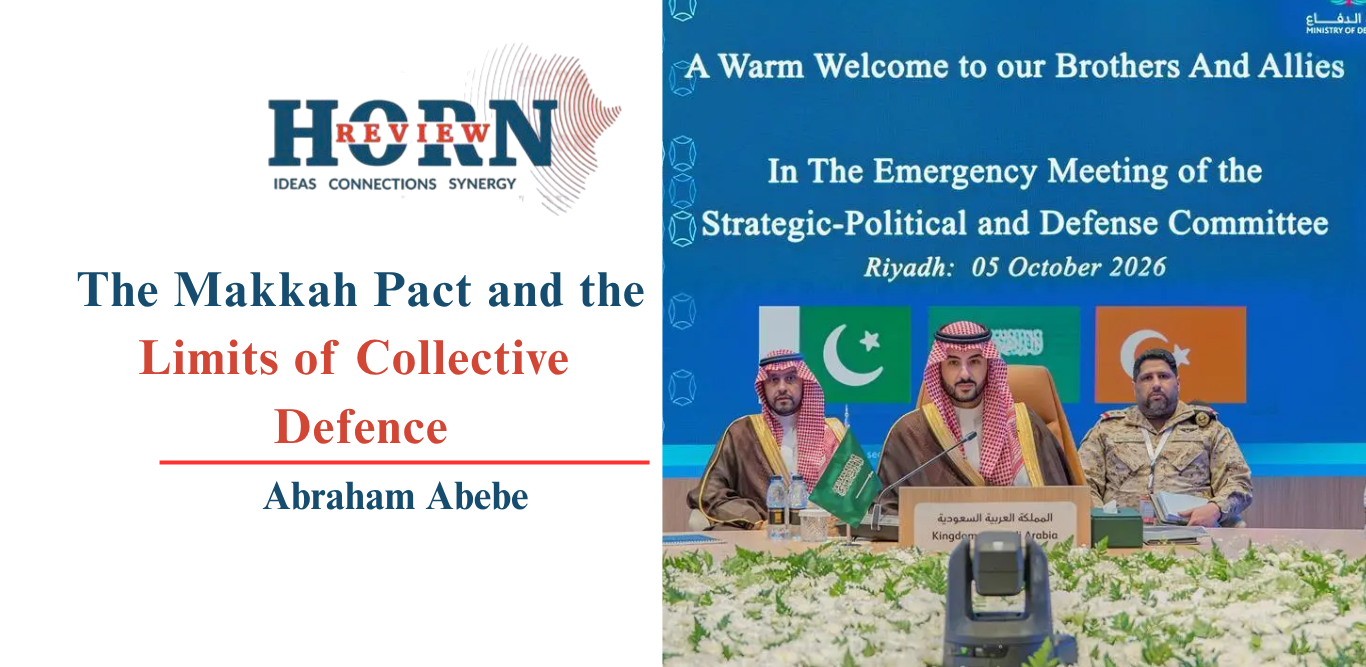
The Makkah Joint Defence Agreement rests on an ambitious principle: an armed attack against one member is to be regarded as an attack against all. Yet the agreement’s first serious test has exposed a substantial gap between that political commitment and the military arrangements required to make it credible. The 5 October 2026 emergency meeting in Riyadh did not resolve that gap. Instead, it highlighted how much remains to be established before the Makkah Pact can deliver the collective defence it promises.
The three governments agreed to move immediately towards the practical implementation of their collective-defence commitments, including measures to provide agreed military forces and capabilities and ensure their rapid deployment in Saudi Arabia. They also appointed Pakistan’s retired Lieutenant General Nauman Mahmood as the pact’s first secretary-general. These decisions are significant, but their wording is revealing. The members are still developing the mechanisms through which forces will be provided and deployed even as Saudi Arabia faces an immediate security threat. The central question, therefore, is not whether Saudi Arabia, Turkiye and Pakistan possess substantial military capabilities individually, but whether those capabilities have been converted into a predictable, jointly usable and politically reliable collective capability.
The pact’s first test came almost immediately after its establishment. Houthi attacks on Saudi territory and economic infrastructure created precisely the circumstances in which its collective-defence commitment was expected to acquire practical meaning. The three governments held political and military consultations, including meetings among their defence chiefs, but the precise mechanisms for translating those commitments into deployable capabilities remained under development before the October meeting. The 5 October decision therefore marked an important step, but it did not remove the underlying uncertainty. Turkiye and Pakistan have begun providing defensive and military support, yet the scale, composition and longer-term deployment arrangements of their contributions remain only partly defined. Moreover, direct combat deployment is constrained by national political and legal considerations, particularly in Turkiye, where parliamentary ratification is still required for the deployment of Turkish forces.
This matters because collective defence depends on more than political solidarity. It requires agreed mechanisms for determining what each member will contribute, how forces will be commanded, how quickly they can be deployed and under what circumstances governments will authorise their use. Without such arrangements, a mutual defence clause can create an expectation of solidarity without necessarily producing a predictable and reliable military response.
The comparison with NATO makes this distinction clearer. NATO’s Article 5 also states that an armed attack against one member is considered an attack against all, but that commitment operates within a much deeper military and institutional architecture developed over decades. NATO has established political and military command structures, a force structure through which national forces can be made available to the Alliance, regular exercises to test interoperability and readiness, and standing forces that contribute to collective defence. Article 3 of the NATO reinforces this architecture by requiring members to maintain and develop their individual and collective capacity to resist armed attack. The significance of NATO’s model, therefore, lies not simply in the mutual-defence clause itself, but in the institutions, capabilities and procedures that give the commitment practical effect.
The important lesson is not that the Makkah Pact should immediately replicate NATO. NATO itself has evolved over more than seven decades, and Article 5 does not automatically require every member to undertake identical military action. Each Ally determines what action it considers necessary to respond to an armed attack, which may or may not involve the use of armed force. The more relevant comparison is therefore institutional: NATO has developed mechanisms for defence planning, command, interoperability, exercises and military readiness that allow political commitments to be translated into coordinated military action. The Makkah Pact has not yet demonstrated an equivalent capacity.
Its institutional development illustrates the problem. The appointment of a secretary-general can improve communication, coordination and continuity, but it cannot by itself generate military forces or resolve political disagreements over their use. The same applies to committees, working groups and a permanent secretariat. Institutionalisation can provide the framework for collective defence, but it cannot substitute for force generation, operational planning, interoperability or the political willingness to accept the risks of military action.
The distinction is particularly important because Saudi Arabia’s immediate security challenge is intertwined with the conflict in Yemen. Protecting Saudi territory from missiles, drones and other attacks is fundamentally different from conducting offensive operations against Houthi positions inside Yemen. The 5 October statement focuses on the rapid deployment of forces and capabilities in the Kingdom, while current reporting indicates that Turkish support is centred on defensive capabilities and Pakistan’s contribution remains focused on supporting Saudi security. Neither government has publicly committed, at this stage, to conducting offensive combat operations inside Yemen. This leaves an important question for the pact’s credibility: whether its collective-defence commitment would extend beyond protecting a member’s territory to supporting the member when its response to an attack requires military action outside its borders.
That creates a significant constraint. Turkiye and Pakistan could assist Saudi Arabia through air defence, intelligence, surveillance, logistics, technical support and other capabilities without becoming direct participants in the Yemen conflict. But the more Saudi Arabia’s security depends on military actions beyond its borders, the more difficult it becomes to separate collective defence from wider regional military involvement. The pact therefore faces an unresolved question: how far should a collective-defence commitment extend when protecting one member increasingly requires action beyond that member’s territory?
The problem is compounded by the different strategic calculations of the three members. Saudi Arabia has the most immediate interest in giving the agreement military substance because it faces the direct security threat. Turkiye and Pakistan, however, must weigh their commitments to Riyadh against the risks of escalation, their wider regional relationships and their own political and legal constraints. This creates an important gap between what the pact may require collectively and what each government may be prepared to do individually. The question is therefore not simply whether forces can be made available, but whether all three governments would accept the political and military risks associated with using them.
This makes political willingness as important as military capability. Collective defence becomes credible not simply when its members possess substantial forces, but when an adversary believes those governments are prepared to accept the costs of using them. If deployment requires further political decisions, negotiations over the nature of the mission and separate national authorisations, the deterrent value of the collective-defence commitment remains uncertain.
The October meeting should therefore be understood less as evidence that the pact has become a functioning defence alliance than as an indication of the scale of the implementation challenge. The need to establish force and deployment arrangements after Saudi Arabia had already come under attack demonstrates that the agreement’s political architecture has developed faster than its military mechanisms. The pact has created a framework for cooperation, but the crisis has exposed the gap between having a collective-defence commitment on paper and having the institutional, operational and political arrangements needed to implement it.
The Makkah Pact may eventually develop into a more credible collective-defence arrangement, but its central promise remains far from fulfilled. Its members have agreed on the principle that their security is interconnected; they have not yet demonstrated that they can translate that principle into a predictable military response. The decisive test will be whether Turkiye and Pakistan establish concrete commitments for the capabilities they can provide, develop workable procedures for their deployment and demonstrate the political willingness to use them when Saudi Arabia comes under attack.
The pact currently has a collective-defence commitment without the demonstrated military architecture needed to make that commitment fully credible. Its greatest challenge is therefore not creating another institution or issuing another declaration. It is closing the gap between committing to defend one another and being prepared, organised and politically willing to do so.
By Abraham Abebe, Researcher, Horn Review