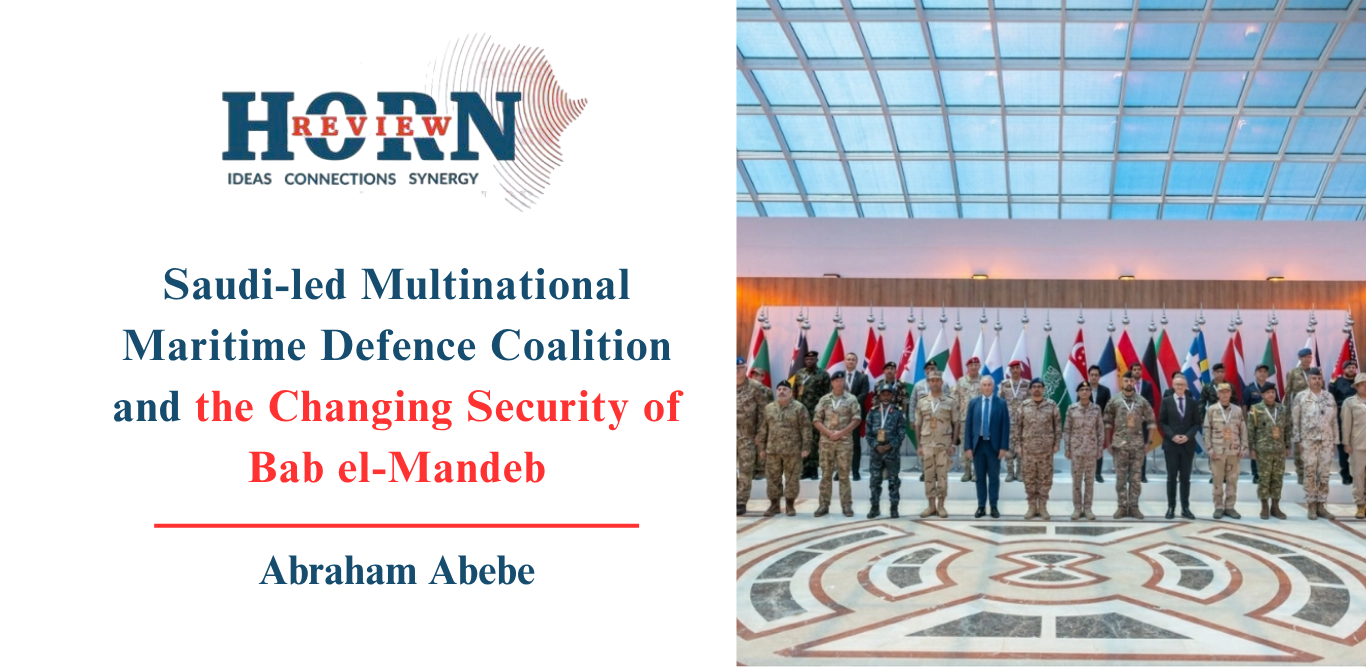
On 2 September, the Saudi-led Multinational Maritime Defence Coalition (MMDC) entered its operational phase from its command headquarters in Jeddah, marking a transition from institutional planning towards an operational framework. Saudi Rear Admiral Abdullah Al-Shehri assumed command, while Pakistan Navy Commodore Rashid Sheikh became deputy commander. Liaison officers from participating countries were also integrated into the coalition’s headquarters. On 18 September, the MMDC reached initial operational capability (IOC), with representatives from 41 countries meeting in Jeddah to coordinate capabilities and prepare for operational deployment. These developments demonstrate significant institutional progress, but they do not yet demonstrate that the coalition has conducted coordinated maritime operations against the Houthis. It is better to ask whether its emerging command structure can be translated into collective action as the security environment around Bab el-Mandeb changes.
The immediate complication is the uneven distribution of the threat. The current Houthi offensive has placed particular pressure on Saudi Arabia, with attacks targeting Saudi territory and energy infrastructure while the Houthis have also expanded along Yemen’s Red Sea coast. Riyadh is therefore bearing a substantial share of the immediate consequences of the renewed confrontation, while other coalition participants do not necessarily face the same level of direct exposure. This matters because a multinational command structure does not by itself determine when individual states will commit forces. The coalition’s founding statement provides that participation in its activities and operations remains a sovereign decision for each member state, subject to national laws and procedures. The concentration of the immediate threat on Saudi Arabia therefore creates a political distinction between the coalition’s existence and the decisions required for collective action.
The threat is nevertheless becoming increasingly relevant to the wider maritime-security environment. Houthi forces have expanded along Yemen’s western coast and moved towards strategically important positions near Bab el-Mandeb, giving their territorial advances direct implications for navigation through one of the world’s most important maritime chokepoints. This creates a distinction between the territorial and maritime dimensions of the conflict without separating them completely. The MMDC was established as a framework for collective maritime defence cooperation, with stated objectives including maritime security, freedom of navigation, international trade routes, energy supply lines and shared maritime interests in Bab el-Mandeb, the Red Sea and the Gulf of Aden. The Houthis’ proximity to the strait therefore places their territorial advances within a maritime-security context, even though the coalition is not itself a mechanism for conducting Yemen’s wider territorial war.
The maritime dimension becomes more consequential if the threat extends beyond Saudi-linked targets. The Houthis have threatened Saudi-linked vessels, while their wider position around Bab el-Mandeb creates risks for commercial navigation. A sustained campaign against international shipping, the maritime interests of multiple coalition participants or freedom of navigation through the strait would establish a more direct common maritime-security challenge. The present pattern is therefore significant not because it automatically requires collective military action, but because it could evolve into a threat that more clearly engages the interests and responsibilities of multiple coalition members.
The coalition’s mandate is consequently important in determining how its emerging capabilities can be used. Participation in a multinational maritime-defence framework does not automatically create an obligation for every member to defend another state’s territory or intervene directly in Yemen’s wider conflict. The MMDC’s founding arrangements establish a framework for maritime security and collective defence cooperation, including the protection of navigation, international trade routes, energy supply lines and shared maritime interests. They also provide for joint maritime operations, while leaving participation in alliance activities and operations to the sovereign decisions of individual states. The coalition therefore possesses a basis for collective maritime action, but the employment of national capabilities remains dependent on decisions taken by participating governments within their respective legal and political frameworks.
The breadth of participation should also be distinguished from the depth of military commitment. At the 18 September meeting, representatives from 41 countries participated, while the coalition continued discussing accession progress and national capability contributions. The meeting involved 154 naval commanders, planners, ambassadors and European Union representatives, while 28 liaison officers were reported to be working within the coalition. The July founding meeting had involved representatives from 43 countries, but only 14 countries initially confirmed their support for the proposed alliance and its founding arrangements, while other states were still completing domestic procedures. These figures demonstrate broad international participation in the coalition’s development, but they do not establish that every country represented has formally joined, pledged naval assets or agreed to participate in a particular operation. The coalition’s practical reach will ultimately depend on the capabilities and commitments that participating states place at its disposal.
The operational question is therefore narrower than whether the coalition exists or has reached IOC. The more consequential test is whether participating states decide to employ their capabilities collectively in response to a defined maritime threat. A continuation of attacks concentrated on Saudi territory and Saudi-linked interests could leave individual governments with different assessments of the need to participate in a particular mission. A broader threat to international shipping, multiple coalition members or freedom of navigation through Bab el-Mandeb would provide a more direct basis for coordinated maritime action. The difference is between institutional capacity to coordinate and political agreement to employ that capacity.
The achievement of Initial Operational Capability remains an important development, but IOC should be understood in the context of what the coalition has publicly described as its next steps. The September meeting focused on integrating capabilities, advancing operational readiness, preparing for deployment and coordinating national contributions. The available announcements do not establish that the MMDC has already conducted a joint operation against the Houthis. IOC therefore demonstrates that the coalition has moved beyond purely preparatory arrangements, while actual operational cohesion will become clearer through deployment, capability integration and the conduct of missions.
The next phase will consequently be measured less by the size of the coalition’s meetings than by what participating states actually place behind its command structure. The key indicators will include the capabilities contributed by individual members, the geographical scope of deployment, the missions authorized, and whether those capabilities are employed through genuinely coordinated operations. The evolution of the Houthi threat will remain an important factor, but so will the willingness of participating governments to translate national commitments into collective maritime action.
The MMDC has therefore reached an important institutional milestone at a moment when the security environment around Bab el-Mandeb is becoming more complex. Its command structure, liaison mechanisms and Initial Operational Capability provide the foundations for coordinated maritime defence, but they do not by themselves establish how participating states will respond to a particular Houthi threat. The decisive issue now is whether the coalition can move from institutional readiness to demonstrable collective maritime action when the interests of its members converge around a common security challenge. Until that transition is demonstrated, the MMDC’s institutional development will remain more clearly established than its operational cohesion.
By Abraham Abebe, Researcher, Horn Review