
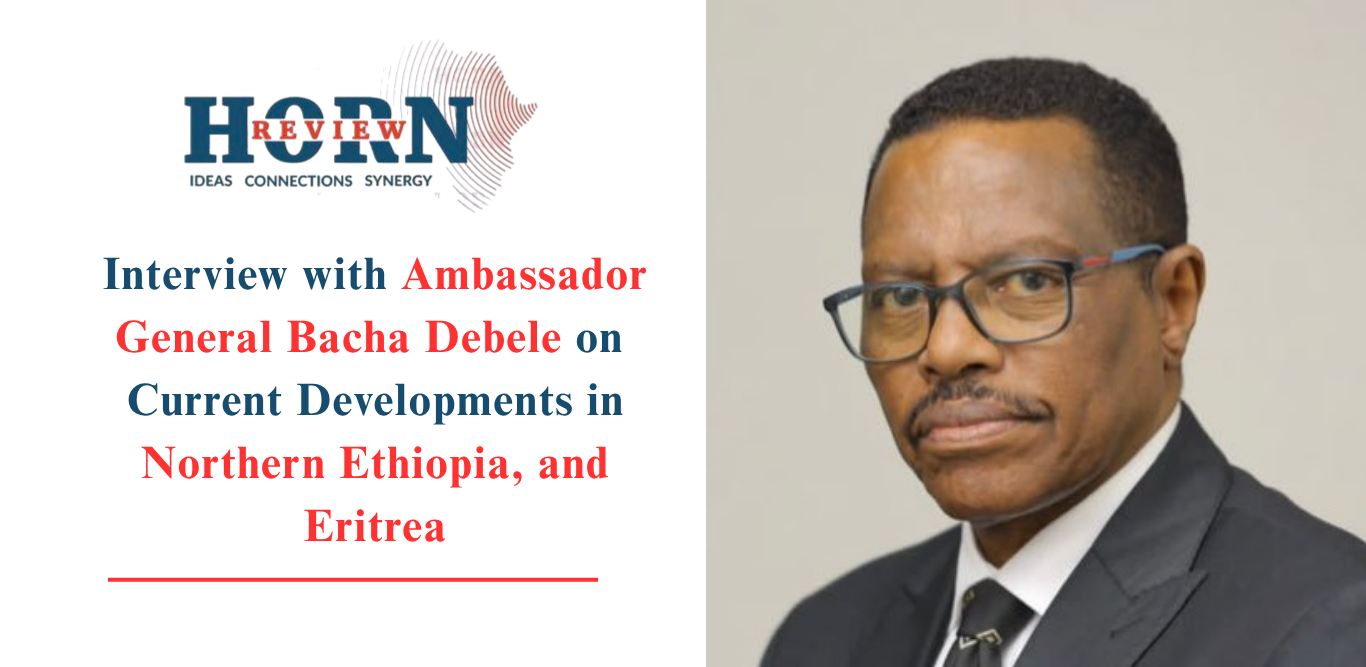
Interview with Ambassador General Bacha Debele on Current Developments in Northern Ethiopia, and Eritrea
Blen Mamo, Executive Director of Horn Reviews, sat down with Ambassador General Bacha Debele, a senior Ethiopian military and diplomatic figure with extensive experience in military affairs, national security, strategic planning, and regional diplomacy. Having served in senior command and diplomatic capacities, General Bacha brings decades of experience in Ethiopia’s security and foreign-policy environment to this conversation on the current developments in Ethiopia and Eritrea.
Download the Pdf version here:
Interview with Ambassador General Bacha Debele on Current Developments in Ethiopia, and EritreaDownload
Blen Mamo: General Bacha, thank you for joining me. I appreciate you taking the time to speak with us.
Ambassador General Bacha Debele: Thank you, Blen, for having me. It is my pleasure to speak with you.
Blen Mamo: Thank you, General. I would like to begin with the emerging seven-group coalition and the broader political and security developments unfolding across the region. You have described this coalition, which is arrayed against the Ethiopian federal government, as fundamentally unsustainable. What, in your assessment, are the principal reasons behind that?
Ambassador General Bacha Debele: The seven-group coalition is fundamentally a failure of strategic conception. Before we even examine who may be sponsoring or directing it, the coalition itself does not possess the essential attributes of a viable political or military alliance: a coherent strategic objective, a unified political program, a clearly defined chain of command, or a common end-state that all of its constituent groups genuinely share.
These groups have emerged from fundamentally different political circumstances, pursue divergent interests, and operate according to different calculations. Their grievances are not interchangeable, their political objectives are not synonymous, and their respective constituencies do not constitute a single coherent political constituency. An alliance constructed on such contradictions may generate temporary pressure, but it cannot readily translate that pressure into a sustainable strategic outcome.
More importantly, the coalition lacks the political legitimacy necessary to sustain a prolonged national undertaking. The popular legitimacy of the TPLF has been severely eroded, while groups such as Fano and the OLA have yet to articulate a sufficiently coherent and nationally inclusive political project capable of providing the foundation for such an alliance.
From a military-strategic standpoint, therefore, this is not simply a question of numbers, armed formations, or the ability to create simultaneous points of pressure. An alliance becomes strategically consequential only when its political objective, military objective, command structure, logistics, territorial calculations, and ultimate end-state converge. I do not see that convergence here.
And that brings us to Isaias Afwerki. The Eritrean dictator, whom I consider to be behind this entire drama, is pursuing an agenda that is in no form or shape consonant with the interests of these seven groups, the national and regional realities of the Horn of Africa, or the broader trajectory of international politics.
His calculations are ultimately personal and regime-centric, and, in my assessment, closely intertwined with Egyptian interests. He is not pursuing a strategic objective that serves Tigray, Amhara, Oromia, or any of the other constituencies being drawn into this arrangement. He is pursuing his own interests.
That is precisely why I regard the coalition as fundamentally compromised from the outset. Its constituent groups may believe that they are entering the arrangement in pursuit of their own political objectives, but the strategic direction of the enterprise is being shaped by interests that are not necessarily identical to theirs.
The coalition therefore does not merely suffer from internal contradictions. Its central strategic problem is that the interests of the actors attempting to use it are themselves incompatible with the interests of those being used.
That, in my assessment, is the fundamental weakness of the entire undertaking.
Blen Mamo: So, in your view, there is an inherent contradiction between the interests and aspirations of these groups and what you regard as the strategic objectives being pursued by Eritrea, with Egypt playing a role in that broader calculus?
Ambassador General Bacha Debele: Precisely. That contradiction lies at the very heart of the matter.
If we are to understand what is unfolding, we have to distinguish between the actors on the ground and the strategic interests of those operating behind them. The groups involved may have their own grievances and political calculations, but those grievances are appropriated and instrumentalized by external actors pursuing an entirely different regional agenda.
In my assessment, that is precisely what Isaias Afwerki has been attempting to do. His calculations are not fundamentally about the political future of Tigray, Amhara, Oromia, or any other Ethiopian constituency. They are about the preservation of his own regime, the advancement of his strategic interests, and the manipulation of Ethiopia’s internal vulnerabilities to serve those interests.
And behind that regional calculation, I see a clear Egyptian dimension. Cairo has its own strategic concerns regarding Ethiopia, particularly with respect to Ethiopia’s regional influence and the broader balance of power in the Horn of Africa, the Nile Basin and the Red Sea. Eritrea’s strategic posture increasingly intersects with those interests.
That is where the danger lies. When an internal Ethiopian political or military grievance becomes connected to the strategic calculations of external states, the original political question can be transformed into something entirely different. The Ethiopian actors involved may believe they are advancing their own causes, while in reality they risk becoming instruments through which external powers pursue objectives that have little to do with the interests of the constituencies they claim to represent.
Isaias Afwerki understands this dynamic very well. He has consistently sought to position Eritrea within Ethiopia’s internal contradictions in a manner that advances his own strategic calculations. But Eritrea cannot indefinitely pursue a regional agenda through proxies while pretending that it has no direct stake in Ethiopia’s internal affairs.
And this is why I say the interests are fundamentally incompatible. The strategic objectives being pursued from outside are not designed to produce a political settlement that serves the Ethiopian actors involved. They are designed to alter the regional balance of power.
Ultimately, the question is therefore not simply who is fighting whom. The more important question is who benefits strategically from keeping these conflicts alive, and whose interests are ultimately being served by the resulting instability.
Hence, that is where the role of Eritrea and Egypt must be examined very closely.
Blen Mamo: Let us turn specifically to the TPLF. You have been particularly critical of its military leadership and its current political trajectory. What is your assessment of the position in which the TPLF now finds itself?
Ambassador General Bacha Debele: The position of the TPLF military leadership is clear. They have lost the political legitimacy and popular support they once possessed, and the circumstances of 2020 no longer exist.
The youth are increasingly rejecting the leadership that has repeatedly committed them to war. If the TPLF could not prevail against the Ethiopian army when it possessed the institutional position, military capability and political standing it had in 2020, it cannot reasonably expect to achieve a different outcome today.
They should have brought their military adventure to an end after Tigray lost nearly 600,000 young people. This is a pattern that has been repeated from one generation to another, and it has to stop. The youths of Tigray cannot continue to be sent to die for the political calculations of the same leadership.
Tigrayan youth should no longer be sacrificed to cover the heinous crimes and irredeemable sins of senior figures within the TPLF, such as the likes of Getachew Assefa. The responsibility of a military leadership is not merely to initiate a war; it is to understand when a war has ceased to serve the interests of the people.
And there is another matter that must be stated without ambiguity. Any alignment with the Eritrean regime will not serve the interests of Tigray or the Tigrayan people.
Tigray has its own interests, its own people and its own future with in the Ethiopian federation. That future cannot be secured by placing Tigrayan lives and territory at the disposal of an external regime pursuing its own strategic calculations.
The TPLF leadership therefore has a responsibility to understand the limits of military power and, above all, to understand the cost of another war to the people of Tigray. No responsible military leadership should ask another generation to pay that price for a political objective that has already failed.
Blen Mamo: On the current TPLF military command, who, in your assessment, are the principal individuals directing its military affairs, and what concerns do you have about their role and the direction they are taking?
Ambassador General Bacha Debele: The principal figures I identify within the current TPLF military command include Debretsion Gebremichael, Fetlework, Getachew Assefa, Haileselassie Girmay, and Birhane Negash, also known as Woldemedhen, among others.
My concern, however, extends beyond the individuals themselves. It concerns the direction in which the military command has been moving and the deliberate marginalization, dismissal, and imprisonment of Tigrayan military and intelligence officers who played significant roles in building the Tigrayan security and military establishment, particularly those who were instrumental in the preparations and conduct of the 2020 war.
In my assessment, a number of these officers were subsequently removed from their positions, dismissed from the command structure, or subjected to detention the past few days because they opposed the course being pursued by the current leadership. Their opposition was not simply a disagreement over personalities. They understood the military consequences of another confrontation with the federal government, and they opposed any strategic alignment with the Eritrean regime.
That is a matter of considerable importance. When experienced military and intelligence officers who understand the operational realities of the previous war are removed because they challenge the political direction of the leadership, the issue goes beyond an internal restructuring of the command. It raises serious questions about whether professional military judgment is being subordinated to a political agenda.
The same concern applies to the question of Eritrea. Those officers who understand the history of the conflict and the strategic relationship between Ethiopia, and Eritrea have every reason to question the wisdom of entering into an arrangement with the very regime against which they fought a devastating war, not just once but twice.
I therefore view the treatment of these officers as part of a broader pattern. And we have to ask why. My concern is that a return to war with the federal government, under the present circumstances, would not simply be another Federal Government-TPLF confrontation. It could serve a broader regional strategy in which Tigrayan forces become an instrument of the Eritrean regime and, ultimately, of the wider interests that I have already discussed.
That is why I regard the current direction of the military command as extremely dangerous. The central question is therefore not simply who occupies the command posts today. It is what strategic objective that command is serving, whose counsel it is prepared to hear, and ultimately whose interests it intends to defend.
Blen Mamo: You have made a particularly strong assertion that the strategic center of this emerging alliance is neither Mekelle nor Asmara, but Cairo. What leads you to that conclusion?
Ambassador General Bacha Debele: The foundation of Tsimdo, or the seven-group alliance, lies neither in Mekelle nor in Asmara. In my assessment, its strategic direction comes from Cairo.
The reason is straightforward. The interests being brought together extend well beyond the immediate political calculations of the groups involved. Eritrea provides the regional conduit, while the various Ethiopian actors provide the political and military instruments. But the broader strategic objective is external to all of them.
Cairo has a direct strategic interest in constraining Ethiopia’s regional position. The Egyptian establishment has made that publicly and overtly clear in different occasions. When those interests converge with Eritrea’s longstanding hostility toward the Ethiopian state, the result is a framework in which Ethiopia’s internal fractures can be exploited for a larger regional purpose.
That, in my assessment, explains the architecture of Tsimdo. The actors may differ in their immediate objectives, but they can nevertheless be drawn into a common strategic enterprise. So when I say the center is Cairo, I am not referring merely to where meetings are held or where instructions are issued. I am referring to the strategic interest that, in my assessment, gives the entire undertaking its direction.
That is the distinction that must be understood.
Blen Mamo: You have argued that the Eritrean regime has repeatedly attempted to provoke an aggressive response from Ethiopia. How do you interpret Ethiopia’s decision to exercise restraint?
Ambassador General Bacha Debele: The Eritrean regime has repeatedly sought to provoke a military response from Ethiopia, but the Ethiopian military has deliberately refused to take the bait. That restraint is a strategic decision.
Ethiopia has understood that responding on Eritrea’s terms would serve Eritrea’s interests far more than Ethiopia’s. A premature military confrontation would create precisely the conditions that Asmara has been seeking to manufacture.
Now that those provocations have failed to produce the response Eritrea wanted, I see the seven-group coalition as the next instrument being brought into play – the last card Afwerki is attempting to deploy, with Cairo providing the broader strategic direction.
But there is a fundamental problem with that strategy. A project built around provocation, external sponsorship, and the manipulation of Ethiopia’s internal divisions cannot substitute for a coherent political objective or genuine domestic legitimacy.
That is why I confidently say the project is compromised from its inception.
Blen Mamo: You have emphasized the position of Tigrayan youth. What, in your view, is at stake for them if this political and military trajectory continues?
Ambassador General Bacha Debele: What is at stake is their future.
There is no justification for sacrificing another generation of Tigrayan youth for a political project that does not serve the interests of either the present generation or those that will follow.
Tigrayan youth have already borne the consequences of repeated wars. They should not once again be placed in the trenches to advance the calculations of political and military elites. Their lives cannot be treated as an expendable resource in a struggle whose objectives are determined by others.
The future of Tigray and its people ultimately lies within the Federal Republic of Ethiopia. Whatever political differences exist, they must be addressed through a framework that preserves the lives and prospects of the younger generation rather than consuming them in another war.
Tigray’s youth should have the opportunity to study, work, build families, develop their communities, and determine their own future. They should not inherit another generation’s war.
That, above all, is the responsibility of those who claim to speak and act in their name.
Blen Mamo: You have been highly critical of President Isaias Afwerki’s current posture toward Ethiopia. How do you assess the course Eritrea is pursuing?
Ambassador General Bacha Debele: The Eritrean leadership understands the capabilities of the Ethiopian military. It therefore also understands the consequences of deliberately testing Ethiopia’s restraint.
There is a fundamental contradiction in Eritrea’s position. You cannot invoke sovereignty as a principle for Eritrea while violating that same principle in relation to a neighboring state. You crossed an international border, intervened militarily in Ethiopia’s affairs, and violated Ethiopia’s national sovereignty. Sovereignty is not a principle that can be applied selectively.
Ethiopia is equally clear about the origins of the conflict, the actors involved, and the interests being advanced through it. We are not confused about who initiated hostilities or whose strategic interests are being served. The present attempt to pursue these objectives through proxies does not change that reality. It only changes the form of the confrontation.
Let me also be unequivocal on this point: Tigray, Amhara, or Afar should not be assumed to be Eritrea’s battlefield. If the present course continues toward open confrontation, the consequences may ultimately reach Eritrean territory. This is a matter of military logic, not rhetoric. A government that repeatedly tests another state’s restraint must understand that restraint has limits.
President Isaias Afwerki is a military man and understands this principle. He knows that once a conflict is initiated, its trajectory cannot always be controlled by those who began it. Ethiopia has exercised restraint because restraint serves its strategic interests. That should not be mistaken for an absence of capability or resolve.
If Eritrea chooses escalation, it must also be prepared to bear the consequences of that decision.
Blen Mamo: If the current trajectory continues, what, in your assessment, should Eritrea do to safeguard its future as a sovereign state and establish a more constructive engagement strategy?
Ambassador General Bacha Debele: Eritrea needs a fundamental recalibration of its regional policy. It must assess its interests pragmatically, recognize the realities of the region, and replace confrontation with a disciplined policy of transactional diplomacy.
A sovereign state cannot secure its long-term interests through perpetual confrontation and interference in the affairs of its neighbors. Eritrea has to determine what serves the interests of the Eritrean people and pursue those interests through diplomacy, engagement, and reciprocal arrangements rather than through proxy conflict or direct confrontation.
This requires a clear recognition that Eritrea’s future cannot be built around the calculations of one individual or the preservation of one regime. If the present course continues unchanged, the political future of Eritrea will ultimately be determined by forces and a political establishment capable of approaching regional affairs with a different understanding of diplomacy, national interest, and democratic governance.
The choice, therefore, remains with Asmara. It can pursue a working relationship with Ethiopia and its other neighbors based on mutual interests and respect for sovereignty, or it can continue down a path that will inevitably generate pressures for political change.
The ball is in Asmara’s court.
Blen Mamo: General Bacha, thank you for your time and for speaking candidly with us about these developments.
Ambassador General Bacha Debele: Thank you, Blen.

RELATED
Posts
26
Sep
The United States’ Shifting Sudan Strategy and the Limits of Coercive Leverage
Blen Mamo, Executive Director of Horn Reviews, sat down with...
26
Sep
Intelligence Report Details the Deep Crisis inside the TPLF & Eritrea's Subsequent Calculation
Blen Mamo, Executive Director of Horn Reviews, sat down with...
26
Sep
Ethiopia’s Tigray Crisis in Context
Blen Mamo, Executive Director of Horn Reviews, sat down with...
26
Sep
The Case against Armed Coalitions and Libya’s Pattern
Blen Mamo, Executive Director of Horn Reviews, sat down with...
26
Sep
Pakistan’s Growing Footprint in the Horn of Africa
Blen Mamo, Executive Director of Horn Reviews, sat down with...
26
Sep
Grand Fulla and the End of Egypt’s Nile Veto
Blen Mamo, Executive Director of Horn Reviews, sat down with...
26
Sep
Egypt’s Scarcity Narrative and the Reality of Nile Water Use
Blen Mamo, Executive Director of Horn Reviews, sat down with...
26
Sep
RSADO Raises Alarm as US Lets Eritrea Sanctions Expire
Blen Mamo, Executive Director of Horn Reviews, sat down with...
26
Sep
The Alliance for “Survival” as Eritrea’s Proxy Coalition
Blen Mamo, Executive Director of Horn Reviews, sat down with...
26
Sep
How Cairo’s Institutions Read Ethiopia
Blen Mamo, Executive Director of Horn Reviews, sat down with...