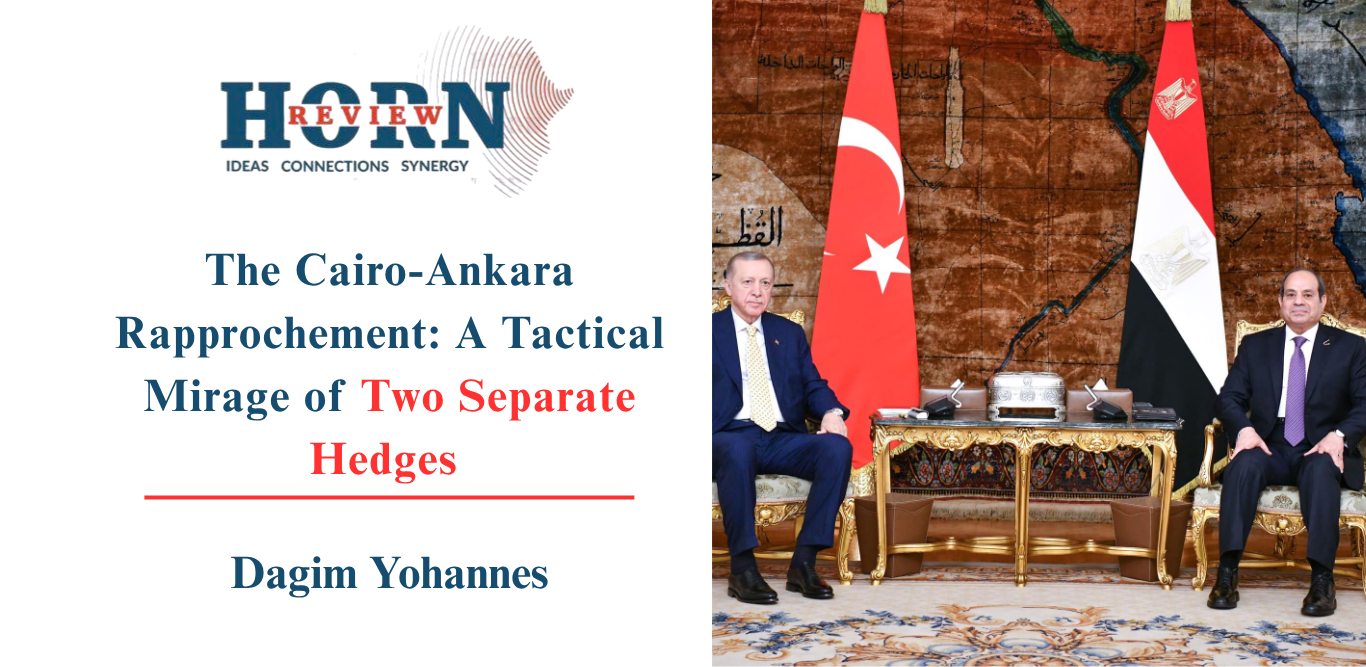
The recent run of headlines out of Cairo and Ankara, from joint air drills and commando exercises to a drone co-production line and a defense memorandum spanning five regional files, has been read as evidence that a century-old pattern of Egyptian-Turkish rivalry has finally given way to genuine strategic alignment. It has not. Egypt and Turkey are not converging on a shared regional vision. They are pursuing two separate hedges against the same set of pressures, and those hedges currently overlap. That is not a partnership. It is a coincidence reinforced by a communications strategy, and that coincidence rests on a structural rivalry with Israel that both states would rather manage jointly than confront alone, rather than on any deeper reconciliation of what each wants the region to look like.
The relationship has never had the institutional depth to sustain the word alliance, and it has a track record to prove it. Egyptian-Turkish rivalry did not begin in 2013; it is closer to two hundred years old. Muhammad Ali’s Egypt fought the Ottoman Sultan directly in the 1830s and came close to marching on Istanbul before European powers forced him back, the first instance of an Egyptian state asserting an independent regional role against Ankara’s predecessor rather than deferring to it. The pattern repeated through the twentieth century in a different register: Nasser’s Egypt positioned itself as the leader of Arab nationalism and the Non-Aligned Movement precisely against the Western-aligned, NATO-anchored Turkey of the Cold War, two states competing for regional leadership from opposite ideological camps. The post-2011 period simply gave the rivalry a new vocabulary. Erdogan backed the Muslim Brotherhood’s rise in Cairo under Morsi; Sisi’s 2013 coup and the subsequent designation of the Brotherhood as a terrorist organization turned that investment into a direct personal and ideological affront, and Erdogan said as much, refusing for years to recognize Sisi as Egypt’s legitimate president. Ambassadors were withdrawn. Egyptian opposition figures broadcast against Sisi from Turkish television studios. By 2019-2020 the rivalry had become a live proxy conflict: Ankara’s military intervention in Libya on behalf of the Tripoli government pushed Haftar’s eastern forces back far enough that Sisi drew a public red line at Sirte and threatened direct Egyptian military intervention if Turkish-backed forces crossed it. That is not a historical footnote to the current rapprochement. It is the baseline the rapprochement has to be measured against, and measured against it, three years of exercises and one defense MoU look considerably less like transformation and more like a tactical pause between two states that have spent two centuries, on and off, competing for the same regional space.
What actually restarted the relationship in 2020-21 was not a change of heart on either side but a change in each state’s isolation. Turkey’s interventions in Libya and Syria and its maritime claims in the Eastern Mediterranean had left it friendless across the region, at odds with Egypt, the UAE, Saudi Arabia, and Greece simultaneously at the exact moment its economy needed capital. Egypt, for its part, had watched Ankara’s Libya intervention demonstrate a capability gap it could not close through Gulf backing alone. Both sides needed an off-ramp, and they built one incrementally: intelligence contacts in 2021, the Erdogan-Sisi handshake in Doha in 2022, ambassadors restored in 2023, Erdogan’s Cairo visit in February 2024. That sequencing matters. Every step was diplomatic and reversible before it was military, and the military cooperation now being reported is the newest and shallowest layer of a rapprochement built for exactly nine years less than the rivalry it replaced. Nothing in that sequence required either state to resolve what actually divided them, not the Muslim Brotherhood, not Libya’s maritime boundary, not the two states’ competing visions of political Islam’s role in the region. It only required both sides to stop actively working against each other, which is a considerably lower bar than alignment and one either side can quietly clear again if circumstances change.
The one force genuinely holding the current phase together is Israel, and it deserves to be named as the actual engine rather than folded into a list of contributing factors alongside drone diversification and Libya fatigue. Egypt has watched Israeli unilateralism in Gaza degrade its position as the region’s indispensable mediator, undermine the Camp David-era security architecture it has spent decades defending, and expose the limits of its own deterrent capacity on its eastern border. Turkey watched the strike on Hamas negotiators in Doha and the Abu Al-Duhur incident and drew the same conclusion Cairo did: that Washington’s security guarantees to its regional partners are no longer reliable, and that Israel will act unilaterally against actors operating on the territory of American partners without meaningful consequence. That is a shared grievance. It produces exactly the kind of cooperation two frustrated powers build when they have no better option: coordinated mediation on Gaza, sympathetic signaling, arms diversification away from Western suppliers who can be pressured to cut off both of them, without requiring either state to sign onto the other’s regional agenda elsewhere.
The emerging Mecca security architecture makes that convergence even more visible. Turkey’s willingness to bring Egypt into the Saudi-Turkish-Pakistani defense pact is evidence that Ankara sees Cairo as a natural addition to a regional security framework designed to reduce dependence on Washington and give regional powers greater collective leverage. Erdoğan has publicly said that Egyptian participation is possible, while Turkish Foreign Minister Hakan Fidan has described Egypt as a natural partner for the pact’s future expansion. The pact is not formally described as an anti-Israel coalition \;i7, and Ankara has explicitly rejected identifying any single country as its common threat. Yet its emergence alongside sustained Turkish-Egyptian coordination over Gaza and repeated joint condemnation of Israeli actions shows how opposition to Israeli unilateralism can serve as a point of convergence between two states that remain divided over much of the regional order.
Strip Israel’s conduct out of the last three years and the security dimension of this rapprochement loses its primary driver. The diplomatic normalization would likely have continued on its slow track, but the drills, the drone deals, the defense MoU, and now Ankara’s willingness to fold Egypt into a broader regional security architecture would be harder to explain as a single trajectory. This relationship is not organized around what Egypt and Turkey want to build together. It is increasingly organized around what both of them are unwilling to allow Israel, or an unreliable Washington, to do next.
Ethiopia is where the limits of the Cairo-Ankara convergence become clearest. Take Ethiopia out of the picture entirely and ask what common ground Cairo and Ankara actually share. Libya survives the test only partially: Turkey still arms and trains forces aligned with Tripoli while expanding contacts with Haftar’s east, and Egypt has tolerated that expansion because it no longer threatens Cairo’s position on the ground, not because the two states are executing a joint Libyan strategy. The 2019 maritime boundary agreement between Ankara and the Tripoli government, the single issue that would prove Turkey is willing to subordinate its own claims to Egyptian interests remains completely untouched, three years into the thaw. Somalia and the Red Sea, the two convergence points most often cited as evidence of shared vision, are not joint projects at all once you look at why each state is there. Egypt’s 2024 defense pact with Mogadishu and Turkey’s mediation of the Ethiopia-Somaliland dispute both trace back to the same trigger Addis Ababa’s January 2024 memorandum seeking Red Sea access through Somaliland but each state reacted to protect a separate interest: Egypt to deny its upstream Nile rival a coastline, Turkey to protect a Mogadishu client relationship it has held since 2017. Remove Ethiopia’s active advancement and neither state had any independent reason to deepen its Somalia posture on this timeline. And on the dam dispute that actually defines Egyptian national security, Turkey is not aligned with Cairo at all: Ankara has been Addis Ababa’s drone supplier since 2021, a sale significant enough that Egypt formally lobbied Washington and European capitals at the time to have it blocked. Ethiopia remains a standing Baykar client today. A state genuinely aligned with Egypt’s core security interest does not keep arming the government Cairo has spent fifteen years trying to isolate over exactly this question and the fact that this contradiction goes unmentioned in nearly every account of the rapprochement is not an oversight .It is the detail that complicates the alliance framing when examined directly.
None of this means the cooperation is fabricated. The exercises happened. The drones are being co-produced, even if the fifty percent local-content figure comes from the Arab Organization for Industrialization itself and has not been independently verified. The MoU was signed. But activity is not the same as alignment, and two centuries of a relationship that has oscillated between open rivalry and tactical accommodation should make anyone skeptical of headlines announcing its permanent transformation on the strength of eighteen months of drills. What the evidence actually supports is narrower and considerably less romantic: two states, each independently constrained by Israeli unilateralism and an unreliable Washington, have found it convenient to stop working against each other and, at times, work in parallel. Yet the relationship that would most clearly test whether this is genuine alignment, Turkey’s continued arming of Egypt’s principal regional antagonist, remains largely untouched. Call it a tactical thaw. Call it mutual convenience. But until Ankara is willing to place its broader regional relationships and interests on the table, the evidence points to convergence of interests, not convergence of strategy.
Dagim Yohannes, Researcher, Horn Review