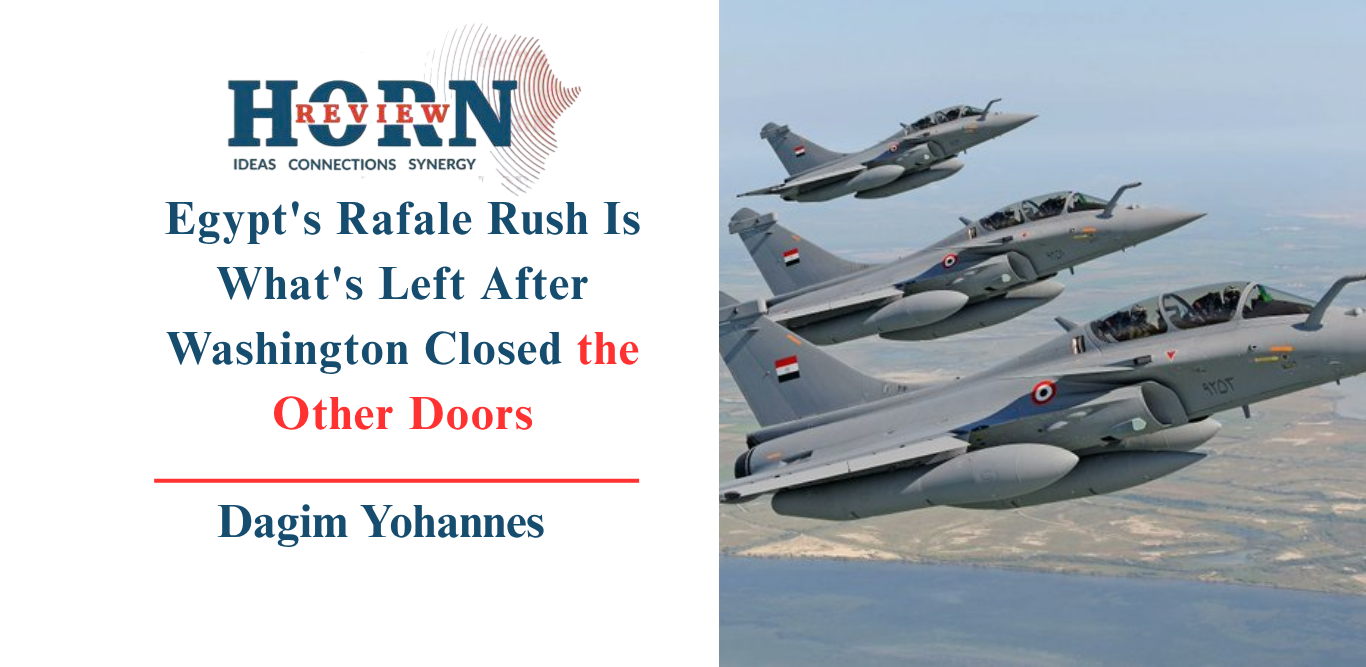
Egypt is nearing a new deal with French company Dassault Aviation to purchase 24 additional Rafale fighter jets, a move that could raise its fleet of the French fighter to 78 aircraft and cement its position as the largest external importer of the Rafale. But this is not a first-choice acquisition. It is the last lane still open. Over the past six years, Cairo has tried twice to build an air force outside the American gatekeeping system, once through Russia, once through China and both attempts have been slowed or killed by the same actor for the same reason: Washington’s commitment to preserving Israel’s qualitative military edge in the air. The Rafale buildout therefore looks less like strategic preference and more like what remains once the other two doors were shut.
The Russian door closed first, and closed cleanly. Egypt signed a roughly $2 billion contract for 24 Su-35s in 2018, a genuine attempt at an independent, high-end air-superiority platform. By 2020, the deal was dead. Then-Secretary of State Mike Pompeo flagged it explicitly at a congressional hearing and warned that CAATSA sanctions would follow if Cairo proceeded; the jets were quietly redirected to Iran instead. This was not subtle pressure. It was a public, on-the-record threat against a state that receives over a billion dollars a year in U.S. military assistance and it worked within two years.
The Chinese door has taken longer to close, and the closing has been less a single veto than a sustained campaign of substitution. Cairo’s interest in Chinese fighters dates back further than most coverage acknowledges, reported contacts over the J-20 stealth fighter go back to at least 2019, with a parallel, more concrete track on the J-10C opening around 2022. Chinese J-10Cs performed at the Egypt International Air Show in 2024, and defense trade outlets (Bulgarian Military first, later picked up by the South China Morning Post and others) reported Cairo had placed an initial J-10C order that August, though neither Cairo nor Beijing confirmed it officially. Notably, Egypt is also reported to have turned down a US offer around the same time to upgrade its F-16s to the F-16V standard and to supply new F-15s, and to have rejected a Russian offer of further MiG-29s suggesting the China outreach wasn’t opportunism but a real attempt to force better terms out of Washington by demonstrating Cairo had somewhere else to go.
It worked, in the sense that Washington responded but not by giving Egypt the China deal or matching it unconditionally. By January 2026, reporting describes the J-20 talks as having entered what one outlet called a “containment phase”: not cancelled, but deliberately slow-walked under sustained US pressure, with Cairo keeping the channel open rather than closing it. The more concrete near-term step under discussion, a single J-10C squadron, on the order of 40 aircraft, to replace ageing F-16 Block 30s has reportedly been met with a specific American counter-package: roughly $4.67 billion for four NASAMS-3 air defense batteries, paired with as many as 200 F-16 upgrade kits to bring the fleet toward a Block 70/72 standard with APG-83 AESA radar. That is not vague reassurance. It amounts to a concrete American effort to keep Egypt inside the existing U.S. supply chain rather than allow a Chinese fighter relationship to become strategically entrenched. Separately, Cairo has also been reported floating a 100-aircraft FA-50 order with South Korea, technology transfer included, a sign Egypt is still shopping multiple non-Chinese alternatives rather than having settled on any single path. There is also a practical limit to how far Cairo can diversify. Egypt already operates a highly fragmented fighter fleet, with American F-16s, Russian MiG-29s and French Rafales requiring different logistics, maintenance, weapons and training ecosystems. Adding another supplier may increase political leverage, but it also increases sustainment and integration costs, particularly when data links, weapons compatibility and spare-parts chains have to operate across separate technological systems. This helps explain why Cairo keeps looking for alternative tracks without necessarily wanting to build an indefinitely fragmented fleet: diversification creates bargaining power, but too much diversification can become an operational burden of its own.
It is worth being honest about the quality of that China reporting: it runs almost entirely through defense trade press Eurasian Times, Army Recognition, SOFREP, Bulgarian Military, rather than confirmed government statements from Cairo, Beijing, or Washington. Treat the J-10C “order” and the J-20 “containment phase” framing as a consistent pattern across sources over 2019–2026, not as an established fact. But the pattern itself, even unconfirmed in its specifics, is the relevant data point: every time Egypt has moved toward a genuine alternative supplier for advanced fighters, a countervailing American offer has materialized within months, structured specifically to make the alternative less necessary. Cairo’s strategy, however, is not simply one of accepting constraints imposed from outside. Egypt has repeatedly used competing suppliers to widen its bargaining space, diversify dependencies and pressure Washington for better terms. The problem is that diversification only works when the alternative supplier is politically and strategically viable. Egypt’s recent experience suggests that the most consequential alternatives can themselves become targets of pressure, leaving Cairo with fewer credible choices even as it continues to shop around.
That is the context the Rafale RFP sits inside. France is the one advanced-fighter supplier where Washington and Israel have not needed to block the sale outright, they simply priced their concession into the contract instead. Reporting from the Washington Institute indicates the US and Israel pressed Paris to equip Egyptian Rafales with the shorter-range MICA missile rather than the 100km-range Meteor, trading capability for the sale rather than preventing it. That is a materially different kind of gatekeeping than CAATSA or a stalled China track: Egypt gets the airframe, gets French sovereignty over the sale (which sits outside CAATSA’s Russia-specific triggers), and absorbs a capped missile loadout as the price of admission. Rafale is not the platform Egypt would build an independent air force around by choice. It is the platform where the veto already happened once, quietly, at the missile level, rather than happening twice more, loudly, at the contract level.
That reframes the “why now.” The RFP lands three weeks before the El Alamein International Air Show, where Cairo has strong incentive to either announce or visibly advance the deal; it follows Egyptian Rafales training against Chinese J-16s in Eagles of Civilization 2026, giving Cairo a fresh, low-cost way to remind Paris and Washington that alternatives exist even as the China track itself stalls; and it comes while Dassault’s order book has a real capacity constraint, with Qatar holding its own outstanding option on 12 more aircraft that could otherwise absorb the production slots Egypt wants. None of this means Egypt has no genuine reason to want Rafale. France offers Cairo a major Western combat aircraft without placing the entire acquisition relationship inside the American security architecture, while Rafale itself provides a capable and politically diversified addition to Egypt’s fleet. The point is not that Cairo chose Rafale reluctantly. It is that Rafale may be the most viable form of diversification available to Egypt within the constraints surrounding its higher-end fighter options. Every signal therefore points to Cairo trying to convert a closing set of options into a locked contract before the next American counter-offer, a further F-16 package, a NASAMS sweetener, or a renewed F-35 gesture aimed at matching whatever Ankara gets out of the Makkah Pact track makes even the capped Rafale less urgent to finalize.
None of this makes Egypt’s air force weaker in raw numbers. It will likely still end up the second-largest Rafale operator on earth, with 78 aircraft against France’s own fleet. But the sequence, Su-35 killed outright, J-10C/J-20 slow-walked and countered, Rafale approved with constraints shows an air force being built not simply according to Egyptian requirements, but within the boundaries of what Washington and Israel are willing to tolerate. Cairo is not a passive actor in this process: it has repeatedly used competing suppliers to preserve bargaining leverage and diversify its dependencies. Yet diversification has its own limits, from political pressure on suppliers to the growing operational burden of maintaining multiple foreign ecosystems. Rafale therefore represents neither a reluctant compromise nor an unconstrained Egyptian preference. It is the most viable form of strategic diversification still available to Cairo. The September rush is consequently less a sign that Egypt has found its ideal fighter than that it understands how quickly its remaining choices can narrow. Cairo is trying to lock in the option that remains politically viable before another American counter-offer, whether a further F-16 package, a NASAMS sweetener or a renewed F-35 gesture changes the calculation again. The Rafale rush is therefore not simply about buying 24 aircraft. It is about securing strategic room to maneuver before that room closes further.
Dagim Yohannes, Researcher, Horn Review