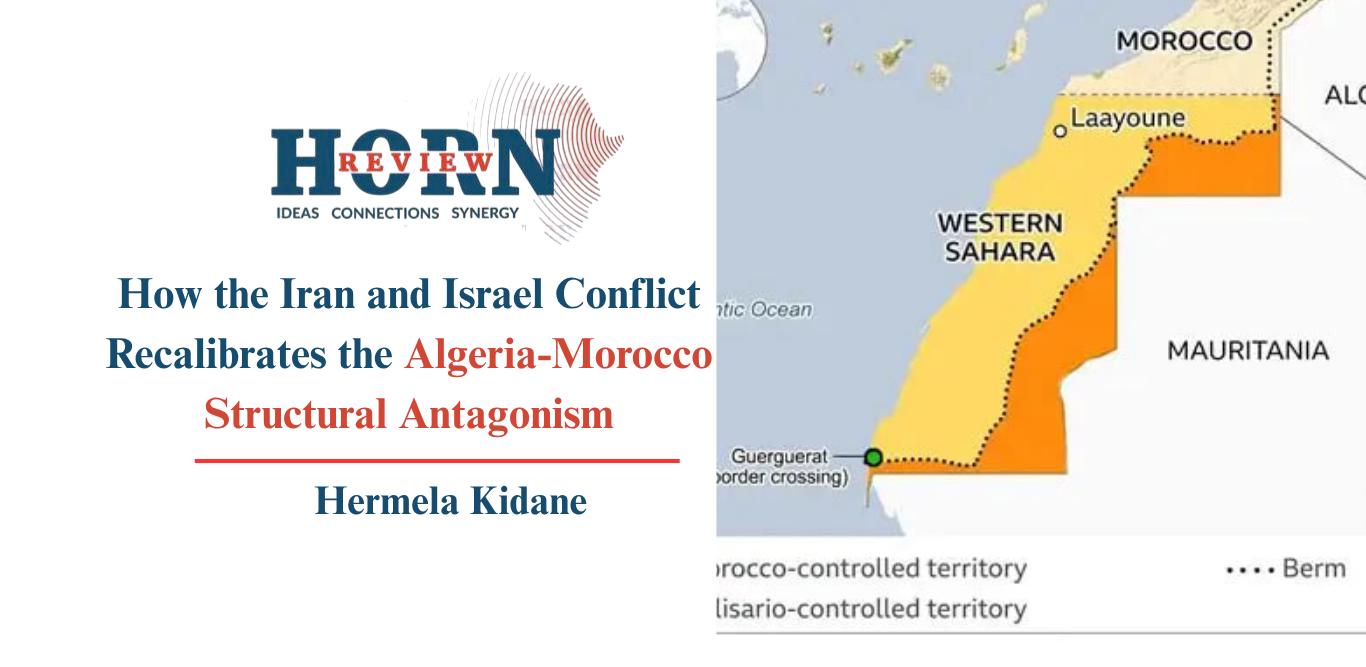
The direct hostilities between Iran and Israel have generated effects beyond the Persian Gulf into the Mediterranean geopolitics. In the Maghreb where relations between Algeria and Morocco remain defined by a durable structural antagonism centered on Western Sahara the conflict functions less as an immediate security threat than as an accelerant of existing patterns. It sharpens pre existing fault lines, clarifies alliance choices and alters the cost benefit assessment of both states without introducing fundamentally new divisions. An examination of their respective responses demonstrates how a distant Middle Eastern confrontation is refracted through the unresolved Western Sahara question reshaping external alignments and reinforcing the competitive logic that governs North African security.
The divergence begins with a clear asymmetry in alliance structures. Morocco’s formalization of relations with Israel under the Abraham Accords in December 2020 constituted a consequential decision. The accompanying United States recognition of Moroccan sovereignty over Western Sahara formed an explicit element of that arrangement. Morocco’s posture in the current conflict therefore presents a continuation and reinforcement of this choice rather than a sudden shift. Morocco has maintained a consistent orientation toward Gulf partners building on its earlier 2018 decision to sever diplomatic relations with Iran following allegations concerning Iranian and Hezbollah support for the Polisario Front channeled through Algeria. Official Moroccan statements have expressed concern over Iranian actions affecting Gulf states while remaining restrained regarding United States and Israeli military operations. This calibrated approach positions Morocco as a reliable security partner within the emerging system associated with the Abraham Accords and related regional orders with the expectation that such alignment will sustain external support on the Western Sahara dossier.
Algeria’s public statements have emphasized the risks of military escalation and the need for restraint while later expressing solidarity with Arab states affected by strikes without assigning explicit responsibility in a manner that would close diplomatic options. This formulation reflects an effort to reconcile long standing commitments to Palestinian self determination and non aligned principles with the practical necessity of avoiding isolation from the United States at a sensitive moment in Western Sahara negotiations. The result is neither full alignment nor outright opposition but a form of hedging designed to preserve room for flexibility under competing pressures. This presents an attempt to engage transactional diplomacy without abandoning core identity markers of the state’s post independence foreign policy tradition.
These diplomatic differences find expression in the domestic and informational domains. Public sentiment across much of the Maghreb has tended to view Iran through an anti imperialist rather than purely sectarian lens however both governments have tightly managed public expression limiting organized demonstrations and maintaining institutional control over the narrative space. Moroccan official discourse has continued to associate the Polisario Front with Iranian influence an assertion rejected by Sahrawi representatives. In a climate of heightened international concern regarding Iranian regional activities such framing aims to influence external perceptions of the Western Sahara conflict and potentially the legal or political status of the Polisario in multilateral settings. Algeria for its part remains attentive to internal security assessments that view external alignments involving Morocco, the United States and Israel as sources of pressure.
The economic consequences of the conflict produce an inverse pattern. Morocco as a net energy importer whose budget assumptions have been calibrated around moderate oil prices confronts rising import costs, elevated shipping expenses and pressure on fiscal balances. These complicate efforts to balance development priorities with social stability. Algeria by contrast benefits from higher hydrocarbon prices as a major producer possessing substantial conventional gas reserves. Its export routes to Europe via the TransMed and Medgaz pipelines under the Mediterranean remain insulated from maritime disruptions affecting Gulf shipping lanes. This differential impact enhances Algeria’s short term fiscal position and strengthens its relative leverage in energy and trade discussions with European partners at a time when diversification of supply sources remains a European priority.
Neither Algeria nor Morocco occupies a position that would render it a direct stage of operations. Their relevance lies instead in complementary but competitive attributes. Morocco’s roles in migration management, counterterrorism cooperation and the African dimension of Abraham Accords related security arrangements, Algeria’s influence in the Sahel and its capacity as an energy supplier. Prospects for any meaningful convergence between the two states remain remote. The core drivers of rivalry the fundamental disagreement over Western Sahara and the security dilemma in which each interprets the other’s defensive measures as potentially threatening retain their structural force. External conflict tends to intensify rather than mitigate these dynamics contributing to sustained military modernization programs that have already made both countries among Africa’s leading arms importers. While rational considerations continue to discourage open interstate war elevated tensions increase the residual risk of miscalculation arising from proxy incidents or unintended escalation.
The experience of the present conflict shows several lessons. First bilateral rivalries are rarely suspended by distant crises and they more commonly absorb and reinterpret external events through local prisms. Second formal alliance choices once institutionalized generate path dependent effects that constrain subsequent policy flexibility. Third energy market disruptions distribute gains and losses unevenly temporarily altering relative bargaining power without resolving underlying political disputes. Fourth narrative competition over the characterization of non state actors can acquire heightened salience during periods of international polarization. Finally, the Maghreb illustrates how unresolved territorial questions continue to shape the region’s insertion into wider geopolitical currents limiting the scope for collective responses and reinforcing competitive rather than cooperative logics.
The Iran and Israel conflict does not redefine the Algeria and Morocco relationship so much as it illuminates and accelerates its established course. Both states interpret the war through the lens of Western Sahara and their respective external partnerships producing greater divergence rather than any prospect of tactical alignment. This reinforces the observation that in a fragmented regional order external shocks are absorbed according to pre existing identities with consequences that endure well beyond the immediate crisis.
By Hermela Kidane, Researcher, Horn Review