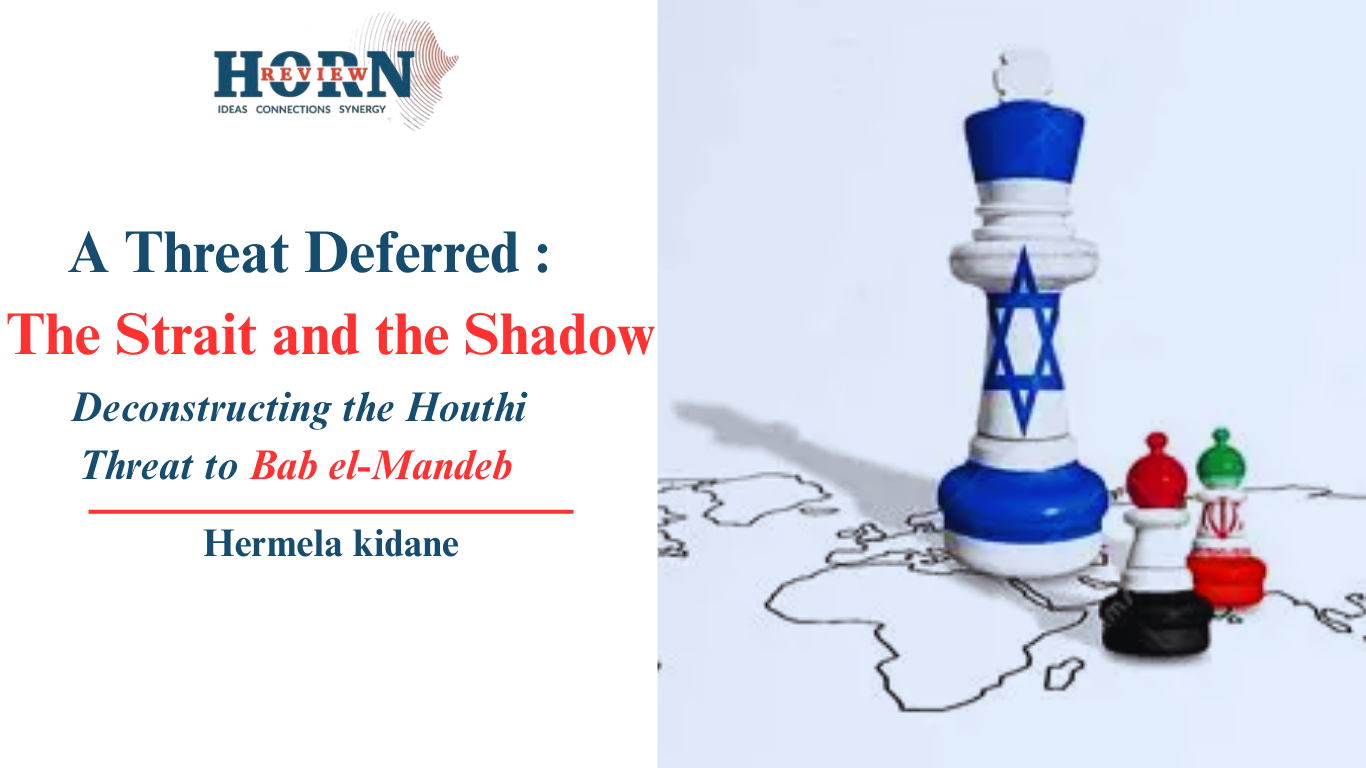
Deconstructing the Houthi Threat to Bab el-Mandeb
On March , 2026 a statement from Mohammed al-Bukhaiti which is a member of Yemen’s Houthi movement’s political bureau reverberated through global security circles. Al-Bukhaiti declared that the group was actively considering the closure of the Bab el-Mandeb Strait to vessels from nations they considered hostile to members of the so-called ‘axis of resistance’. This warning encase explicitly as a move to support Iran in its confrontation with the United States and Israel injected a new and potent variable into the geopolitics. The declaration arrived twenty four days after the eruption of a major conflict, a temporal gap that transforms a simple threat into a puzzle. The central question is not just what a blockade would entail, but why given the stated capability and intent the Houthis have not yet translated this signal into operational reality.
The Bab el-Mandeb Strait is not just a body of water however it is the southern gateway to the Suez Canal of singular importance to global trade. Its closure would not simply inconvenience commerce but it would fracture the world’s most main maritime. For the Horn of Africa the immediate impact would be severe and multifaceted. The Horn of Africa would transition from a peripheral zone of counter terrorism operations to a central front in great power maritime competition.
The Houthi threat is rendered even more by its explicit linkage to the Iran-Israel conflict. It presents a fundamental shift in the nature of that confrontation. What was once a conflict primarily conducted through land-based proxies, air strikes and cyber operations is now being consciously expanded into the maritime domain. The Houthis by positioning themselves as Iran’s maritime arm are weaponizing trade routes, transforming commercial shipping into a legitimate in their framing coliseum of war. This expansion is not haphazard but exhibits a logic of controlled escalation. Al-Bukhaiti’s careful stipulation that the Houthis would target only vessels from countries they consider hostile is a deliberate sign of controlled escalation. It is a signal designed to create a bounded conflict, one that pressures specific adversaries like the United States and Israel while avoiding a blanket declaration of war against global commerce.
The importance of Bab el-Mandeb is often compared to the Strait of Hormuz but such a comparison while useful can obscure more than it reveals. Both are main points but their disruption impacts the global system in fundamentally different ways. The Strait of Hormuz is the world’s primary point for the supply of crude oil and its closure would trigger an immediate and severe supply shock leading to a vertical spike in global oil prices as of now. Bab el-Mandeb conversely is a conduit for the flow of goods, including a portion of the world’s containerized trade, energy shipments from the Persian Gulf destined for Europe and a vast array of manufactured goods. Its disruption would not necessarily remove oil from the market but would radically alter its transport. The resulting increase in shipping times, fuel consumption and insurance costs would generate a more insidious and prolonged form of economic pressure like systemic inflation. This distinction is crucial. A Hormuz closure is a sudden crisis, a Bab el-Mandeb closure is a slow-burning drag on global economic activity. If both main points were threatened simultaneously, the combined effect would be catastrophic, creating a perfect storm where supply is cut and flow is choked leading to unprecedented global economic instability.
Given the gravity of such an outcome the responses of main global actors are predetermined yet reveal divergent cultures. A Houthi blockade would therefore compel a swift, military heavy response, likely involving the establishment of an expanded naval escort mission, the deployment of additional air assets to the region and targeted strikes against Houthi coastal defense systems and command nodes.
If the Houthis possess the capability through a demonstrated arsenal of anti-ship missiles, naval mines and unmanned systems and have articulated the intent, why have they not acted in the twenty-four days since the war’s outbreak? The response is in the distinction between tactical capability and wisdom. An attack now would crystallize a diffuse threat into a concrete casus belli. It would unify the disparate interests’ countries and regional powers into a single, focused coalition with a clear objective like the dismantling of Houthi anti-access and area-denial capabilities in the Bab el-Mandeb. By maintaining the threat in a state of unclarity the Houthis achieve several objectives.
The Houthi movement’s consideration of a blockade is therefore a exemplary case in modern asymmetric strategy. The group has successfully framed the Bab el-Mandeb Strait not just as a trade route but as a political bargaining chip of immense value. Their restraint is not a sign of weakness but a choice born from the understanding that the power of a weapon often lies not in its use but in the credible fear of its deployment. The twenty-four days of inaction are not a void but a statement a silence that forces the world to contemplate a future where one of the planet’s most vital road is perpetually held hostage. The Red Sea has thus become a silent front where the greatest battles are not fought with missiles and mines but with threats, perceptions and the agonizing arithmetic of when and if to pull the trigger on a lever that could upend the global economic order. The true conflict is not over control of the waterway but over the mastery of the shadow it casts.
By Hermela kidane, Researcher, Horn Review