China, the Houthis and a Conditional Maritime Order
Within days of the Houthis announcing a maritime blockade against Saudi Arabia on 20 July 2026, Beijing opened direct communications with the group to seek assurances for the safe passage of Chinese-linked vessels through the Bab el-Mandeb Strait. Rather than relying exclusively on naval protection or multilateral security mechanisms, China opted for direct engagement with the actor capable of imposing significant risks on maritime traffic. The move can be interpreted as a pragmatic response to an increasingly complex security environment, suggesting that, in contested waterways, the practical exercise of freedom of navigation may increasingly be shaped not only by international legal norms but also by political engagement with actors capable of affecting maritime security outcomes.
Beijing’s approach reflected a broader reassessment of maritime risk. Commercial continuity could not be guaranteed through naval deterrence alone, particularly as regional tensions created uncertainty across key maritime chokepoints. The Houthis declaration coincided with heightened insecurity around the Strait of Hormuz, further highlighting the strategic importance of Saudi Arabia’s Red Sea export infrastructure, especially the Yanbu terminal connected to the East-West Pipeline. For China, maintaining reliable access to this Red Sea route offered an important means of reducing exposure to disruptions affecting Gulf energy flows. Negotiation, viewed from this perspective, was not a diplomatic concession but a calculated instrument of economic statecraft designed to preserve commercial resilience.
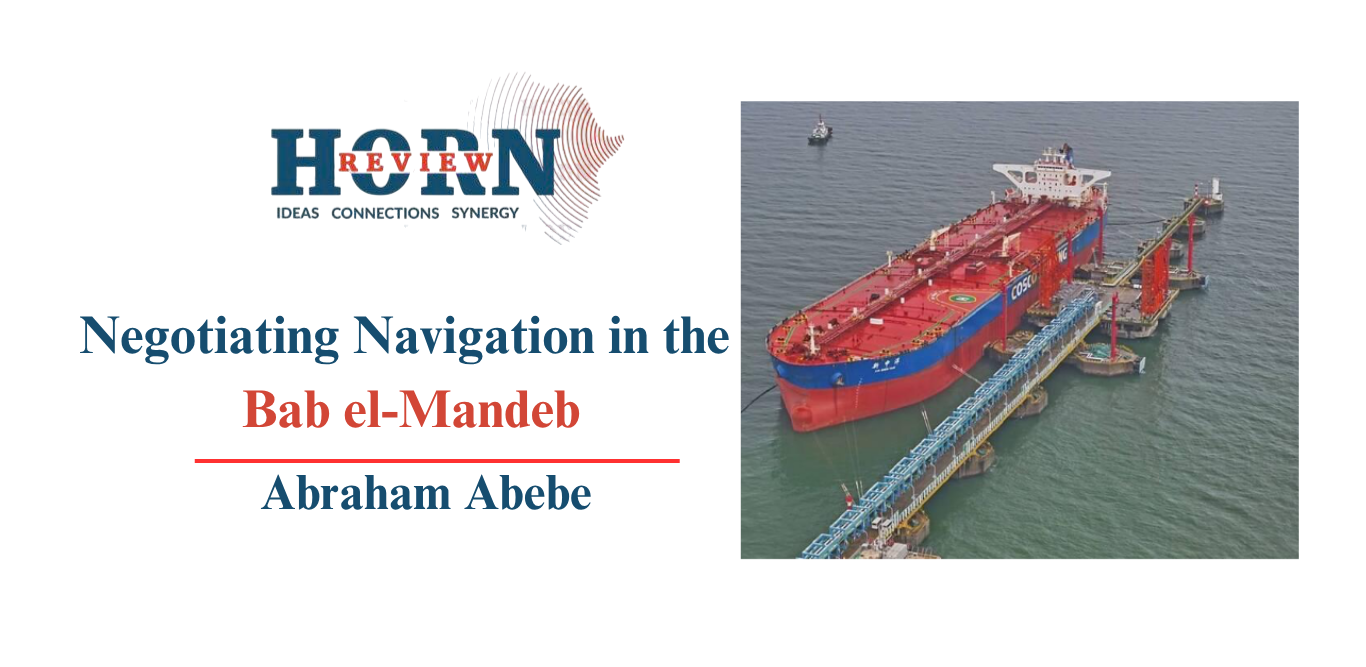
Operational evidence illustrates the practical consequences of this strategy. Chinese officials reportedly engaged with the Houthis through individual transit arrangements to seek assurances for the passage of Chinese-linked ships. Ship-tracking data from Kpler, LSEG and MarineTraffic indicated that at least four tankers carrying Saudi crude destined for China transited the Bab el-Mandeb after the restrictions were announced. These voyages suggest that political understandings may facilitate safer passage for states possessing sufficient diplomatic influence. By contrast, the oil supertankers New Champion and New Prime turned back from the Gulf of Aden into open waters amid heightened security concerns. The differing outcomes indicate that, in contested maritime environments, practical access is increasingly influenced not only by legal entitlement but also by political relationships.
These contrasting experiences suggest the emergence of what may be described as a Conditional Maritime Order. Under this evolving pattern, the practical exercise of freedom of navigation in contested maritime spaces increasingly depends on political understandings, strategic relationships and negotiated security arrangements, alongside the legal rights established under international law. The modern law of the sea is founded on the principle that vessels entitled to navigate under international law enjoy equal legal rights regardless of political alignment or commercial affiliation. That legal foundation remains unchanged. What appears to be evolving is the operational environment within which those rights are exercised. In practice, some vessels are able to reduce operational risks through diplomatic engagement or political accommodation, while others continue to navigate under significantly greater uncertainty despite possessing the same legal entitlements. The result is not the erosion of international maritime law itself, but the growing influence of parallel political mechanisms that increasingly shape how established legal principles are implemented and experienced in practice.
This development is significant because it alters the relationship between coercion and governance at sea. The Houthis have not transformed their maritime capabilities into recognised authority over the Bab el-Mandeb, nor have they established conventional control of the maritime domain. Instead, they have demonstrated that influence over a strategic maritime chokepoint does not necessarily require formal sovereignty or naval dominance; it can also be exercised through the ability to generate uncertainty, disrupt commercial calculations and impose costs on international shipping. In such an environment, uncertainty itself becomes a source of leverage, encouraging governments and commercial actors to seek selective arrangements that reduce operational risks. If this pattern continues, it may reinforce a broader shift in which maritime stability depends not only on state-based security mechanisms but also on forms of political accommodation with armed non-state actors capable of affecting commercial access. Over time, operational necessity risks creating forms of practical engagement that increase the influence of armed non-state actors, even without any formal change in their international legal status.
The implications extend beyond China’s immediate interests. In contested waterways, maritime security is increasingly shaped not only as a collective public good but also through selectively negotiated arrangements. States possessing substantial diplomatic influence, economic weight or established channels of communication are better positioned to secure practical advantages unavailable to others. China’s central role in global trade, combined with its engagement with the Houthis and its importance as a major destination market for Saudi oil exports, may have contributed to Beijing’s ability to obtain practical assurances for selected maritime movements. The contrast between vessels able to secure passage and those that continue to face uncertainty illustrates how commercial access may increasingly depend upon political influence operating alongside legal rights.
The deeper concern, however, lies not in China’s individual response but in the broader precedent such arrangements may create for maritime governance. Similar dynamics could emerge in other strategically important maritime regions where geopolitical rivalry intersects with weak governance or the presence of organised armed groups. If major powers increasingly pursue separate arrangements to safeguard their own commercial shipping, international maritime security could gradually become more fragmented, with political bargains operating alongside universal legal frameworks rather than replacing them. This does not imply that China’s approach is strategically misguided. From a national perspective, reducing commercial risk through diplomacy represents a rational response to an uncertain security environment. The broader challenge arises when individually rational strategies collectively weaken the shared expectations upon which the international maritime system depends. If more trading states seek separate accommodations with local power brokers, collective maritime governance may become increasingly difficult to sustain. The immediate beneficiary may be commercial continuity, but the longer-term consequence could be a weakening of confidence in the principle that access to international waterways should be practically available on equal terms to all.
China’s engagement with the Houthis should therefore be understood not simply as a diplomatic initiative, but as a possible indicator of broader changes in the governance of contested maritime spaces. The principal contest in the Red Sea is increasingly not only about territory or military superiority, but also about the capacity to influence access itself. If the conditions associated with a Conditional Maritime Order continue to develop, future maritime competition may revolve less around controlling the sea in a conventional military sense and more around shaping the political conditions under which others can navigate it safely. Such a development would not displace the principle of freedom of navigation embedded in international law. Rather, it would represent a transformation in how that principle operates in contested maritime environments, where legal rights increasingly coexist with political bargaining as parallel determinants of practical access.
By Abraham Abebe, Researcher, Horn Review