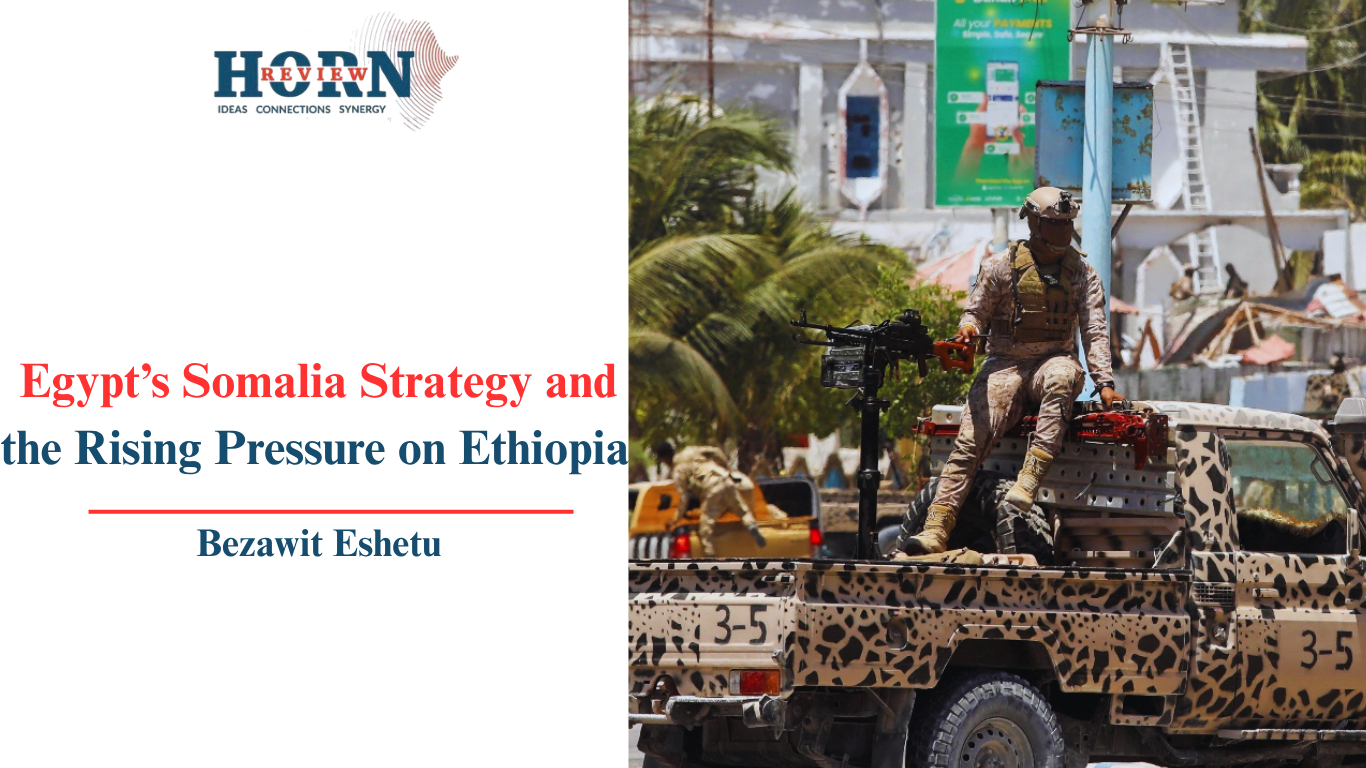
As federal Somali National Army units, equipped with armor and artillery from Egypt, move west from Mogadishu, they advance through contested areas toward Baidoa, the administrative center of Southwest State. What seems like a routine show of central power is actually a carefully planned geopolitical move. Officials in Southwest have accused President Hassan Sheikh Mohamud’s government of orchestrating this advance. They claim it is backed by clan militias loyal to Mogadishu and aims to dismantle regional autonomy. This push also seeks to replace President Abdiaziz Hassan Mohamed Laftagareen.
The ease of the operation through territory influenced by Al-Shabaab raises valid concerns about hidden deals that redirect counter-terrorism efforts toward internal power struggles. Yet, the implications extend beyond Somalia’s internal issues. This advance marks a new chapter in Egypt’s long-standing strategy to exert power over Ethiopia by exploiting the Horn’s weakest point. It aims to transform Somali territory into a base for resurrecting old containment strategies amid ongoing disputes over the Nile and Ethiopia’s desire for access to the Red Sea.
This situation exemplifies Cairo’s encirclement strategy. It uses Somalia’s ongoing institutional weaknesses to impose costs on Ethiopia without risking a direct military conflict. Egypt’s defense agreement with Mogadishu involves multiple arms shipments via aircraft and warships, training programs for Somali forces, and plans to contribute troops under the African Union Support and Stabilization Mission. These measures are framed as efforts to stabilize Somalia and combat Al-Shabaab. In reality, these actions position Egyptian influence and its allies along the Ethiopia-Somalia border, providing leverage in negotiations over the Grand Ethiopian Renaissance Dam.
They also aim to counter Ethiopia’s 2024 agreement with Somaliland for naval access. Southwest State shares a direct border with Ethiopia and hosts Ethiopian troops for joint security operations, making it a focal point in this situation. What appears to be internal centralization in Mogadishu also represents a major shift, placing Egyptian-supported forces dangerously close to Ethiopia.
This pattern reflects Egypt’s long-standing strategy of neutralizing threats from upstream Nile states. In 1964, Egypt did notfight Ethiopia directly. What it did was use selective military support for Somalia as a pressure tool. The documented support included plane loads of ammunition and infantry rifles, sent on Nasser’s orders, with the Hakim rifle especially important because Somalia’s army was short of basic infantry weapons at the start of the war. The strategic effect was to help Somalia stay in the fight while keeping Ethiopia pinned on its eastern frontier. What ended that round was not Egyptian escalation, but Sudanese mediation in Khartoum, which produced the armistice and troop pullback.
In the Ogaden War of 1977–78, Egypt’s role was broader and more consequential, but still indirect. After Somalia lost Soviet backing, Cairo became one of the external suppliers helping keep Mogadishu armed, alongside other conservative Muslim states. One historical account note that Somalia’s late-1977 shortages were being met by regimes including Egypt, and contemporary reporting said Somalia was quietly buying Soviet-built arms from Egypt. That mattered because it helped sustain Somalia after the Soviet split and prolonged the pressure on Ethiopia at a moment when Addis Ababa was already destabilized internally.
So, the real pattern is not a grand conventional campaign by Egypt; it is a proxy-containment strategy: limited but targeted arms transfers, political alignment with Somalia, and support that kept Ethiopia occupied, overstretched, and vulnerable on another front. The aim, as the historical literature frames it, was to weaken Ethiopia so Cairo could protect its downstream Nile interests.
That historical logic has not disappeared. The current core dynamic is a three-way contest over access, legitimacy, and strategic depth. Ethiopia’s push for sea access through Somaliland upset the old balance, drew Somalia closer to Egypt and Eritrea, and turned the Horn into a sharper arena of regional competition. Ankara briefly lowered the temperature by pushing Ethiopia and Somalia into technical talks, but it did not resolve the deeper rivalry. Egypt then moved beyond political alignment into direct military posture by joining the Somalia mission and supplying weapons and ammunition to Mogadishu, giving the relationship the character of calibrated strategic positioning rather than neutral stabilization.
AUSSOM has now become the institutional framework for that competition. The African Union endorsed Djibouti, Egypt, Ethiopia, Kenya, and Uganda as troop contributors and authorized a total force of over 11,000, including 2,500 Ethiopian troops and 1,091 Egyptian troops. The UN Security Council then extended AUSSOM’s mandate to 31 December 2026, making this a durable operating environment rather than a temporary arrangement. That means the Horn is not dealing with a short-lived deployment cycle, but with a long-term security structure that will shape the regional balance around Somalia.
Militarily, al-Shabaab remains the decisive spoiler and the main beneficiary of fragmentation. The UN Panel describes it as the most immediate threat to Somalia and the wider region, still capable of complex asymmetric attacks, still active across central and southern Somalia, and still sustained by supply routes and extortion networks. West Point’s CTC adds that al-Shabaab resurged in 2025, retook strategic ground in Middle Shabelle, and exploited political division and weak federal coordination. Every external alignment that deepens Somalia’s internal fracture therefore expands the space in which al-Shabaab can maneuver.
For Ethiopia, the correct military logic is forward depth, not border fixation. The strongest defense is to keep pressure on hostile movement inside Somalia’s layered security space, preserve working relations with local power centers that actually hold ground, and prevent Mogadishu’s internal politics from collapsing the buffer that keeps insurgents and hostile external influence away from Ethiopian territory. The real danger is not a dramatic single strike. It is the slow creation of gaps through political rupture, rival patronage, and mission friction, until al-Shabaab can move faster than any conventional force can plug the seams.
That is why Ethiopia’s southern security shield matters so much. It runs through Gedo, Bay, Bakool, and Hiiraan. Gedo is the western gate, tying the border fight to the Ethiopia–Kenya–Somalia junction; Bakool is the interior pressure point on the southwest axis; Bay, centered on Baidoa, anchors the political and logistical hub of South West State; and Hiiraan controls the central corridor toward the Shabelle system. This is not a thin border line. It is a layered depth zone designed to keep violence, insurgent movement, and hostile external leverage away from Ethiopian territory. That matters because al-Shabaab still maintains a real presence in the border regions with Ethiopia, especially Gedo and Bakool, and continues to exert pressure in Hiiraan, where it has seized ground and pushed offensives through the central theater.
Ethiopia should therefore lock in the buffer belt as a forward security architecture: hold ground through working ties with regional administrations, maintain persistent intelligence collection on militia movement and weapons flows, and keep rapid-reaction capability inside Somalia rather than waiting at the border. The mission environment is now more crowded and more political, with AUSSOM active since 1 January 2025 and Ethiopia and Egypt both inside the same AU framework, so the real contest is about who shapes Somalia’s security terrain first.
Ethiopia’s best answer is a doctrine of depth, mobility, and local partnership: deny al-Shabaab room to mass, deny external actors easy proxy access, and preserve the regional administrations that actually stabilize the frontier belt. Ethiopia should not treat Gedo, Bay, Bakool, and Hiiraan as peripheral Somali districts. They are the outer ring of Ethiopian national defense. Holding them tightly is the difference between a controllable frontier and a strategic opening that invites insurgent infiltration, political fragmentation, and proxy pressure.
By Bezawit Eshetu, Researcher, Horn Review