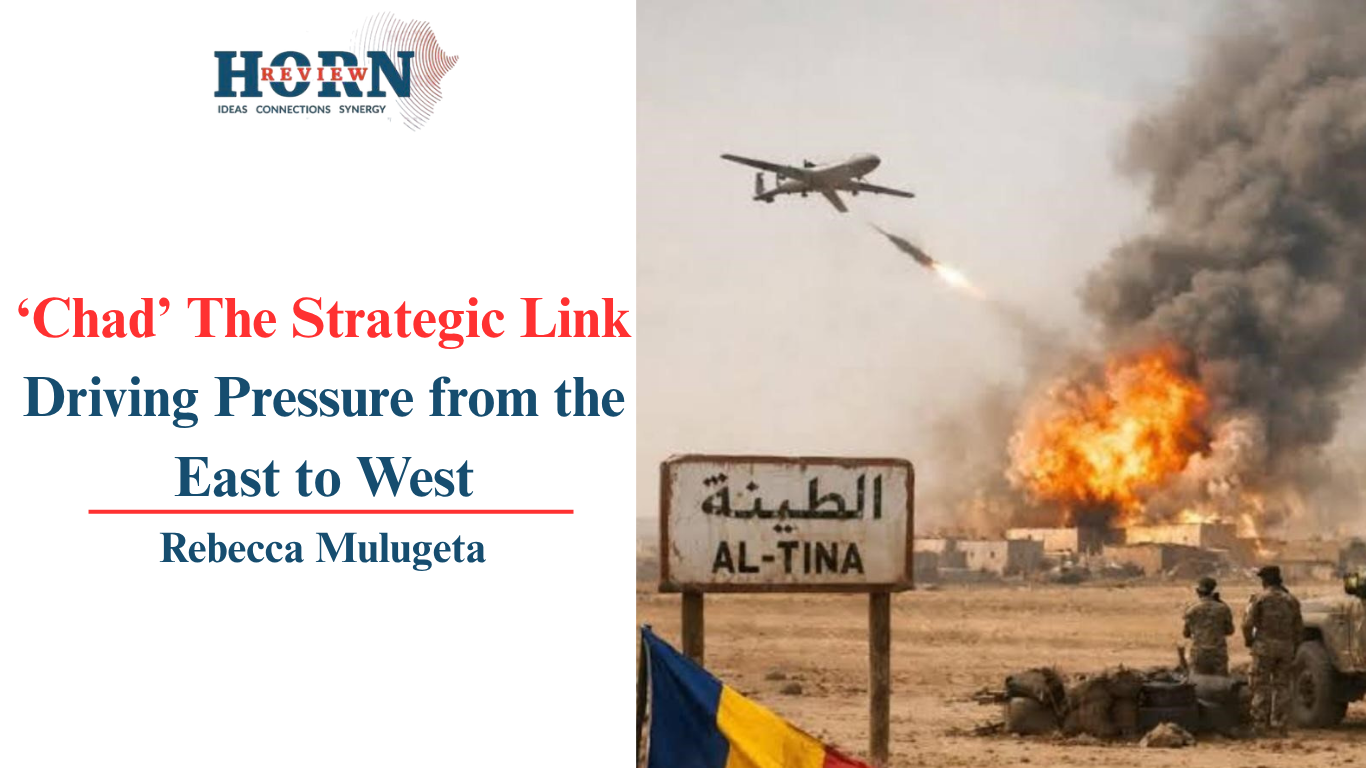
There is a tendency to read Africa’s conflicts as if they exist in separate rooms. The Sahel is discussed in one conversation, and the Horn of Africa in another. Each is treated as its own crisis with its own internal logic. But on the ground, these conflicts are no longer contained. They bleed into one another through routes, relationships, and realities that are rarely captured in official narratives. At the center of this emerging geography of conflict sits Chad, a country that has quietly become the most critical connector of instability across the continent.
Chad’s importance is decisive because of its position. To the west, the Sahelian insurgencies (JNIM and IS-Sahel) are probing closer to urban centers. To the north, Libya remains a fractured depot for arms and mercenaries. To the south, the Central African Republic (CAR) struggles with cross-border incursions. To the east, the war in Sudan has finally shattered the border’s “buffer” status, dragging N’Djamena into a direct and dangerous confrontation.
This idea of a corridor is key to understanding Chad’s role. It is not simply that conflict exists on its borders. It is that Chad is increasingly used, directly and indirectly, as a space through which conflict moves. Weapons pass through it and Fighters cross it. Ideas, tactics, and networks circulate within it. And because these movements do not respect borders, they begin to connect regions that were once seen as separate.
From the west, pressure comes from the Sahel, where jihadist groups have built resilient and adaptive networks. Organizations like Boko Haram and Islamic State West Africa Province operate in and around the Lake Chad Basin, directly affecting Chadian territory. These groups are not isolated. They are part of wider ideological ecosystems linked to Al-Qaeda and Islamic State. Over time, they have developed the ability to survive military pressure by moving, adapting, and embedding themselves within local and cross-border systems
Chad has long been seen as a frontline state in confronting these groups. Its military is experienced and often deployed in regional operations. But even as it fights these insurgencies, Chad is also exposed to the deeper structures that sustain them. These include smuggling economies, informal trade routes, and loosely governed spaces that stretch across the Sahel. These same structures do not stop at Chad’s borders. They extend into its territory and, crucially, beyond it.
What begins in the Sahel does not stay there. Weapons trafficked across desert routes, fighters seeking new fronts, and networks looking for opportunity gradually move eastward. Chad becomes part of that movement, not necessarily as a willing participant, but as a geographic inevitability. Its vast and often difficult-to-govern terrain makes it a natural passageway. In this way, the pressure generated in the Sahel begins to travel.
To the east, Sudan’s war creates a powerful pull. Since the outbreak of conflict, armed groups have relied on external supply chains to sustain their operations. Among them, the Rapid Support Forces have demonstrated a particular dependence on cross-border networks. Eastern Chad has increasingly been drawn into this system. Air corridors, remote airstrips, and land routes have all been cited in various investigations as part of the broader logistical environment that supports the flow of weapons and supplies into Darfur.
Malabo and N’Djamena operate under a unique set of sovereignty constraints, perpetually balancing domestic regime survival against a volatile network of external alliances and immediate border threats. Since the transition of power following the death of Idriss Déby, this equilibrium has become increasingly precarious. Central authority is notably uneven, particularly in the peripheral borderlands where the reach of the state is nominal at best. These governance voids have effectively become unmonitored zones and strategic blind spots that are rapidly exploited by non-state armed actors and covert external logistics networks. In this landscape, Chad functions less as a singular actor and more as a fragmented geography where limited oversight allows for the seamless movement of conflict assets across the Sahel-Sudan axis.
The result is that Chad becomes embedded in Sudan’s war economy, not as a central planner, but as a critical enabler. Its territory functions as part of the infrastructure that allows the conflict to continue. At the same time, the war does not remain contained within Sudan. It spills back into Chad through refugee flows, cross-border violence, and the movement of armed groups. The boundary between the two countries becomes increasingly blurred, turning eastern Chad into an extension of the Darfur crisis.
If the Sahel provides the push and Sudan provides the pull, then Libya adds another layer to the system. To the north, the fragmentation of Libya has created one of the largest reservoirs of weapons in the region. Since the collapse of centralized authority, arms have moved freely across borders, feeding conflicts far beyond Libya itself. Chad is one of the routes through which these weapons travel south and east. This creates a vertical dimension to the corridor, linking North Africa to the Sahel and onward to Sudan.
The south adds yet another direction. The Central African Republic remains deeply unstable, with armed groups controlling territory and engaging in cross-border activities. Southern Chad is directly exposed to these dynamics. Smuggling networks, armed movements, and informal economies connect the two countries, creating pathways that do not stop at national boundaries. These southern routes can link upward into Chad and then outward toward Sudan or westward toward the Sahel.
When all these directions are taken together, Chad emerges as a junction within a multidirectional system of conflict. Pressure does not simply move from one place to another. It circulates. It builds, overlaps, and reinforces itself. The Sahel feeds into Chad, Chad feeds into Sudan, Libya feeds into both, and the Central African Republic connects from the south. Over time, these connections form a continuous belt of insecurity that stretches across regions.
This is where the implications extend beyond Chad and Sudan. The Horn of Africa, often seen as a separate strategic space, is increasingly exposed to this broader system. Sudan acts as the immediate bridge. As instability spreads within Sudan, it moves closer to the Red Sea corridor and toward neighboring regions. The same networks that move weapons and fighters across Chad can, over time, intersect with routes leading into East Africa. Groups like Al-Shabaab operate within their own context, but they exist within a continent where connections are becoming easier and more frequent.
What ties all of this together is not a single organization or a coordinated plan. It is a structure. A structure built on weak borders, strategic geography, informal economies, and external interests. Chad sits at the center of that structure. It is used because it is there, because it is connected, and because it cannot fully control everything that passes through it.
External actors have also recognized this reality. In the context of Sudan’s war, foreign involvement has relied heavily on regional corridors to move resources and influence outcomes. Chad, alongside its neighbors, becomes part of this operational landscape. Geography is no longer neutral It is actively used, shaped, and contested as part of the conflict itself.
What makes this particularly concerning is that it creates resilience within conflict systems. Even when pressure is applied in one area, networks can adapt by shifting routes and redefining connections. Closing one corridor often leads to the opening of another. Chad’s central position means that it is constantly part of these adjustments, whether as a barrier or a passage. It would be misleading to describe Chad as the origin of these crises. It does not create the ideological foundations of terrorism, nor does it initiate wars like the one in Sudan. But it plays a critical role in how these crises evolve and spread. It is a transmission point, a place where different forms of instability meet and move forward.
This requires a different way of thinking. Security cannot be understood only within national or regional boundaries. It must be seen in terms of connections. What happens in the Sahel does not stay in the Sahel. What unfolds in Sudan does not remain within its borders. And what passes through Chad does not end there.
Chad’s significance lies in this movement. It is not just a country under pressure from all sides, It is a country through which pressure flows. That flow is shaping the future of conflict across Africa, linking west, north, central, and eastern regions into a single, if fragmented, security landscape. As long as Chad remains fragile and these networks remain intact, the corridor will stay open. And as long as the corridor stays open, the conflicts it connects will continue to reinforce one another, making resolution not just a local challenge, but a regional one.
By Rebecca Mulugeta, Researcher, Horn Review