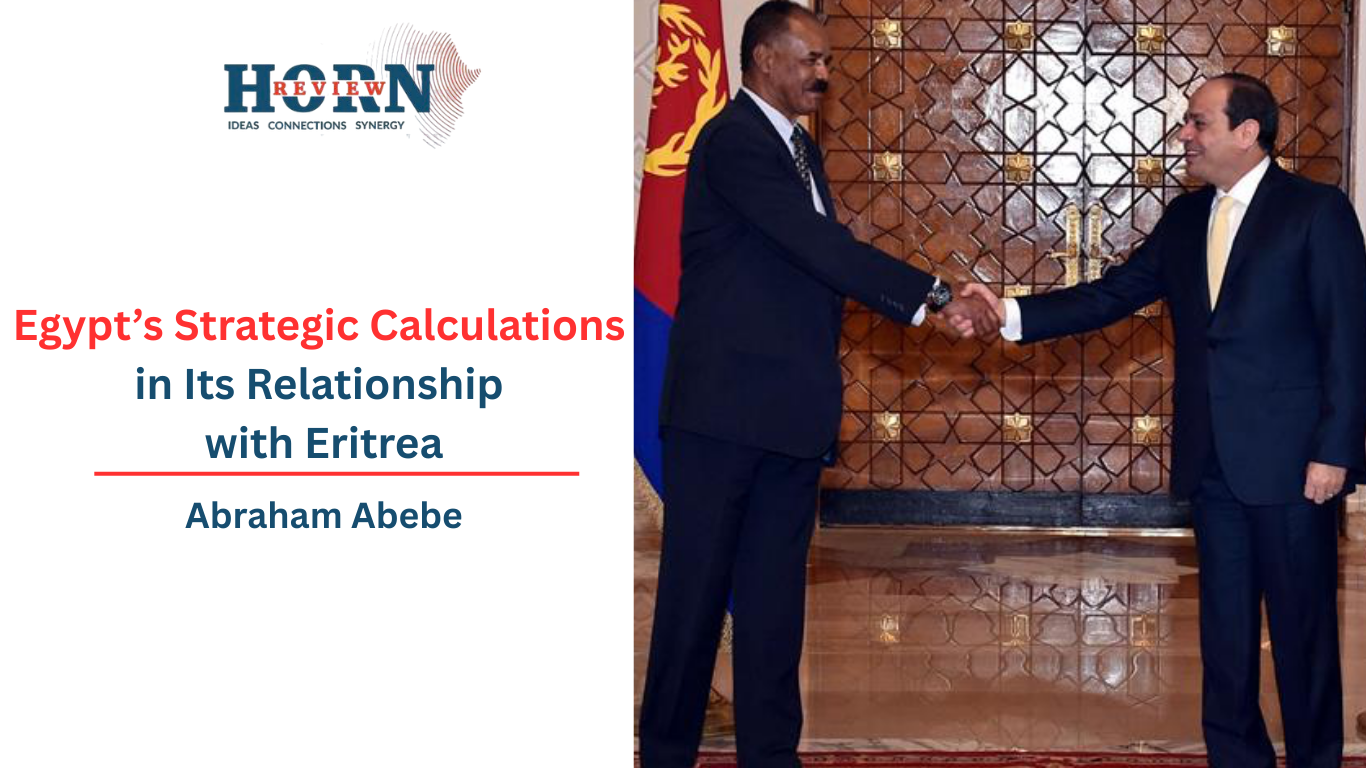
Egypt portrays its relationship with Eritrea as pragmatic cooperation in the service of regional stability. In practice, however, the relationship reflects a calculated strategic alignment shaped primarily by Cairo’s geopolitical priorities in the Horn of Africa. Eritrea’s location along the Red Sea and its proximity to several regional flashpoints, including Ethiopia’s neighbourhood, make it an attractive partner for Egypt as it seeks to expand its influence and manage regional rivalries. Rather than a partnership grounded in mutual solidarity, the relationship increasingly functions as an instrument through which Egypt advances broader strategic objectives across the Red Sea and the Horn.
These calculations are particularly visible in Egypt’s confrontation with Ethiopia over the Grand Ethiopian Renaissance Dam. As tensions surrounding the dam have intensified, Cairo has sought to strengthen diplomatic and security ties with states across the Red Sea and the Horn of Africa to reinforce its regional position. Eritrea’s geographic proximity to Ethiopia and its strategic coastline have therefore elevated its importance within Egypt’s regional diplomacy. In this context, closer engagement with Asmara provides Cairo with an additional geopolitical foothold in a region where influence competition is increasingly shaped by the Nile dispute and broader security dynamics.
Within this environment, the Egypt-Eritrea relationship reflects a distinctly transactional form of regional politics in which political alignment often outweighs broader societal considerations. Egypt’s engagement with Eritrea appears driven less by normative partnership and more by strategic utility. Eritrea offers geographic access, diplomatic alignment, and a supportive voice within regional political debates. At the same time, Egypt provides international legitimacy and political backing that can reinforce the durability of the Eritrean regime. The result is an asymmetrical arrangement in which state-level interests converge, even if the benefits for wider populations remain limited.
Egypt’s broader regional calculus, including competition for influence in the Horn of Africa, security concerns surrounding the Red Sea, and tensions connected to the Nile dispute, has made Eritrea a particularly useful strategic partner. Eritrea’s longstanding diplomatic isolation has also encouraged closer alignment with Cairo, creating a political environment in which cooperation between the two governments can deepen with relatively limited external scrutiny. Yet while this relationship may serve the interests of political elites in both capitals, it has not necessarily translated into improved protection for Eritrean civilians beyond Eritrea’s borders.
This gap becomes particularly visible in the experiences of Eritrean refugees in Egypt. Many Eritreans leave their country in response to indefinite national service, economic hardship, and political repression, seeking safety and international protection abroad. In Egypt, however, asylum environments have increasingly been shaped by security-oriented migration policies that leave many Eritrean nationals vulnerable to detention and restrictive legal conditions. As a result, individuals fleeing hardship often encounter a protection landscape that is constrained by broader state security priorities.
Evidence gathered by human rights monitoring organisations illustrates the scale of these concerns. Human Rights Concern-Eritrea has estimated that more than 3,000 Eritrean refugees and asylum seekers may currently be detained in Egypt, including individuals who were reportedly registered with the United Nations High Commissioner for Refugees at the time of their arrest. Particularly troubling are reports indicating that two young children died after their mother was detained and subsequently disappeared, raising serious humanitarian and legal questions. According to these reports, such incidents raise concerns regarding compliance with international refugee law, including protections against arbitrary detention, torture, and the principle of non-refoulement.
These developments do not appear to represent isolated cases. Instead, they reflect a broader policy environment in which the management of Eritrean refugees is closely intertwined with Egypt’s diplomatic relationship with Eritrea. Egypt’s willingness to detain Eritrean nationals and consider deportation suggests that humanitarian protection concerns may at times become secondary to wider geopolitical considerations. Reports of potential deportations to Asmara have therefore prompted concerns among human rights observers that migration governance may be influenced, at least in part, by efforts to maintain favourable relations with Eritrea’s ruling authorities.
In this sense, Eritrean refugees increasingly find themselves caught within geopolitical dynamics that extend far beyond the humanitarian sphere. The contrast between Egypt’s diplomatic rhetoric of partnership and the restrictive treatment many Eritrean nationals face highlights the instrumental nature of the relationship between Cairo and Asmara. Rather than reflecting a framework centred primarily on refugee protection, current policies suggest that strategic calculations, particularly those linked to Red Sea politics, regional alliances, and the Nile dispute, play a significant role in shaping Egypt’s approach.
The implications of this approach extend beyond individual cases. Restrictive policies toward Eritrean refugees risk undermining regional trust, intensifying displacement pressures, and weakening the credibility of international protection frameworks. When international legal obligations are selectively applied amid geopolitical rivalries, refugee populations can become unintended casualties of broader power politics. Such dynamics illustrate how strategic competition between states may narrow the space for humanitarian protection.
Egypt’s treatment of Eritrean refugees has therefore become a revealing indicator of how geopolitical priorities can shape migration governance in the Horn of Africa. The evolving relationship between Egypt and Eritrea demonstrates how strategic partnerships can intersect with refugee policy in ways that expose vulnerable populations to heightened risks. By prioritising diplomatic alignment and regional strategy, policies toward Eritrean refugees risk reinforcing a system in which the interests of political elites outweigh the protection needs of displaced civilians. The experience of Eritrean refugees thus provides an important lens through which to understand the broader consequences of power politics for international refugee protection and for the stability of humanitarian norms in the region.
By Abraham Abebe, Researcher, Horn Review