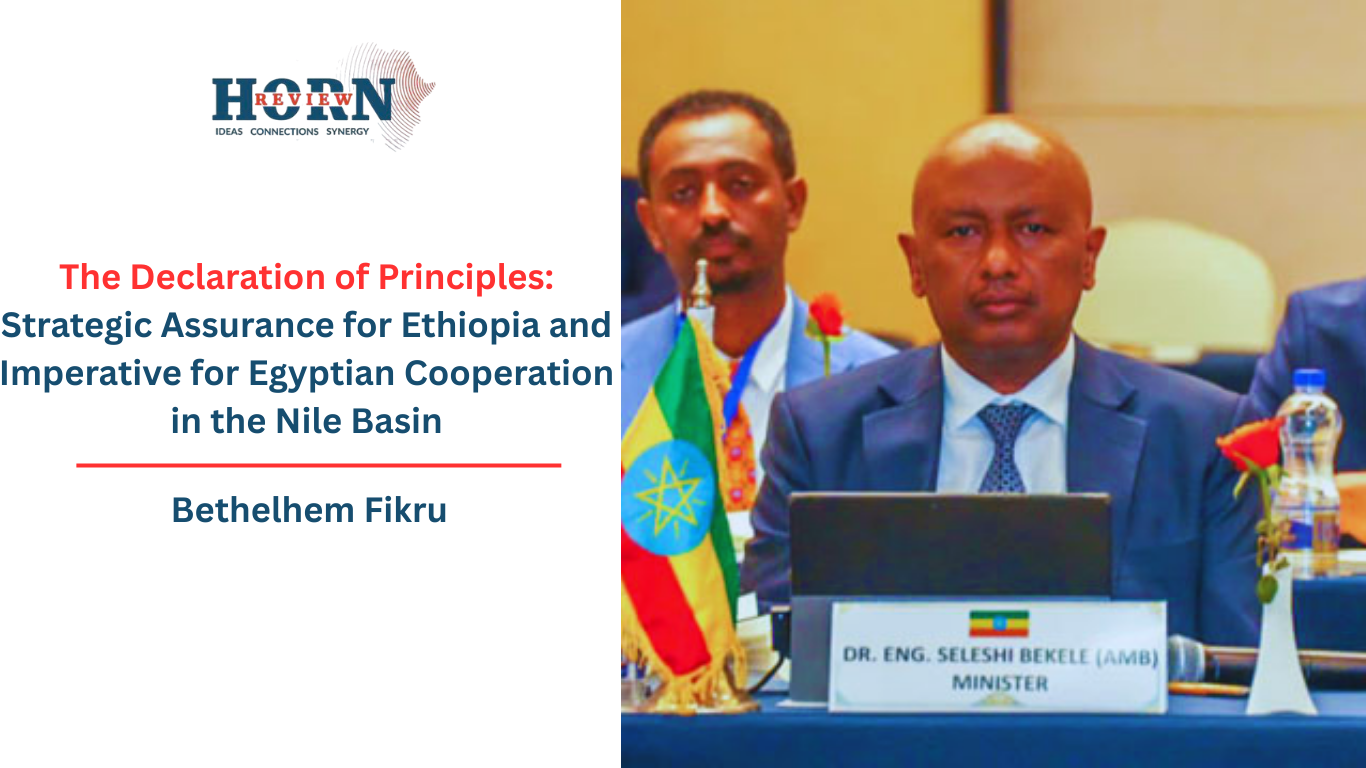
The Declaration of Principles (DoP) signed in 2015 represents one of the most consequential diplomatic frameworks in contemporary Nile Basin politics. Rather than a temporary political accommodation, it established a normative architecture through which the Grand Ethiopian Renaissance Dam (GERD) moved from a contested project to an accepted structural reality. Whatever disagreements persist over filling schedules, operational modalities, and dispute mechanisms, the foundational question, whether the dam would exist, has effectively been settled. In strategic terms, the DoP transformed GERD from a subject of existential contestation into a shared geopolitical fact, compelling all parties, including Egypt, to recalibrate their long-term planning around its permanence.
This shift constitutes a major strategic assurance for Ethiopia. By securing Egypt’s formal signature on a document that recognizes principles such as equitable and reasonable utilization, the obligation not to cause significant harm, and the pursuit of cooperative outcomes, Addis Ababa obtained more than diplomatic symbolism. It acquired a form of normative legitimacy that anchors the project within international water law rather than unilateral ambition. Large-scale infrastructure on transboundary rivers often generates prolonged legal ambiguity; the DoP narrowed that uncertainty by embedding GERD within a rules-based framework. The result is a structural stabilization of Ethiopia’s developmental trajectory, reducing the probability that the dam could be delegitimized through purely coercive or diplomatic means.
Equally important is the interpretive consequence of Egypt’s participation. By endorsing the DoP, Cairo implicitly acknowledged a transition from historically asymmetric Nile governance toward a more plural basin order. For decades, hydro-political arrangements reflected colonial-era allocations that privileged downstream security over upstream development. Acceptance of the DoP signals recognition, however cautious, that demographic expansion, energy demand, and climate variability necessitate adaptive management rather than rigid preservation of inherited quotas. GERD therefore functions not only as an energy platform but as a catalyst for institutional evolution within the basin.
The durability of this framework depends on whether all parties consistently uphold the principles they have endorsed. Egypt’s continued emphasis on legally binding arrangements that could effectively preserve a downstream veto raises important questions about how equitable utilization is being interpreted in practice. Principle 4 calls for the consideration of geographic, hydrological, and socio-economic realities across all riparian states, not the preservation of historical patterns alone. A negotiating posture that prioritizes past consumption without proportional recognition of upstream developmental needs risks recreating the very imbalances the DoP was intended to correct. From a structural standpoint, this approach reflects a state seeking to maximize its water security amid perceived vulnerability; however, it may also narrow the space for cooperation required to build long-term basin resilience.
Public rhetoric has at times reinforced this tension. Periodic references by Egyptian officials to the full spectrum of policy options, including coercive ones, introduce a deterrent signal that sits uneasily beside the cooperative commitments of Principle 1 and the peaceful dispute provisions of Principle 10. Even when intended primarily for domestic reassurance, such signaling can elevate threat perception and narrow diplomatic flexibility. Stable river governance depends less on maximal guarantees than on predictable reciprocity; language associated with compellence tends to erode that predictability.
A similar dynamic is visible in the treatment of risk narratives. Egyptian diplomatic outreach has frequently foregrounded the possibility of severe water shortages, framing GERD as a destabilizing intervention. The DoP’s third principle, however, links harm assessment to scientific analysis and adaptive mitigation. Evidence suggesting that regulated flows may reduce flood volatility and enhance seasonal predictability complicates claims of uniform downstream loss. The persistence of unilateral appeals in international forums, including recourse to the UN Security Council, has the unintended effect of externalizing what the DoP envisioned as a cooperative technical process. Trust-building mechanisms, particularly data exchange under Principle 9, derive credibility from sustained engagement rather than episodic escalation.
Negotiation behavior further illustrates the tension between formal commitment and strategic caution. Egypt’s withdrawal from certain mediation tracks and intermittent pauses in the African Union–led discussions can be read as attempts to secure procedural advantage during periods of uncertainty. Yet protracted delay carries systemic costs. Rivers are continuous systems; governance gaps invite misperception. Prioritizing short-term bargaining leverage over long-term operational clarity risks perpetuating precisely the instability all parties seek to avoid.
Economic logic also suggests unrealized convergence. GERD’s projected hydropower output offers downstream states access to comparatively affordable electricity while supporting regional grid integration, an outcome aligned with Principle 5’s emphasis on mutual benefit. Resistance to exploring such complementarities appears less a rejection of material gain than a reflection of entrenched strategic habit. Egypt’s own hydraulic history, particularly the construction of the Aswan High Dam without upstream consent, underscores the evolving nature of river governance norms. The basin is no longer organized around unilateral engineering but around interdependence.
Discussions surrounding the GERD have frequently highlighted issues of transparency, safety assurances, and operational coordination, considerations that are both understandable and common in large transboundary infrastructure projects. Addressing these matters through institutionalized monitoring mechanisms and technical committees could strengthen mutual confidence while supporting Ethiopia’s commitment to cooperative river governance. The Declaration of Principles provides a framework for such engagement, emphasizing verification, dialogue, and shared responsibility. In this context, effective geopolitics benefits from measured approaches that temper immediate security concerns with long-term institutional thinking. Durable water arrangements are more likely to emerge when diplomatic processes guide strategic decision-making and encourage predictable collaboration among riparian states.
Egypt’s strategic horizon is no longer defined by whether GERD should exist, but by how it chooses to engage with a reality that has already taken structural form. Acceptance of this reality invites a transition from resistance to constructive stewardship, positioning Egypt not as an external challenger but as a central stakeholder in shaping the cooperative order envisioned under the Declaration of Principles. Rather than seeking disproportionate mediation outcomes or external arbitration that may prolong diplomatic inertia, a more durable path lies in direct engagement with Ethiopia through strengthened data-sharing, coordinated drought management, energy interdependence, and forward-looking agricultural planning. The underlying question for Cairo is therefore strategic as much as diplomatic: will Egypt treat GERD as a fixed constraint to be contested, or as an emerging platform through which mutual stability can be engineered?
The DoP stands simultaneously as an achievement and a measure of political maturity, aligning both states within a framework that privileges cooperation over securitized river politics. Continued reliance on external guarantors risks signaling hesitation at a moment when adaptive diplomacy is better suited to the hydrological and demographic pressures reshaping the basin. If the prevailing mentality shifts from preservation of historical control toward participation in a shared institutional future, GERD can evolve from a source of strategic anxiety into a mechanism for regional continuity. The responsibility now rests with both governments to operationalize the cooperative logic they have already endorsed, ensuring that the Nile is governed less by zero-sum calculation and more by calibrated partnership.
By Bethelhem Fikru, Researcher, Horn Review