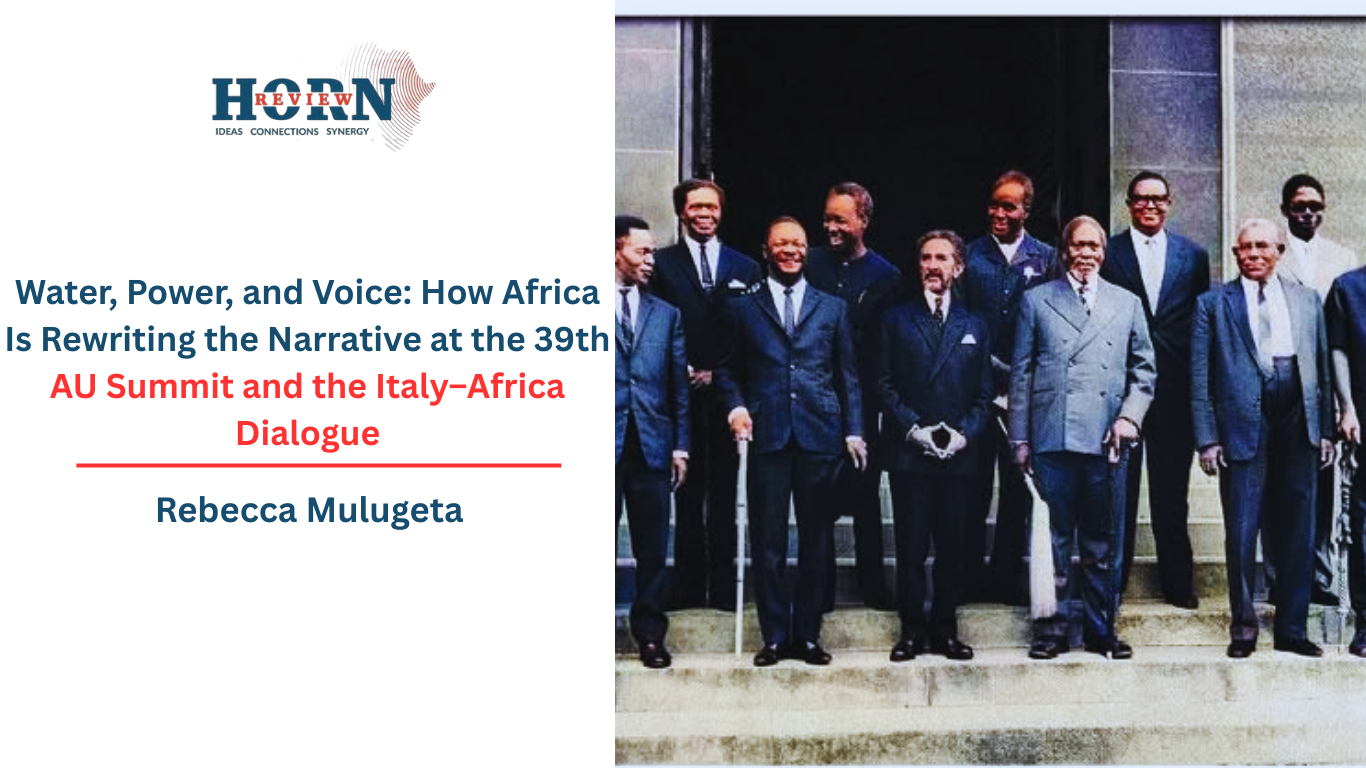
Addis Ababa rises at a historic moment. This year, it hosts the 39th African Union Summit alongside the second Italy–Africa Summit, an event that carries more weight than diplomacy alone. This is not merely a summit for Ethiopia, nor simply a forum for discussion. It is a stage where Africa’s past, present, and future converge. It is a declaration that the continent will no longer allow its rivers, its seas, and its resources to be instruments of subjugation or exploitation. Africa convenes on its own soil, on its own terms, and Ethiopia sits at the center not by chance, but by centuries of resilience, struggle, and strategic vision. This year Assuring Sustainable Water Availability and Safe Sanitation Systems will give ground for Ethiopia asserting its right to water, maritime access, and regional leadership, showing that the summits are as much about Africa reclaiming its dignity as they are about agreements and investments.
Water has always been more than a resource in Africa; it is life, power, and destiny. Throughout history, rivers have shaped kingdoms, nourished civilizations, and determined the fates of peoples. Water is a dynasty. Water is sovereignty. Empires rose and fell on access to it, wars were fought over it, borders drawn in its shadow, and peace forged where it flowed freely. The Nile is not simply a river; it is the lifeblood of Ethiopia and its neighbors. The Grand Ethiopian Renaissance Dam is not merely a construction project; it is the embodiment of centuries-long ambitions for autonomy, development, and regional leadership. Its waters are a promise to Ethiopia’s children and a testament to the nation’s ability to chart its own destiny. The GERD represents more than energy or irrigation; it symbolizes Africa’s right to determine its own future, to harness its own resources, and to negotiate as equals with the world.
This summit is an acknowledgment of that truth. Ethiopia’s ambition is not limited to the dam. Its pursuit of Red Sea access, the management of transboundary waters, and its role as a diplomatic hub demonstrate the nation’s understanding that sovereignty, prosperity, and security are interconnected. Water is a strategic asset and control of it shapes diplomacy, determines economic power, that is not only it secures a nation’s ability to protect its people. For Ethiopia, access to the Red Sea is not a luxury; it is the fulfillment of a right long constrained by geography, history, and the ambitions of others. The summits in Addis Ababa are as much about asserting this right as they are about convening leaders, negotiating trade, or sharing investments.
Africa’s history teaches that water has always been contested. The Nile shaped the fates of kingdoms from the Pharaohs to colonial administrators. Rivers were the source of wars, the axis of empires, and the foundation of dynasties. European powers carved borders with disregard for existing hydrological realities, extracting resources and controlling flow to dominate populations. The waters that should have united were used to divide. Colonial ambitions turned rivers into instruments of power and submission. Post-independence, Africa continued to face external pressure, debt, and neo-colonial interference, making the control of water a matter not only of survival but of dignity. Every drop has been contested, every river a political battlefield. Ethiopia, with the GERD, with its Red Sea ambitions, and with its assertive diplomacy, demonstrates that water is no longer a tool for subjugation, it is a tool for empowerment, for leadership, and for African unity.
Hosting both the African Union Summit and the Italy–Africa Summit simultaneously is more than a logistical achievement; it is a statement. Addis Ababa is Africa’s diplomatic heart. Ethiopia’s leadership in organizing these meetings shows that the continent’s agenda can be determined by Africans, for Africans, while engaging the world on equal terms. The summits make clear that the continent’s resources, its rivers, its seas, and its future are not prizes to be contested by foreign powers; they are the inheritance of Africa’s people even though a new axis is forming along the coastal areas by foreign powers. The presence of Italian partners, working through mutually beneficial programs like energy, agriculture, and water management, demonstrates a new model of engagement: collaboration, not dependency; partnership, not patronage. This is a new African diplomacy bold, strategic, and self-determined.
The Continent cries are visible and audible everywhere, in the cities where rising seas swallow homes and livelihoods, civil war expands in countries like Sudan and Democratic Republic of Congo and terrorist action amplifies. These are not abstract crises; they are the direct consequences of centuries of slavery, colonial subjugation, economic exploitation, and deliberate underdevelopment. The rivers, coasts, and soils have been exploited, labor extracted, sovereignty challenged. And yet, Africa endures and survives. The summits in Addis Ababa are a platform to honor that endurance and transform suffering into power, despair into determination, and fragmentation into unity
Water is central to this transformation. It is the foundation of trade, and the measure of a nation’s sovereignty. For Ethiopia, the GERD is a physical manifestation of decades-long ambition and a vision for a continental role. Through careful negotiation, diplomacy, and planning, Ethiopia has shown that it is possible to manage transboundary resources responsibly while asserting national rights. The summits allow Africa to codify this approach, to translate access to water into a broader framework for regional stability, economic development, and continental unity. By linking energy production, agriculture, trade, and water management, it is showing that its resources can be tools for prosperity rather than instruments of dependence.
Ethiopia’s role as a diplomatic hub is equally transformative. Countries across the continent and the world recognize that Addis Ababa is where strategy is discussed, alliances are formed, and Africa’s future is shaped. Ethiopia’s leadership in convening these summits demonstrates its ability to navigate centuries of imposed limitation while providing a platform for collaboration, dialogue, and continental decision-making. Access to the Red Sea, the management of transboundary waters, and the pursuit of regional cooperation are not merely Ethiopian concerns; they are continental and regional imperatives. By asserting these rights, it affirms that Africa can defend its resources, negotiate on equal terms, and lead in a multipolar world without surrendering its dignity.
The Red Sea, once a corridor of trade and connection, is now a zone of contestation, reflecting global and regional ambitions. Ethiopia’s pursuit of access to this vital maritime route demonstrates that sovereignty is inseparable from survival. Ports, trade routes, and maritime corridors are essential for economic growth, regional cooperation, and national security. The summits provide the framework to negotiate access peacefully, strategically, and cooperatively, asserting Africa’s control over its own destiny. seas are not commodities to be bargained away; they are lifelines that must be claimed and protected.
Africa’s youth and ingenuity are the continent’s greatest resources. The African Continental Free Trade Area demonstrates that Africa can integrate its markets, trade with itself, and grow internally. Digital technology allows Africa to leapfrog centuries of imposed stagnation, improving governance, resource management, and service delivery. Migration is not abandonment, it is a search for dignity, opportunity, and hope. African leaders have a moral obligation to create that hope at home, to restore opportunity where it has long been denied, and to empower generations to claim what is rightfully theirs. Agenda 2063 is not simply a vision it must not be, it must be a covenant with generations yet unborn, a pledge to ensure that Africa survives.
The summits in Addis Ababa must affirm African unity, strength, and strategic foresight. They must be leaders who can manage resources, negotiate partnerships, and protect sovereignty without compromise. By asserting water rights, pursuing Red Sea access, and convening global and continental actors, Ethiopia shows that the continent can lead, protect, and invest in its future. Africa’s rivers are more than water; they are lifelines, dynasties, and tools of sovereignty. It must ensure that these lifelines are defended and shared wisely, benefiting not just one nation, but the continent as a whole.
The 39th AU Summit and Italy–Africa Summit are moments of reckoning. Will Africa continue to allow external powers to dictate its resources and its destiny? Or will it seize the opportunity to unite, assert sovereignty, and invest in itself? Its stance must be clear that Africa can negotiate as equals, harness its resources responsibly, and lead its own future. Every discussion of water, trade, and energy becomes an act of reclamation, a statement that Africa will no longer be defined by centuries of subjugation, but by its courage, intelligence, and unity.
Africa’s past is heavy with struggle, but its present and future must radiate with possibility. Centuries of slavery, colonization, and economic exploitation sought to silence the continent’s potential, yet Africa survived. Its people endured. Its rivers ran. Its lands flourished in spite of exploitation. Today, Ethiopia and Africa show that resilience can be transformed into power, that suffering can become strength, and that unity can become a strategy. These summits are not about speeches, they are about action, assertion, and legacy.
Africa must choose itself. Ethiopia demonstrates that leadership rooted in vision, and courage can navigate centuries of imposed limitations while creating opportunity. By asserting water rights, maritime access, and continental priorities, Africa must proclaim: the era of exploitation is over. The era of African-led sovereignty, unity, and prosperity begins now. The continent’s rivers, seas, and lands are inheritances, not privileges to be granted. The generations yet unborn will inherit a continent that protects, nourishes, and empowers them. The 39th AU Summit and Italy–Africa Summit are milestones, not just meetings , they are declarations that Africa will unite, and determine its own destiny. History will judge whether Africa reclaimed its voice, its rights, and its destiny.
By Rebecca Mulugeta, Researcher, Horn Review