The Ethiopian Air Force: 90 Years of Power, Precision & Enduring Legacy
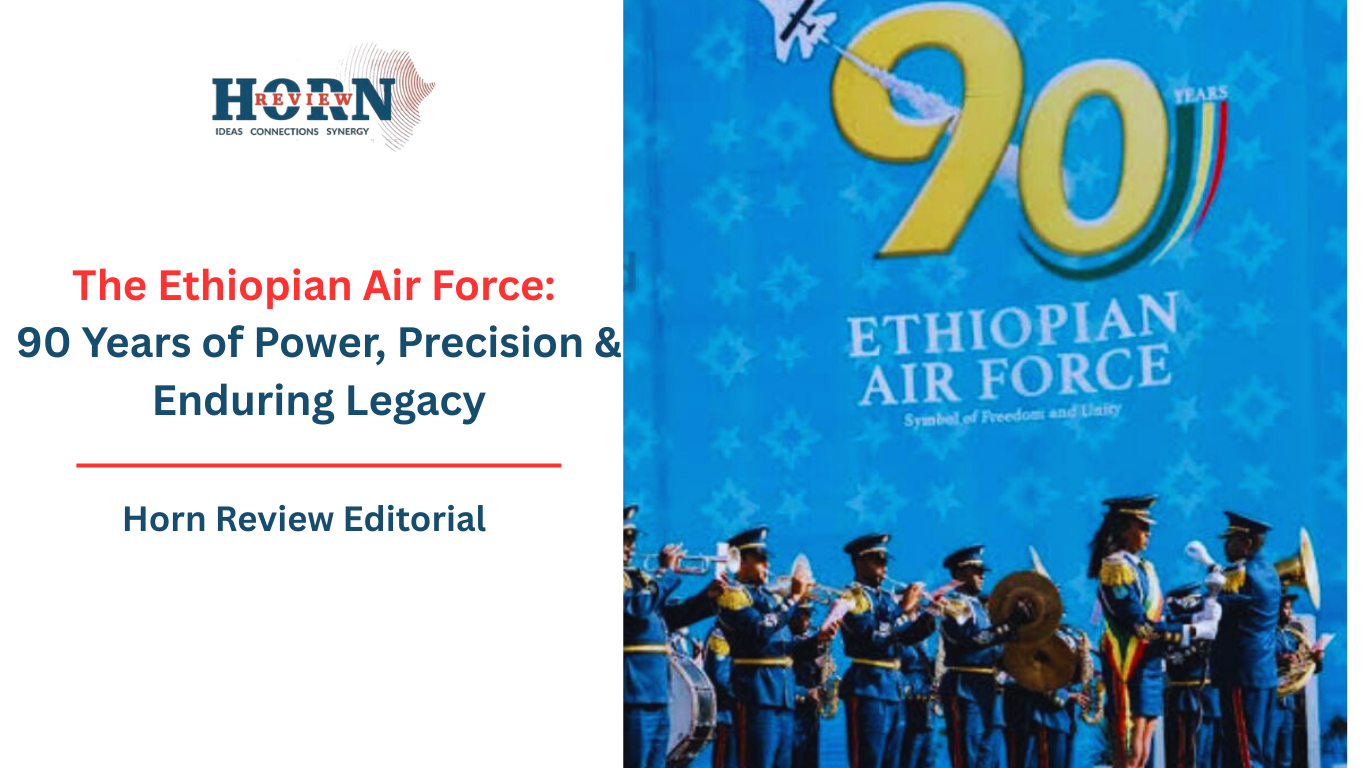
The ninetieth anniversary of the Ethiopian Air Force provides a rare opportunity to analyze the relationship between air power, sovereignty, and state endurance in the Horn of Africa. Beyond commemoration, the institution’s longevity invites a deeper examination of how a Global South state has sustained a technologically complex military arm across regime change, ideological realignment, and persistent regional instability. This analysis situates the Ethiopian Air Force within a regional security complex framework, emphasizing air power as both a material and institutional response to enduring geopolitical constraints.
From its origins, Ethiopian air power was embedded in a project of state survival rather than alliance projection. Unlike many African air forces that emerged through postcolonial inheritance, the Ethiopian Air Force developed under conditions of existential threat and strategic isolation. This formative context produced an institutional culture oriented toward territorial defense and centralized command authority, with early priorities persisting across imperial, socialist, and post-revolutionary political orders. During the Cold War, Ethiopia’s air force became a focal point of external interest, yet shifts in patronage did not fundamentally alter its strategic orientation. Changes in alignment were managed pragmatically, preserving operational continuity while avoiding full strategic capture. This selective engagement with external actors, rather than dependence, allowed Ethiopia to leverage foreign technology and training without subordinating doctrinal control. In geopolitical terms, the Air Force functioned as a buffer between external power competition and domestic sovereignty.
The post–Cold War security environment has intensified the strategic relevance of air power in the Horn of Africa. The region constitutes a classic regional security complex: threats are geographically proximate, interlinked, and rapidly transmissible across borders. Weak state capacity in neighboring countries, the proliferation of non-state armed actors, and the presence of global and middle-power militaries have elevated the premium on rapid response, surveillance, and escalation control. In this environment, air superiority is not simply a battlefield advantage but a prerequisite for strategic autonomy.
Ethiopia’s investment in air power modernization, particularly since 2018, must therefore be understood through the lens of political economy as much as military necessity. Sustaining an air force under conditions of economic constraint reflects deliberate prioritization rather than surplus capacity. The allocation of resources to air capabilities signals a strategic calculation that control of airspace compensates for vulnerabilities in terrain, borders, and regional volatility. This choice entails opportunity costs, yet it underscores the Ethiopian state’s assessment that sovereignty in the Horn is increasingly determined vertically as much as horizontally.
The Ethiopian Air Force is distinguished by its professional discipline, operational readiness, and emphasis on maintaining a highly trained and capable force. Its command structures emphasize rigorous training, coordinated operational planning, and adherence to international standards, ensuring that personnel are prepared to execute complex missions both within national borders and in support of regional peacekeeping and humanitarian operations. This focus on professionalism underpins the Air Force’s reputation for reliability and effectiveness in diverse operational environments. It is also recognized for its active role in peacekeeping and regional security support.
Ethiopia has been one of Africa’s most consistent and trusted contributors to international peacekeeping, and the Air Force has played an enabling role in these operations through air mobility, logistics, and operational support. In the United Nations Interim Security Force for Abyei (UNISFA), Ethiopia served as the sole and later primary troop-contributing country, with Ethiopian officers repeatedly appointed as Force Commanders, helping stabilize a sensitive border region between Sudan and South Sudan. In Somalia, Ethiopia has been a major contributor to African Union peace operations under AMISOM and its successor ATMIS, supporting stabilization, civilian protection, and the rebuilding of Somali security institutions. Beyond traditional peacekeeping, the Ethiopian Air Force played a critical role during counter-terrorism operations against extremist groups in Somalia, providing reconnaissance, close air support, and operational coordination that enhanced the effectiveness of ground forces. These operations were closely integrated with broader multinational efforts, including support from United States Africa Command (AFRICOM), which facilitated intelligence sharing, logistics, and training for regional partners. Through this cooperation, Ethiopian air assets contributed to degrading extremist networks, recovering territory from insurgent elements, and enabling the gradual transition of security responsibilities to Somali forces. Ethiopian peacekeepers have also served in UNAMID in Darfur, UNMISS in South Sudan, and in missions in Liberia, Burundi, Rwanda, the Democratic Republic of the Congo, and Côte d’Ivoire. Across all these missions, air support – including strategic and tactical airlift, helicopter mobility, medical evacuation, logistical resupply, and rapid deployment – has significantly enhanced the operational effectiveness and responsiveness of Ethiopian and allied forces in complex and austere environments.
The Air Force’s defense capabilities are built around a layered and modernized fleet. Its air superiority and multirole strike capability are anchored in Sukhoi fighters, with approximately twenty Su-27 aircraft forming the backbone of air defense, providing long-range interception, radar capability, and control of national airspace, while Su-30 multirole fighters, inducted since 2024, expand operational flexibility with advanced avionics, precision strike, maritime patrol, and command-and-control functions. Older platforms, such as MiG-23BN fighter-bombers, continue to serve in ground-attack and training roles. A major leap in capability has come through the integration of unmanned aerial systems (UAS), including Bayraktar TB2, Bayraktar Akıncı, Wing Loong II, and Mohajer-6, which provide persistent intelligence, surveillance, reconnaissance (ISR), and precision strike capability, enhancing situational awareness and operational reach while reducing risk to manned aircraft.
Transport and rotary-wing assets complement combat capabilities, enabling rapid deployment, logistical support, and humanitarian assistance. Fixed-wing platforms such as the C-130 Hercules, Antonov An-12, Antonov An-32, and Twin Otter provide strategic and tactical airlift for troops, equipment, and relief supplies. Rotary-wing aircraft, including Mi-8 and Mi-17 utility helicopters and Mi-35 attack helicopters, deliver mobility, close air support, and rapid response in challenging terrain, supporting both national defense and international missions.
Sustaining these capabilities relies on a highly trained cadre of officers and aircrew. Most pilots, aircrew, and technical personnel receive initial and advanced training at Harar Meda Air Base, Ethiopia’s principal operational and combat training center, and at Bole International Aviation School in Addis Ababa, where technical and leadership skills are developed. Local military academies provide officer commissioning, leadership development, and joint-service education. Select personnel also undergo advanced international training in countries such as Russia, Turkey, and China, particularly for operations involving fighter aircraft and UAVs. Advanced jet trainers, including the Yak-130, support transition to frontline fighters, while Aero L-39, SF.260, and Grob G 120TP aircraft provide foundational and intermediate pilot training. Locally developed surveillance and light aircraft also supplement training and operational reconnaissance capacity.
A notable recent development in Ethiopia’s evolving air and defense technology landscape has been the growth of indigenous drone manufacturing. Ethiopia has moved from primarily acquiring UAVs from abroad to producing its own drones, reflecting a strategic shift toward technological self-reliance and defense industrialization. In March 2025, SkyWin Aeronautics Industry, Ethiopia’s first dedicated drone manufacturing facility, was inaugurated in Addis Ababa to produce unmanned aerial vehicles for both civilian and military applications. These drones, incorporating emerging technologies such as artificial intelligence and advanced sensor systems, are intended to enhance national surveillance, reconnaissance, and defensive capabilities while also serving civilian needs such as infrastructure monitoring and disaster response. The establishment of SkyWin is part of a broader ecosystem that includes Aero Abay, another domestic drone production facility, visited by the Prime Minister in September 2025 as a milestone in transitioning from merely importing UAVs to designing and producing them locally. These initiatives underscore the country’s ambition to develop competitive drone technologies that may support sovereign operations and, eventually, export markets, even as specifics of advanced platforms remain closely held and beyond publicly available data.
Comparatively, Ethiopia’s air force occupies a distinct position in the regional balance of power. Unlike alliance-embedded air doctrines, or patron-dependent capabilities of smaller Red Sea states, Ethiopia maintains a nationally centered doctrine focused on territorial defense and regional stabilization rather than power projection. External partners, including Russia, China, and Gulf states, provide technology, training, and limited procurement support, yet Ethiopia’s approach emphasizes diversification and strategic non-alignment, preserving doctrinal autonomy while extracting material benefits from multiple sources. All details presented here are drawn from publicly available sources; it is likely that the Ethiopian Air Force operates additional aircraft or capabilities that are not publicly disclosed, potentially including more advanced or classified platforms.
The ethical and escalation risks inherent to air power underscore the importance of responsible operational planning. Ethiopia’s doctrine emphasizes the controlled application of air assets, ensuring that legitimacy, deterrence, and civilian protection reinforce one another. Looking ahead, the Air Force’s strategic relevance will depend less on platform acquisition alone than on adaptive integration of emerging technologies such as unmanned systems, cyber-enabled command networks, information warfare capabilities, and responses to non-state air denial threats. Successfully navigating these challenges will require institutional learning, sustained civilian oversight, and confidence-building measures within the region.
At ninety years, the Ethiopian Air Force represents more than a collection of aircraft or bases. It is a repository of national identity, institutional continuity, and strategic autonomy, demonstrating that complex military institutions in the Global South can be locally rooted, professionally sustained, and operationally effective. Its endurance challenges conventional narratives of African military fragility and provides a compelling case study in how air power, when oriented toward national survival rather than external dependency, can contribute decisively to state resilience in a volatile regional order. The Air Force’s continued evolution will remain a consequential element of Horn of Africa geopolitics, embodying both the material and institutional dimensions of sovereignty in the twenty-first century.
By Horn Review Editorial

RELATED
Posts
7
Sep
Abiy Ahmed and the Remaking of the Ethiopian State
Blen Mamo
The political trajectory of Abiy Ahmed cannot be adequately...
3
Sep
Is Ethiopia Ready for a Presidential System?
By Blen Mamo
Ethiopia has spent much of its modern political...
28
Aug
Ethiopia-U.S. Strategic Defense Partnership
The recalibration of United States–Ethiopia relations recently reflects a deeper...
20
Aug
Eritrea’s Buffer Zone Politics from Eastern Sudan to Ethiopia's Tigray
The most consequential development in the Horn of Africa may...
14
Aug
Ethiopia’s Withdrawal from Burhakaba and What Comes Next for Al-Shabaab?
The recent handover of the Burhakaba forward operating base...
13
Aug
What Another War Against Ethiopia Could Mean for Eritrea’s Future
Another Ethiopia–Eritrea war would not be a replay of 1998....