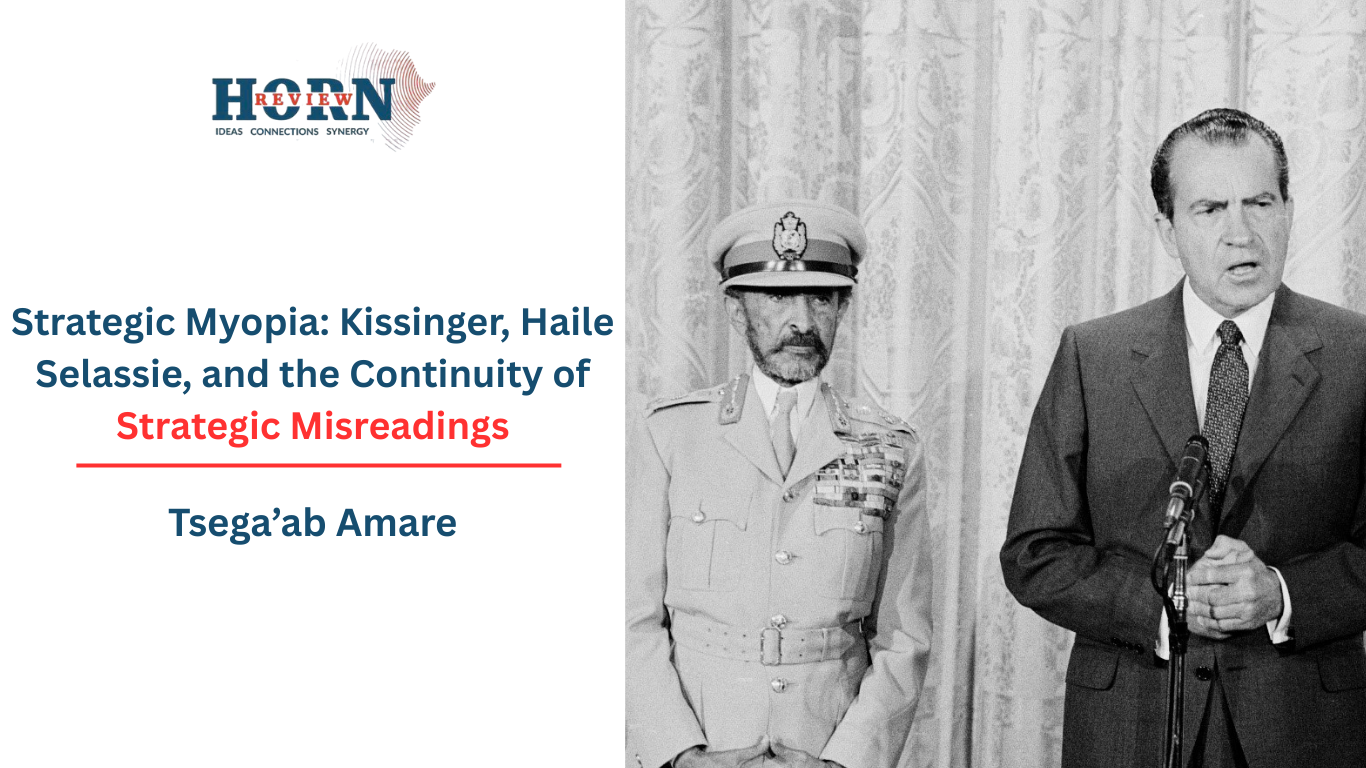
The decades-long relationship between Imperial Ethiopia and the United States reached a critical inflection point during Emperor Haile Selassie I’s state visit to Washington in July 1969. For nearly two decades, Ethiopia had been described within United States policy circles as Washington’s closest friend in Africa, a partnership anchored by the 1953 Mutual Defense Assistance Agreement and the strategic value of Kagnew Station.
Yet the National Security Council briefing prepared by Henry Kissinger on July 6, 1969 reveals that the visit was not conceived as a reaffirmation of alliance, but as an exercise in strategic containment. The Nixon administration’s objectives were explicitly transactional. President Nixon was advised to honor the emperor as a moderate and pro-Western leader while holding the price of good relations at the existing level of military assistance. Stability was to be managed cheaply, not secured decisively.
At the core of this approach was a deliberate dismissal of Haile Selassie’s threat perceptions. Kissinger instructed that the emperor should be reassured without indulging what the memorandum described as a parochial and exaggerated view of Ethiopian security challenges. The emperor’s appeals for military reinforcement were reframed not as rational responses to a deteriorating regional environment, but as an excessive appetite for American arms that Washington could ‘‘neither justify nor satisfy’’ under its own threat assessments.
More revealing was Kissinger’s belief, as articulated in the memorandum, that Ethiopia’s requests functioned as a bargaining tactic. Military assistance was interpreted as leverage designed to extract concessions for base rights rather than as a response to genuine strategic vulnerability. This framing marked a decisive shift in United States priorities. Kagnew Station was treated as the asset of consequence, while the survival and cohesion of the Ethiopian state hosting it were reduced to variables to be managed through restraint and fiscal discipline.
The Emperor’s Strategic Worldview
Haile Selassie arrived in Washington shaped by a political memory forged in catastrophe. His worldview was marked by the Italian invasion of the 1930s and his failed appeal to the League of Nations. The NSC memorandum acknowledged that these experiences had produced what it termed a siege mentality, yet it failed to engage seriously with the analytical foundations beneath.
The emperor warned of a common and immediate peril confronting both Ethiopia and the Western alliance. He identified a Communist-Muslim thrust into the Horn of Africa driven by Soviet arms shipments to Somalia, Sudan, and Yemen. To Haile Selassie, these were not isolated developments but interconnected components of an encircling strategy aimed at undermining Ethiopia’s territorial integrity and strategic position.
Kissinger discounted this assessment, attributing it less to contemporary realities than to royal self-esteem and historical trauma. Rather than addressing Ethiopia’s defense concerns directly, Kissinger’s administration sought to redirect the emperor toward economic development. The memorandum argued that economic progress, not military preparedness, represented the true outlet for volatile energies and frustrations within Ethiopian society.
The Flawed Intelligence Assessment
The decision to cap military assistance at approximately twelve million dollars annually rested on a series of optimistic judgments that history would soon invalidate. The memorandum asserted that the regional picture was not altogether bleak. Sudan’s radical regime was assessed as preoccupied with internal instability and therefore incapable of posing a serious external threat. Somalia was judged unlikely to disrupt its détente with Ethiopia, as Prime Minister Mohamed Ibrahim Egal was portrayed as inward-looking and focused on domestic consolidation. Ethiopian forces were considered sufficient to meet any plausible threat from neighboring armies deemed comparatively weak.
These assessments formed the intellectual foundation for Washington’s refusal to expand its military commitment. They reflected a static reading of a region already undergoing rapid ideological, military, and geopolitical transformation.
The Collapse of the Premises
The fragility of Kissinger’s assumptions became evident almost immediately. The stability of Somali leadership collapsed just three months after the emperor’s visit. In October 1969, a military coup overthrew Egal and installed Siad Barre, whose regime quickly aligned itself with the Soviet Union. This shift shattered the premise that the threat environment in the Horn was exaggerated and confirmed the emperor’s warnings of a widening Soviet-backed arc surrounding Ethiopia.
Domestically, Kissinger’s memorandum correctly identified the emperor’s structural dilemma. Modernization had generated rising political expectations among younger cohorts that strained an aging autocracy, and the document accurately anticipated a period of political instability. However, by denying Ethiopia the military resources required to manage its most immediate security challenge, namely the Eritrean insurgency identified in the memorandum as a vulnerability for Kagnew Station, the United States weakened the very regime upon which its strategic posture depended.
As Washington once dismissed Haile Selassie’s strategic warnings, similar misreadings today risk undermining Ethiopia’s legitimate development and regional stability objectives.
Strategic Consequences
The policy of capping assistance while extracting strategic value proved self-defeating. By treating Ethiopia’s existential anxieties as secondary and privileging short-term economy over long-term stability, Washington accelerated the erosion of its own position. The Ethiopian Revolution of 1974 fulfilled the memorandum’s forecast of instability, but under conditions shaped by years of strategic neglect.
By 1971, Kissinger and his advisers had acknowledged that the threats Haile Selassie had highlighted, including Soviet arms shipments to Somalia and Sudan, escalating support to the Eritrean Liberation Front, and regional instability, were real and verifiable. Despite this recognition, Washington maintained its restrictive military assistance ceiling. The transactional management of bilateral relations continued to take precedence over the security of the Ethiopian state, and the emperor’s appeals were still framed as politically motivated leverage rather than strategic warning.
The Marxist Derg regime that emerged from this rupture abandoned any alignment with the United States. In April 1977, Ethiopia formally abrogated the Mutual Defense Assistance Agreement and expelled American forces from Kagnew Station before the lease was due to expire. The geopolitical vacuum left by Washington was rapidly filled by the Soviet Union, which executed a decisive realignment during the Ogaden War. Soviet military assistance soon eclipsed the aid ceiling that Kissinger had defended as sufficient.
The July 1969 memorandum, reinforced by the 1971 assessment, stands as a case study in the limits of transactional foreign policy. By dismissing Haile Selassie’s warnings as parochial and substituting strategic restraint for strategic investment, the United States facilitated the very outcome it sought to avoid. The loss of Ethiopia as an ally did not preserve American influence in the Red Sea basin. It surrendered it.
Contemporary Echoes
Tensions surrounding the Grand Ethiopian Renaissance Dam illustrate how these patterns persist. As of January 2026, President Donald Trump has placed the GERD dispute at the top of his diplomatic agenda, signaling renewed United States engagement in Nile Basin negotiations and heightened sensitivity to Egyptian water security concerns.
President Abdel Fattah al-Sisi has welcomed American involvement, framing external mediation as a guarantor of downstream stability and reiterating that the Nile’s flow is existential for Egypt. Ethiopia, by contrast, views the GERD as a sovereign development project essential for national energy security, economic growth, and regional stability. Its position is grounded in commitments under the Cooperative Framework Agreement and the Nile Basin Initiative, which emphasize equitable and cooperative water management.
These developments underscore the persistence of structural misreadings in which external powers prioritize short-term risk management and narrow strategic interests over nuanced engagement with regional security realities and Ethiopia’s sovereign development imperatives. As in the Kissinger era, African-led mechanisms are often treated as peripheral, reinforcing asymmetry, mistrust, and instability rather than enabling durable regional solutions.
By Tsega’ab Amare, Researcher, Horn Review